Category Archives: Uncategorized

Of CABGs and Kinks

“The time has come,” the Walrus said,
“To talk of many things:
Of shoes–and ships–and sealing-wax–
Of cabbages–and kings–
And why the sea is boiling hot–
And whether pigs have wings.”

–Lewis Carroll, “The Walrus and the Carpenter”

Cardiac Artery Bypass Graft (CABG, pronounced cabbage) is not a term one thinks about while riding one’s bicycle.  Indeed, the association is with elderly, out-of-shape American males who have been indiscriminate in diet and lax in activity.  However, all of those things are cumulative over time, leading eventually to atherosclerosis in the elderly of both sexes who haven’t succumbed to some other infirmity.  Somehow, though we don’t feel “elderly” at 70, we do fit the demographic age group, are overweight, and exercise in spurts.

So, after a decade of daily bicycle commuting, near the end of which a cardiac stress test was passed with flying colors, I found myself, in semi-retirement, having some pain on casual, but aggressive riding.  “Out of tune, out of shape” seemed a reasonable assumption, and, indeed, the pain vanished with longer rides and more regular riding.  This went on for the next nearly five years, with occasional attempts to find answers, and several thousand kilometers of training and touring.

However, the persistence of some pain, usually at the start of a ride, led to a medical consult before commencing on our 2013 self-supported bicycle tour.  GERD (Gastro-Esophageal-Reflux-Disease) seemed a resonable solution and, indeed, a round of the popular treatment Omeprazole seemed to alleviate the symptoms, and off we went on tour, with no adverse affects during the 700-Km tour, riding up to 70Km per day over several weeks, towing a heavy (45Kg) trailer full of gear.

After the tour, however, the symptoms resumed, and eventually could not be reconciled to either poor choice of food before or during the ride (though cold weather was once thought to be a factor).  A second round of Omeprazole was ineffective, though a switch to the more preventive treatment, Ranitidine, seemed to help some.  Rides became shorter, as pains returned soon after the start of a ride, and required a stop to subside.  And, multiple stops, on a 30-km ride around Payette Lake in Idaho.

Yet another medical consult, this time insisting on a cardiac stress test.  We had registered for a week-long inn-to-inn bicycle tour at the end of July and were woefully behind in training for it.  After waiting more than a week for a referral, we took matters into our own hands and contacted our HMO’s cardiac unit directly, the closest in-house cardiology department being in Tacoma, rather than Olympia, where we usually go for specialty care.  Yes, we could get in Friday afternoon.  Meanwhile, the referral through our primary physician came through, too, though we would not have been scheduled until at least the following week.

On Friday, the stress test started normally, though my pulse rate went up quickly and blood pressure had been abnormally high during the last few doctor visits (abnormal for me, but apparently not for the average 70-year-old in poor health).  As soon as the test went to the next level at three minutes, classic angina pain set in; every reading spiked as pulse and blood pressure headed for the 200 mark, and the EKG readout looked like the audio track from one of our grandson’s  heavy metal rock recordings.  The test was immediately terminated.  The cardiologists had gone home for the day, so I was  prescribed a cocktail of nitro and heart regulators and sent home for the weekend, cautioned to “do nothing.”  Of course, I did tidy up, package, and upload my latest code project to the NIH, so as to justify my time and possibly leave behind something useful…

Monday was a consult with the cardiologist, who, with one glance at the EKG result, announced “serious blockage,” and muttered “time bomb” while scheduling a cardiac catheterization for early the next morning to plan the next step.

Cardiac catheterization is a minimally-invasive look at the heart’s arteries with a scope inserted into a groin artery, through which also the blocked artery might be opened without surgery using a balloon and a mesh expander called a stent.  The procedure is performed at an ambulatory surgery center, in this case, at the Franciscan Cardiac Unit at St. Joseph’s Hospital in Tacoma, 80Km from home.

On awakening, I was shown the result: two of the three major arteries supplying blood to the left ventricle (the big one) were blocked over 90% and the third one compromised.  The blockage, at the junction of the arteries, was not fixable and would have to be bypassed.  I had been minutes from a fatal heart attack every time I had felt a twinge in my chest over the past at least 200Km of riding, or even while taking out the garbage.  In these cases, the patient is not released, but scheduled for open-heart surgery at the next available opportunity.

Fortunately, there was a procedure in progress and the team agreed to put on a second procedure (an open heart surgery for bypass or valve replacement takes four to six hours or more).  I was sedated once more and wheeled off to the surgery suite.

I have been told that the prep is quite involved.  First, they paint you orange from head to toe with an antiseptic solution, attach various plumbing to manage bodily fluids, stuff your nose with anti-MRSA goop, then chill you to preserve the meat for what comes next, which is both terrifying and a miracle.

To get at the heart or lungs, sometimes surgeons can work between the ribs, or cut through only a few on one side.  But, for most, it is necessary to open the thorax completely, which means cutting the sternum from top to bottom.   I will have a scar about 25 cm long from my collar down.

Next, the blood flow is diverted through a pump and diffuser to oxygenate the blood and keep it flowing through the brain for next hour or so.  And the heart stops, the old definition of The End.

Working quickly, the surgical team takes sections of veins harvested at some point in the process from the legs and chest and sews them into the main arteries and the blocked arteries to create a new pathway.  Fortunately, with bicycling, I had lots of nice leg veins from which to choose, leaving a rather large scar behind my left knee. and an area that will remain numb for at least several months.

With the two bypass channels secured in place, and the seams checked for leaks, the heart is restarted and the massive wounds reclosed, stitching bone back together with heavy-gauge wire, and super-gluing external tissues together.

Finally, at nearly midnight on a day that started before 8:00 with the first injections of sedatives, I become aware of what seems to be a vacuum cleaner hose stuffed down my throat, which is being pulled out with the most unpleasant sensations.  Amazingly, the tortured vocal cords still work, but it hurts.  I immediately begin coughing up a sticky clear fluid and foam that is trying to fill my lungs, a process that continues, nearly two weeks later.  Deep breathing exercises are supposed to help the expectorant process, but the ribs and chest hurt, and the lungs don’t seem to expand all the way, possibly due to two rubber tubes stuffed in the sac with them, that are draining fluid and blood away into a container under the bed.

First post-surgery meal, in the ICU

But, the important part is, I am still alive, and probably wouldn’t have been had I not sought treatment when I did or had persisted in “riding through the pain” the last couple of months when we aborted rides that were especially painful.

Before long, I get bundled out onto a high-rise walker with hooks and racks for oxygen and aero-bars for a cruise around the ICU station, two laps.  Before leaving the Intensive Care Unit, the various tubes get yanked out, and off I go down the hall to the Progressive Care Unit, where I have to get up to the bathroom. Often.  Meals are delivered, but the food is inedible, some beef-eaters idea of “vegetarian” cuisine as boiled-to-mush starch and green paste.  I manage a few pieces of melon and occasional bowl of cream of wheat or oatmeal, and beg a snack pudding from the floor nurses the last day.

After I spend two nights in the PCU, get my cardiac jumper cables snipped (they are supposed to pull out, but hang up somewhere) and demonstrate the ability to climb a long flight of stairs without aid, Judy arrives with my clothes (sans personal cell phone, which disappeared somewhere during the personal effects transfers) and I am out the door,  four days nearly to the minute that I was wheeled into the operating room for  prep, and climb a bit unsteadily into the car for the 80-Km trip home, via the pharmacy.  I am now officially labeled with Cardiac Artery Disease, and must take several medications daily for whatever time remains to me.

Cat Therapy
Cat Therapy

Adapting to the residual diuretics, laxatives, and pain killers is part of the post-op/post-hospital period., and brings its own set of horrors.  Judy has bought me a La-Z-Boy chair, electrified, in which I will spend the next few weeks until I can lever myself in and out of bed without putting weight on my shoulders/elbows, etc.  No pushing, pulling, or lifting more than 4Kg until the cloven sternum is fully knitted under its metal lacing.  The lung fluid continues to collect, now without a built-in vacuum, but I learn to spit into a cup without leaving slug trails everywhere, mostly.  Sleeping in the chair elevated to aid breathing and  coughing leaves me with a painful kink in my neck (hence the title).

Sleep has eluded me since waking festooned with tubes, with the constant need to clear my airway of slime.  I am expected to get 8 hours of sleep, but it comes in 10 and 15-minute snippets.  The food is better, as Judy learns to cook what I usually prepare.  Melon continues to be a favorite, but I am soon eating well, then sleeping longer and longer as the flow of slug slime from my lungs diminishes.  It is hard to remember to use the “Incentive Spirometer” gadget they send home to build up your lung capacity and help clear the fluid.  The indicator is set at 750ml: I started past 1500ml in the ICU and peak the device at 2500 by the time I am home, leaving me to nearly turn blue waiting for the device to reset itself.  I still need to remember to practice deep, cleansing yoga breathing several times a day.

Venturing outdoors.
Venturing outdoors.

Finally, I manage to get in at least four hours of sleep, in 30-minute chunks as the diuretics work to dump the  remaining 5 liters of fluid pumped into my system during the surgery by the heart-lung machine.  This works too well, and I am soon 5Kg below my check-in weight by the time the pills run out.   I also had dropped the narcotic pain killers, opting for plain acetaminophen instead, so I spend most of the next day fuzzy and depressed, nose dripping, like a street junkie down on his luck.

Six days after returning home, I am ready to venture out: first mission, replace my lost phone.  A trip to the mall 30 Km away in the rain is mostly pleasant–I am not allowed to drive for six weeks while the bones heal–but then, done with the diuretics, the accumulated laxatives win the battle for fluid.  Dizzy with low fluid levels, I stumble from one restroom to the next as we finish our shopping and head for home.  Still, I am alive, and moving under my own power.  Life is good.

At last, down to my normal lifetime medication list and the lung output continuing to drop, we can plan the rest of the recovery.  The glue lines start to itch, tapes begin to peel, walks around the yard become less tiring.  Back and forth up and down the sidewalk; breathe, fall into an even cadence, faster, further.  There are trails yet to ride.


Acknowledgements:

Dr. Roger Chamusco and P.A. Bjorn Larsen, Group Health Cooperative, who treated my symptoms as an emergency and acted promptly.

Dr. Susan Hecker and her staff, Franciscan Cardiothoracic Surgery, who stayed overtime after a long procedure to perform mine, tired, but steady.

The ICU and PCU staff at St. Josephs Hospital, who put up with me through my recovery and discharge.

And, of course, Judy, who put on her nurse’s hat once more to see me through transition to convalescence at home and was there for me throughout my ordeal, and who said “Stop!” when I pedaled to the edge.


Happy Birthday World Wide Web

Today is the 25th anniversary of the birth of the World Wide Web, which is known today simply as “The Web,” or, even more generally, “The Internet.”  The “‘Net,” of course, is much more, encompassing email and communications other than HTML, but for most people, the Web is their main contact.

Tim Berner-Lee didn’t invent the Web out of thin air, though.   During the period of proliferation of personal computers in the early 1980s, the diversity of languages, applications, and data formats made it difficult to exchange data between different systems.  An early attempt to make a universally-readable data file was in the GEM (Graphical Environment Manager) system, which initially ran on top of CP/M, one of the first microcomputer operating systems.  GEM was based on research at the Xerox Palo Alto Research Center (PARC).

The “killer app” that resulted in GEM-like interfaces being ported to Apple and MS-DOS was Ventura Publisher, an early desktop-publishing software system that promoted WYSIWYG (What you see is what you get) editing.  The data files were plain text, “decorated” with markup language “tags” to identify elements like paragraphs, chapter and section headings, and all typographical marks that editors normally penciled in, hence “markup.”  The first standard in this was SGML, or Standard Generalized Markup Language, and style manuals, most notably the one from the Chicago Press, were published to promote standardized markup notation.   SGML really didn’t catch on, though, as popular word processors of the time, such as WordPerfect and Microsoft Word and desktop publishing software like Aldus Pagemaker (now owned by Adobe) retained their own binary document formats.  GEM and Ventura Publisher became buried in history with the demise of CP/M and the introduction of the GEM look-alike Apple Macintosh and the decidedly inferior Microsoft Windows graphical desktops that took center stage.

Meanwhile, in the Unix world, networking and inter-networking was the focus, along with a graphical desktop environment, the X Window System.  The X Window System was too cumbersome and tied to Unix to be used over the relatively slow inter-networks and with the now predominant IBM PC running MS-DOS and Microsoft Windows or the niche Apple environment.  Meanwhile, Berners-Lee was experimenting with a subset and extension of SGML called HyperText Markup Language (HTML).  Hypertext introduced not only markup for the appearance of rendered text, but the ability to cross-reference one section of text from another, even between documents.    Hyper-threaded text concepts were known at least since the 1940s, and used to create alternate endings or story lines in printed fiction, but computers made it possible to achieve smooth navigation between paths.

At the same time, networks were becoming mature, with the introduction of the Domain Name System and the TCP/IP network protocol in an internetworking scheme that provided unique names and addresses for every computer in the network, on a global scale.  Incorporation of DNS names and local paths in hypertext references made it possible to connect any document on any computer with references stored in different files on the same or any other computer in the network.  To implement these connections, a new network protocol, HyperText Transport Protocol (HTTP) was developed, and the World Wide Web was born in a flash of inspiration.

To complete the system required software that could speak HTTP and render HTML into formatted text and links on a computer screen, a server, and a client, which came to be known as a web browser.    The first web server was on a Next (Unix) machine, and early browsers were text-only, as the Internet was still largely based on dial-up modem access over ordinary phone lines.  But, with the increasing use of graphical displays, browsers also became graphics-capable, adding imaging and other visual effects to the HTML palette.

Today, 25 years later, most web servers are running some form of Unix or Unix-like operating system, mostly the open-source GNU/Linux system, though Microsoft Internet Information Service (IIS) runs many corporate internal services and public sites.  Browsers are now graphical, either Microsoft Internet Explorer or based on the Mozilla project, an open-source release of the original Netscape code derived from Mosaic, the first graphical browser.

The Web itself has evolved, with the addition of scripting capabilities on both the server and the client browser to create dynamic pages created at the moment, tailored to changing data, with the ability to refresh elements on a page as well as the whole page, and the ability to stream video and audio data as well as display text and images.   Indeed, HTML version 5 replaces many of the commonly-scripted constructs with simple markup tags that modern browsers know how to render.  The advent of social media sites to connect multiple people in real-time as well as  provide private messaging and real-time chat has largely replaced the spam-plagued email system for many people, and brought the promise of video-phone connections to reality.

The Web, in 25 years, has transformed society and our technology, nearly replacing newspapers, magazines, the telephone, and the television and video media player.  Even the personal computer has been transformed: the advent of software as a service (SAAS) means that users no longer have to purchase expensive applications to install on one computer, but can “rent” the use of an application on a distant server through the web browser, and rent storage space in “the cloud” that is available on any computer, even small hand-held devices like tablets or phones.  The web has also made possible the concept of wearable computers, such as Google Glass.  The World Wide Web not only covers the planet, but beyond (with live feed from the International Space Station and the Mars rovers), and has infused itself into our experience of reality.

I’ve evolved with the Web, starting with experimenting with SGML and HTML in the late 1980s, writing HTML in the mid-1990s, and in the late 1990s writing CGI (Common Gateway Interface) scripts in Perl, then server-side scripts in PHP,  progressing to Ruby CGI scripts and Javascript client-side scripting, some generated by the underlying server-side scripts to dynamically add images to slideshows.  Today, I still write CGI and server-side scripts, and create Cascading Style Sheets (CSS) for page layout and element design, but increasingly use content management systems like WordPress or CMSBuilder that make editing web sites no more difficult than writing an email or posting a status to Facebook.  Yet, I’d like to see the grandchildren and great-grandchildren–who have lived with the web either from the time they learned to read (for the older grandchildren)  or since they were born–learn to see “under the hood” and learn how the web works, so they can shape the future instead of being shaped by it.

Road Trip 2014 — Ventura Highway to Olympic Highway

sportyDSCF1249

rainbowDSCF1265
Rainbow near Paso  Robles
LAdowntownDSCF1237
Downtown L.A.
coastalDSCF1258
Ventura Highway, Pacific Coast

Finally, our family duties discharged, we headed north on the Ventura Freeway, winding up through the coastal mountains and farmland, electing to spend the night in Carmel-by-the-Sea, a port of call on free weekends when I was stationed at Fort Ord in 1966. Rain followed us intermittently. We stayed at a lovely cottage resort, braving the rain to go out to dinner at Yafa, a middle-eastern establishment not far from our cottage. Excellent food, friendly staff.

The next morning, since we didn’t have far to go to our next destination, we toured the city. A short walk on one of the beaches, a drive-by for a re-take of a 1966 photo of the city beach, a stop at a mid-town coffee shop, in the courtyard of a block of shops. We also stopped at the local yarn shop, located behind the Yafa restaurant, and toured the restored 244-year-old Carmel Mission (officially, Mission San Carlos Borromeo de Carmelo), still an active parish and school.
carmelbeachDSCF1279carmelmissionDSCF1284carmelmissionDSCF1289
Back on the 101 through the Salinas Valley, our GPS detoured us at San Jose eastward through Oakland and across the Richmond-San Rafael Bridge. A stop in San Rafael at the Whole Foods to pick up lunch, and we were soon at our turn-off at Hopland toward Lakeport and Clear Lake, over a steep, winding mountain road rimmed at the top with snow from the storm the day before. We arrived at our resort promptly at the 4:00pm check-in time and settled in for a few days of bike riding and site-seeing along the lake.

richmondrefineryDSCF1305richmond-sanrafaelDSCF1308ca175DSCF1317

The first day dawned very cold. We ventured out on the bike, but only as far as the supermarket at the north end of town, for a short 8Km loop along the shore. We did walk about a bit and enjoyed the flocks of ducks and coots that alternated between the resort grounds and the shore, though we had to step lightly and carefully everywhere: the sidewalks and grounds were well-fertilized by the waterfowl. We took a car trip south to the town of Clear Lake “for coffee,” winding back along the hilly shoreline to Clear Lake Oaks, then retracing the shore highway back to Nice.


Clear Lake from Larye Parkins on Vimeo.

The second day was not much warmer, but we put on heavy gloves and layers and rode to LakePort for lunch, round trip 34Km, along the lakeshore. We didn’t explore the town much, as the temperature peaked at 8 Celcius and started dropping as rain clouds moved in from the west, bringing a damp chill to the air. The much-needed rain came shortly after we were off the road, and stayed with us for the rest of the trip.


LakePort from Larye Parkins on Vimeo.

Our riding ended by the cold rain, the next day we ventured out by car to check out the parts of Lakeport we missed (not much, actually) and the village of Upper Lake, where we lunched at the Blue Wing Saloon, part of the restored Tallman hotel complex. Our impression of the lake communities was that the recession had hit here, too, with many storefronts vacant. A cyclist we met in Lakeport, the former city planner, said that the water quality in the lake was a big factor, too, with early summer algae blooms sending vacationers elsewhere for water sports. We also read that mercury contamination from an old mine also had diminished the joy of fishing if you intended to eat the catch.

clearlakeDSCF1329

On our way again, we headed north on CA 20 to US 101, backtracking to Ukiah to visit the campus of the City of 10,000 Buddhas, a Chan Buddhist community, school, and monastery occupying a former California State Hospital complex. It was pouring rain and a school holiday, so there was not much activity, though a number of monks and nuns gathered for noon meditation in the great hall. We were going to lunch at the restaurant on campus, but it was cash-only and we don’t usually carry enough to be worth mugging us for, so it was back to town and deli fare in the Safeway parking lot, in the rain.
leaving10KbuddhaDSCF1350

The rain stayed with us through the Redwoods: we toured the Avenue of the Giants, but it was raining too hard to explore under the trees, so we pressed on to Fortuna for the night, dining at the brew pub next door to our motel. The one good thing about traveling along the coast is that most restaurants now have a reasonable variety of vegetarian fare, so I’m not restricted to fettucine alfredo or bean burritos (though the brew pub’s burrito was tasty), or the usual meat country fare of bread and garnishes (i.e., regular sandwich sans meat) or skimpy salad greens with no protein whatsoever that is what they think vegetarians subsist on.
redwoodsDSCF1359
In the morning, with the rain lighter, we ventured off-road to the Ladybird Johnson Grove, which turned out to be not just 5km off the highway, but nearly 300 meters above, on a very steep, narrow road with switchbacks. After Crescent City, we were in “new” (to us) territory, not having traveled the coast between Crescent City and Coos Bay. Our destination for the night was Florence, but we were blocked 20km south by a large fir tree fallen across both lanes of the coast highway, minutes before we arrived on the windy ridge. We turned back to Reedsport to get groceries for dinner, by which time the blockage had been cleared and we proceeded on. Wind and rain continued to batter the area through the night.
hecataDSCF1365

Sunday morning, our 22nd day on the road, dawned clear, but cold. We got a few “scenery shots” along the way, but when northbound, most of the scenic turnouts are on the left, of course, and usually on a curve with no visibiity. On we went, encountering snow at the 45th parallel near Lincoln City, where we stopped at an ATM to get cash for anticipated stops later. We followed an 18-wheeler travelling at blizzard speed (very slowly) for many miles, finally passing at the intersection with OR 26, and made our way to the Tillamook Air Museum, a collection of mostly World War II military aircraft, housed in the remaining blimp hanger from the war. The structure itself is worth the stop: it is constructed of wood, over 300 meters long and almost 65 meters high, the largest open-span wooden building in the world. Most of the building is rented storage: the museum takes up less than half the length, but includes a heated display room, theater that shows a history of the facility, and a gift shop.

TillamookDSCF1379
The Latimer Textile Museum isn’t open on Sundays, so we continued on, deciding to make it home by dark, since it was too cold and snowy to explore much, and the entire I-5 corridor through Oregon was essentially shut down due to the storm. We snacked in the car and stopped for coffee at Seaside, then crossed the Columbia at Astoria, back into Washington, took WA 104 to WA 4 rather than the 101 through Ilwaco, rejoining US 101 north of Naselle, then leaving 101 on WA 107 to US12, via WA 108 to Kamilche, then back on US101 4 miles to Shelton, where we found an inch or so of snow on the ground.
astoriaDSCF1399
In retrospect, it was good that we got home three days early (we intended to explore the northern California and Oregon coast a bit more, if not for the weather), as we had plenty of emergent work with our consulting projects and weaving guild programs, and the cat was happy to be home, too.

Road Trip 2014 — Part II: Family

lunch_at_kalens20140123_131104
The primary reason for the tour is to visit with family. First stop, our granddaughter in Santa Fe. We also planned to bicycle the excellent bike trails in Santa Fe, but the weather was very cold (minus 12 C overnight), so we got in more visiting time. We delivered a quilt for our newest great-grandson, and got a request for woven scarves from our great-granddaughters. Another great-grandson we hadn’t met (our last visit was just before he was born) was already walking and talking. The two older boys are talking about careers in public service. Grandson-in-law Paul teaches history and coaches basketball at a middle school, so we saw him briefly after long day of teaching and back-to-back games after school.

rocky20140123_121611karyssa20140123_194646

After a final stop to pick up baby clothing for exchange with another granddaughter, we headed south through Madrid, NM, an arts and crafts community east of the Sandia Mountains. The traffic was more pleasant this way than along the busy I-25 corridor between Santa Fe and Albuquerque. But, soon we were on I-25 headed south. A brief lunch stop (picnic on the plaza) in Socorro, a fuel stop in Truth or Consequences, and a snack stop in Hatch brought us to Las Cruces, where we checked in at the Lundeen Inn of the Arts, a downtown B&B that also serves as an art gallery and architect’s studio.

alex_cage_zyl20140125_202040 enzo_cardo_chano20140125_202205 murph20140126_161441 kiki20140125_204044 enzo_at_one20140126_161045

January is a big birthday month in our family. We took another granddaughter to dinner for her 25th birthday and attended a first-birthday party for a great-grandson. While we did have a much-abbreviated family potluck, we also visited with most family members individually: lunch with a son, dinner with a daughter, and a trip to El Paso for lunch with the birthday girl and to see her new apartment.

Meanwhile, we did find time to bicycle, a trip through the huge Saturday Market stretching the length of the downtown business district on Main, and a Sunday loop ride on the bike trail along I-25, in the middle of a half-marathon with over 2,000 participants. Fortunately, the runner’s route turned soon, and we continued on to the NMSU campus, then back through town.

Las Cruces – NMSU from Larye Parkins on Vimeo.

The B&B provide interesting breakfast conversation, including a couple from northern Alberta whose sport was curling. And, as always, hosts Jerry and Linda provided good conversation. A final family stop at our oldest daughter’s, and, all too soon, we found ourselves packed and headed west, enduring the Border Patrol checkpoint on I-10 that makes Las Cruces seem like a foreign destination.

papers_pleaseDSCF1200
All roads leading north, east, and west out of Las Cruces have Border Patrol checkpoints. Always scary, and a bit surreal, but then, so are the random DUI dragnets the state conducts, possible in a place where there are few roads.

A lunch stop in Wilcox, Arizona and a detour around a traffic jam in Tucson got us to Casa Grande for the night, just after sunset.
suguaroDSCF1216

In the morning, the GPS routed us around Phoenix on rural highways, which was most pleasant, but by afternoon we were in the thick of Los Angeles traffic. After a series of “Keep left, then bear right” directions from the GPS, we got the dreaded equivalent of “Oh, no, you did what I told you [–recalculating],” and ended up the last few miles on Anaheim city streets, which suited us fine.

scrapbooks20140131_171236
Judy and Ben pore over family photo albums and scrapbooks.

A couple days visiting with relatives in Anaheim, Judy’s brother-in-law and nephew, plus a side trip to Thousand Oaks to visit a niece (during which we did a drive-by of the Ronald Reagan Presidential Library, on the way), and we prepared for a leisurely trip north toward home. Fortunately, a light rain during our stay cleared out the smog so we could breathe easier.

RRprezlib20140130_123549
Ronald Reagan Presidential Library: we didn’t go it, as we hadn’t time.

Road Trip 2014 – Stage 1: Shelton to Santa Fe

mt_hoodDSCF1123

Mid-January is probably not everyone’s idea of a good time to tour the country, but our primary destination is the Southwest, where the weather tends to be a bit more mild than the rest of the country.  Besides, it has been over two years since we have visited the New Mexico relatives, so it is time to do this.

A road trip by car is a tale of fuel and food as much as scenery and people.  We started our trip on a Sunday, first dropping the cat at the Just Cats Hotel, then spending a few pleasant hours at Ruby Street Quiltworks in Tumwater, with our art quilting group, which involves, of course, a light lunch and coffee at the Starbucks across the parking lot.

Setting off south at 2:00pm, we cruised through foggy conditions until reaching Vancouver, WA, where we stopped for gas and road food at Costco, crossing into Oregon and clear skies for a spectacular view of Mt. Hood before making our way up the Columbia Gorge with the setting sun behind us.

We stopped just after dark in tiny Arlington, at the Village Inn cafe, where Judy had a tasty black bean soup and I had a vegan bean burrito–rice and beans inside, quacamole and chopped tomatoes outside.  We can’t get though Oregon without a stop at a full-service station (there isn’t any other kind in Oregon), so we stopped in Pendleton at Safeway.  Then, up over the mountains in ice fog with nearly zero visibility, ending the day in La Grande.

The next morning, we left at the crack of dawn, scraping frost off the windshield and soon back in the fog off and on over the Snake into Idaho.  A stop in Nampa for fuel and coffee sent us through a winter wonderland of hoar frost and on toward Utah.

hoarfrostDSCF1127

The last fuel stop in Idaho, in the “middle of nowhere” listed regular unleaded at $4.30, so we drove on at reduced speed, arriving in Beeville, Utah on fumes, but with fuel at more than a dollar cheaper. By now, we had been fighting headwinds and freeway speeds for two days at 18mpg, about 20% below our usual. We were thinking our decision to bring our tandem bike on top of the car was going to cost us $200 in extra fuel before we were done. Lunch was nuts and fruit in the car, as we had nearly 600 miles planned for today. We pressed on through Salt Lake City in heavy traffic, though light on the MLK holiday, arriving in Provo just after sunset. From our motel near BYU, it was a short backtrack to a bakery cafe, where Judy had a bowl of corn chowder and I had a “veggie pesto” sandwich, actually a caprese panini, fresh mozzarella, tomatoes, and basil.
provoDSCF1143
In the morning, we backtracked to Starbucks and then resumed our journey as the sun touched the peaks of the Wasatch Range above the city.

Up the Spanish Fork canyon, we stopped in Price for fuel and yogurt, then south to Green River and Moab, the hiking, rafting, and biking Mecca, which was pretty much closed, between seasons.  At Monticello, we stopped for coffee and an excellent roasted red pepper and potato soup at the Peace Tree Juice Bar, one of our “must stop” places on this route.

monticello20140121_133424

Topping off the fuel again, though our mileage had started to rise due to prevailing winds and lower secondary highway speeds. we headed east to Durango, where we stayed at the historic Strater Hotel downtown. We ate at the Diamond Belle Saloon in the hotel, Judy had a fusion “Greek” salad, with avacados and other ingredients that don’t grow in the Hellenic region. I had a vegan risotto that came in a trencher bigger than my head. Even so, we managed to force down separate orders of creme brulee on top of all that and stagger off to bed.

strater_hotel20140121_161125

After morning breakfast of whole-grain french toast and made-to-order omelette, we retrieved our bicycle from the butlers closet at the hotel and loaded it back on the car, topped off our frozen travel mugs at Starbucks, and headed east to Pagosa Springs through beautiful forested mountains reminiscent of western Montana. Another fuel stop to top off, then south into New Mexico, where we planned to stop at the Ghost Ranch Visitor Center and museums, but the complex was closed, though there was a workshop in session at the ranch itself, a few miles down the road.
pedernal_DSCF1191

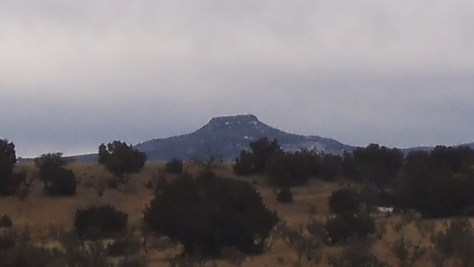
We did get a number of photos of the Pedernal, the butte made famous by the Georgia O’Keeffe paintings. Then, on to Espanola, where we had lunch at El Paragua. Judy had a BLT, which included a spicy guacamole spread and fries, and I had a roasted green chile on french roll with “monetary” jack cheese (according to the menu), which was like a chile relleno sandwich, with avacado slices and fries. We then stopped at the Espanola Valley Fiber Arts Center, where we bought yarn and yet another inkle loom and 3.5Kg of upholstery fabric remnants, from a stash that nearly filled the classroom area, a donation from an Albuquerque fabric outlet.

Arriving in Santa Fe, we made arrangements to visit our granddaughter and the great grandkids the next day, picked up some supplies at World Market. Next, visits with relatives here and in Las Cruces and El Paso over the weekend before heading west to California.