The Parkins Report: Events of 2014

Note: this is an expanded version of the one-page PDF we circulate.

DSCF1134banner
“Entering Utah,” on Road Trip 2014, a January venture to visit relatives in New Mexico,Texas, and California.

This year was characterized by extreme medical adventures, interspersed with the usual auto tours and some slightly different activities. The year started fairly normally, with an auto tour to New Mexico and California, and a business trip to Montana, but then took a different tack.

The Southwest Loop tour began with the Bike Friday perched on top of the Jeep, with the intent of getting in some winter riding early, while visiting with kids, grandkids, and great-grandkids in Santa Fe, Las Cruces, and El Paso. In keeping with our advancing age and reluctance to let scenery pass by in the dark, we took several days enroute, stopping in eastern Oregon and Durango, Colorado, arriving in sunny Santa Fe to -11C temps, much too cold for riding.

Las Cruces was a bit more hospitable, weatherwise, and we did get in a few rides, one in the middle of a half-marathon, where we shared the trail with many runners for 2 km. The back and chest pain Larye had experienced on early-season rides for the past several years returned, but overall the ride was pleasant.

desert_shadowDSCF1220
Crossing the Sonoran Desert, headed from Las Cruces to Anaheim.

Moving west, we visited relatives in Anaheim and Thousand Oaks. After a few days, we headed north, overnighting in Carmel-by-the-Sea before settling in for a few days vacation and riding at Clear Lake. The weather was a bit cold and Larye’s discomfort was more pronounced, through we did manage a 30-km ride on a mild day. Despite the drought, we drove US 101 the rest of the way north to Oregon in sometimes heavy rain, taking time to tour the scenic drives through the redwoods. In Oregon, our way was blocked by a large tree blown down across US101, with high winds when we finally reached our evening’s destination. Our tour culminated with a stop at the chilly air museum in the blimp hanger at Tillamook, then directly home after encountering snow at the 45th parallel.

judy_cabin20140302_095613
A quick inspection of the exterior of our cabin: the snow was piled deep against the front door, so we didn’t go in.

In early March, we traveled to Montana, staying with nephew Rick rather than shoveling out our cabin, which was buried in several feet of snow. A business trip to Rocky Mountain Laboratory yielded a task to flesh out a web application Larye had written years before and package it for general distribution to other users of the instrumentation with which it was designed to work.

bdfacs_login
The login screen on Larye’s web app, a custom user interface to create plate definition files for the BD Biosciences FACS cell-counting instrument, originally designed for the Research Technology Section of the Research Technology Branch of the National Institute for Allergy and Infectious Disease, and soon to be released to Open Source as a Linux software package and virtual appliance, for all users of the instrument model.


old_mill20140414_154350
At Lake Chelan, as the fruit trees were starting to bloom.

We visited with friends Gary and Char at a resort near Mt. Hood in the spring, and they stayed with us in May at McCall, Idaho. It’s always fun to share vacations.  Gary was the first to note that Larye’s exercise-related pain might be something other than reflux, having been through similar symptoms himself the year before.

A few local bike rides were cut short because of Larye’s recurrent pain when starting out. We spent a week at Lake Chelan in late April, with some riding around Manson, with minor starting-out pains. Memorial Day weekend, we rode the 30km around Payette Lake, from McCall, Idaho, with frequent stops for pain to subside and pushing through the loose sand and gravel on about a quarter of the route.

readytorideDSCF1743
Ready to begin our circumnavigation of Payette Lake, at McCall, Idaho. The 30-km loop was fraught with frequent stops to let the angina pain subside. Judy grounds Larye for the duration of the week: three weeks later, he was in ICU recovering from cardiac bypass.

On returning home, Larye saw his physician and insisted on a cardiac stress test, “just to rule out any problems.” Well, the stress test lasted almost three minutes before blood pressure and pulse spiked over 200, and Larye was feeling pain down to his fingertips. This was on a Friday, and he was sent home with nitro pills and beta blockers, with a Monday cardiology appointment, which yielded an early Tuesday catheterization: the blockage was severe, and a full cardiac artery bypass graft was scheduled for the afternoon, as soon as the surgical team finished the morning surgery.

Waiting for lunch in the ICU, the morning after surgery.

So, suddenly, the summer plan turned from training for a bicycle tour in Wisconsin to slowly regaining strength by walking back and forth on the porch, gradually extending to downtown sidewalks, then city and county parks, then regional trails, and an excursion into the Olympics and salt marshes, hiking trails we hadn’t visited in 20 years or more. By the time the Portland Knit,Quilt, and Stitch came around in August, Larye was ambulatory enough to drive to the Lacey Amtrak station and we attended the conference via public transit, after getting a clean bill of health from his cardiac surgeon, and later, a release from the cardiologist: no rehab program needed, since we were hiking up to 6km on the trails by then.

mid_span20140811_102742
Rehab: a walk across the Tacoma Narrows Bridge, 6km round trip, before going in for 8-week checkup with the heart surgeon.

Labor Day weekend found us “on the road again,” with the weekend in Silverton, Oregon, touring the Oregon Gardens, with a brief tour of Silver Falls before heading east to the dry side for a week in the Bend area. The original plan had been for a bicycling holiday, but we continued to hike, visiting the Newberry Volcanic National Monument and hiking the trails around the resort, including an hour’s spin on a side-by-side one-speed tricycle just to prove we could still ride, albeit cautiously. Since then, Larye has set up his old Fuji touring bike on a wind trainer in the basement to get in some interval training without danger of crashing, something we don’t want to do: read on.

Workout from Larye Parkins on Vimeo.

Recovery was not without setbacks, however. A couple weeks after surgery, on July 4, Larye experienced a pulmonary embolism, which prompted another hospital stay, so he is on blood thinner for a year, which involved several weeks of daily painful injections into the stomach while building up the poison levels… Then, a few days before a planned long fall vacation trip to Montana, Idaho, eastern Washington, and British Columbia, the warfarin mistook Larye for a rat and he turned up with bleeding kidneys, for a few frightening days until the warfarin level was brought down and the flow stopped, plus some unpleasant tests to rule out bladder cancer: found a kidney stone, to be addressed later. We were able to join our vacation route “in progress,” with a trip to visit Judy’s brother and sister-in-law in eastern Washington before heading for Canada’s Okanagan Lake and a visit with Larye’s cousin, Becky.

kelowna20141025_124316
Kelowna, BC, Canada. Where we stayed was exactly 75km each direction from cousin Becky’s house, on the opposite side of the lake. The lake is 135km long, with Kelowna and its floating bridge about halfway.

We had one more trip planned this year, at least, to spend another week at Lake Chelan, finishing out this year’s timeshare obligations, sans bicycle, but with hiking shoes. It is quiet time at the resort, with only three of the 24 units in our section occupied, including ourselves.

This was the year that Larye became more or less retired for real, after electing not to renew his contract for support of the NIH, which expired in September. He has hinted to his remaining clients that nothing is forever, so they should have a Plan B.

Being an official “retired person,” Larye didn’t have any excuses to put off completing the inside storm window project this fall, spurred on by an early cold snap in mid-November.

Our fourth year as Warm Showers hosts saw an early influx of bicycle tourists, with a trio of hardy souls in January on a Seattle-to-Los Angeles trip, and a scattering of early season tourists in between our own travels in the spring. The medical issues forced us to close for the summer as well as cancel a few reservations, but we had a flurry of guests between our Bend and Kelowna trips, and a late-November tourist who needed rescued from storms and steep hills that left him cold and wet, far short of his goal by dark, 60km from us and far from other hosts. We had to turn down yet another potential guest in early December, due to our schedules.  The guest count is close to 100, plus a number of cancellations and just requests for advice or assistance.

lacey_art_20140606_180515
“Twilight in the Garden,” a quilted, discharged, appliqued, and bead-embellished piece from 2008, which now hangs in a classroom at the Lacey Senior Center

Judy continued as program director for the Olympia Weavers Guild, which is more or less a full-time job, if not a lifetime position, as few are willing to undertake the task. She also is now primarily a weaver, having sold her quilt fabric stash last year and, on the weekend before Larye’s surgery, her long-arm quilting machine. Fortunately, her health has been good this year.  Judy also sold an art piece this year, to the Lacey Senior Center, as a result of a call for entries for art to hang in the new center at Woodland Park.

Peace — Larye and Judy (and Delia)
For more photos and videos, find us on Facebook,Vimeo, or our personal blogs.  (Links to some of our videos below.)

IMG_0003_w
18-year-old Delia runs the house, insisting on a lap near the fire, and her favorite quilt.

Appendix: Travels with Judy and Larye, a video notebook

Las Cruces – NMSU from Larye Parkins on Vimeo

Once past the half-marathon (2000 runners) with whom we shared the bike path, we continued on to the New Mexico State University campus, then back to our B&B on the normally busy El Paseo commercial strip, where there was no bike lane.

LakePort from Larye Parkins on Vimeo.

A ride around the north end of Clear Lake to Lakeport and back saw much heavy traffic, despite being “off season.”

Wapato Lake from Larye Parkins on Vimeo

On our spring trip to Lake Chelan, we rode up into the hills and around the lakes and apple and wine country north of Manson.

Payette Lake from Larye Parkins on Vimeo.

The Payette Lake ride was the ultimate wakeup call that no amount of diet and training was going to fix what turned out to be advanced heart disease. The lack of film footage on this ride around the beautiful high mountain lake was telling–Larye was too busy dealing with getting back to town alive to operate the camera.

Capital Lake from Larye Parkins on Vimeo.

One of our first long walks.  We also walked around the north basin of Capital Lake later, and made a number of walks on the 3-km Huff ‘n Puff trail park in Shelton, as well as other city trails and county park trails.

Staircase remix from Larye Parkins on Vimeo

Staircase is the southwest gateway to the interior of the Olympic National Park.  We last hiked this in 1985 on a weekend backpacking trip with Matt, Mark, and Jason.

Theler Wetland Nature Preserve Trail from Larye Parkins on Vimeo.

Another nostalgic visit: we hiked this tidal marsh trail when it first opened in 1994.

Amtrak Cascades – Olympia to Portland from Larye Parkins on Vimeo.

A train trip to the Quilt, Knit, and Stitch expo in Portland.  We did a lot of walking around the Lloyd Center area, where our Montana friends
were staying, as well as downtown Portland, taking the light rail and buses around the city, along with more walking.

Newberry caldera from Larye Parkins on Vimeo.

A trip to Bend, Oregon, led us to a hike around the east shore of West Paulina Lake, in the crater of the Newberry volcano south of Bend, in search of the hot springs at the north side of the crater.

ClineFalls from Larye Parkins on Vimeo.

We had intended to cycle the paths around Eagle Crest Resort and the roads and trails near Bend, but ended up hiking the trails instead, one of which led us down into the Deschutes River trail upstream from Cline Falls.

Trike from Larye Parkins on Vimeo.

Our first pedal outing, on a rented side-by-side trike at Eagle Crest Resort, near Bend.

Vacation as Mental Recreation

Vacation:

1. n. an extended period of recreation, especially one spent away from home or in traveling.

2. n. the action of leaving something one previously occupied.

The second definition just means “leaving,” without specific reference to reason or purpose…  As to the first, there are many different forms of recreation, which may or may not require extended travel.

Somehow, during the early 1990s, we talked ourselves into the time share mode of vacationing.  The scheme works like this:  you find a place you like to visit, with activities you like to do, and you buy a small share of a condominium at a resort near that location.  The purchase qualifies as a second home for tax purposes, so the interest bite isn’t quite so bad, and you own a tiny portion of [supposedly] prime real estate.  And, you get to use the property at designated times of the year, commensurate with the share you own.  Disregarding the purchase price, which is promoted as an “investment,” the cost of the vacation in an apartment with full kitchen, laundry, etc. and access to beach, tennis, pool, and proximity to other amenities such as golf and skiing (in season) is little more than or even less than a stay in a cramped and dark motel room nearby — provided, of course, that you use all the time allotted to you and that the property retains resale value.

Other than the fact that the amenities desirable to us, namely nice scenery and good places to ride our bicycle and hike, interesting shops, etc., make the venue less exclusive than the golfing, boating, skiing, etc., that attract most other resort guests,  our activities are exploratory, not conducive to repeat visits year after year, regardless of the season.

Not long after committing to this life-long enforced vacation plan, we found ourselves in jobs that

  1. didn’t have a lot of vacation time (as a troubleshooter and “cleaner” I tended, in the 1990s, to change jobs every year and a half, on average), and
  2. didn’t offer time off when we could schedule vacation, i.e., when not teaching night school, which was the other reason we became interested in the floating exchange system, besides the spirit of adventure: we could possibly coordinate our calendars, provided there was a vacancy in a place we wanted to visit at the time we desired.

The first reason made it difficult to use up the backlog of vacation credits, as we also needed time off to visit relatives, of which there were too many to have them visit us at the time share, and which option was impractical for a lot of reasons, such as wrong time of year for school vacations, travel cost, etc.

But, as often happened, I had jobs where I could telecommute from home, or, as it turned out, from anywhere with a phone connection (later, Internet connection).  Judy, with a more stable job, usually, had more vacation time accrued, but, due to commuting time, had little time for hobbies. Later, she was also self-employed, and vacation was a time to do her own sewing, weaving, and hand work, or portable projects for customers (we once pieced a guild raffle quilt at a time share condo, and were asked by the management to limit use of the sewing machine, as it vibrated the building).

We did have an option to get around the fixed vacation times, too:  for a few hundred dollars more a year, in membership fees and “exchange” fees, we could use our vacation credit to go to other comparable resorts instead of our own, if desired.  Which we did, for a number of years, a scheme that also allowed us to gain more vacation days by traveling exclusively in the “off season,” i.e., between the skiing and golfing/boating seasons, which are the best times for cycling and hiking, anyway.  The operative term being “comparable,” which means that all the other resorts have boating, skiing, and golfing as primary attractions, as well.

So, early on, we started using our resort time as a working vacation, hauling computers, sewing machines, looms, fax machines, and cell phones off to the resorts, spending part of the day working and the rest of the day exploring on foot or wheel.  This, then, has been our recreational plan for over 20 years.  And, the “24x7x365” work mentality has carried through even on non-resort outings, carrying on remote Internet work while traveling, from coffee shops, motels, and campgrounds, and even sometimes phone consultations pulled over at a freeway exchange or shopping center parking lot, or, on the bike, standing in the middle of a country road in the rain.

Now, in semi-retirement, with only a few clients in maintenance mode and some volunteer work, one would expect we would be free at last to have a “normal” vacation.  Well, old habits are hard to break.  On our most recent trip, back to the original time share condo that we actually own a piece of, we loaded the car with our computers and looms, knitting needles, and balls of yarn.  This time, though, the objective was, on the fiber side, perfecting new skills and making items for relatives, and the computer efforts aimed at also learning and perfecting new skills, and working on blog items.

Judy finishes tying on the warp, ready to start weaving on the small 1930s Structo Artcraft metal loom we recently acquired.

This past week’s effort was aimed at setting up an experimental compute cluster, using the popular Raspberry Pi single-board tiny Linux computers.  We have a collection of them at home, pressed into service as Internet gateway, network services, and print server, respectively, but had acquired a couple more to experiment with home automation controls and sensors.  These, we wired up at the resort as a local area network, connected to the Internet via the resort WiFi, and using dnsmasq and IP forwarding to route our other computers to the Internet.  Setting up a compute cluster also involves sharing storage resources, so we were busy installing packages for the services needed, such as NFS (Network File System) for disk sharing and PostgreSQL for a database server, with the intention of building a distributed software application server that is extensible by adding more low-cost nodes to the system.  Fortunately, it was the slow season, with few other tenants in residence, so our bandwidth hogging went unnoticed, and the service was nearly as fast as at home.

pi_netDSCF0116
Two Raspberry Pi computers, plus power strip, Ethernet switch, WiFi dongle, USB hub, and smart phone comprise part of a makeshift local area network. Not shown: laptop computers connected to the switch and a USB hard drive added to the USB hub later. The extra cords are chargers for two iPads that complete the complement of “necessary” electronics.

This isn’t the first time we’ve wired up a router while on vacation — some resorts still charge for Internet, and only allow one or two devices on one account, so it is convenient to connect your own router and switch and run everyone’s personal devices off one login account.  In Canada, some hotels and resorts have wired Internet rather than WiFi, so having a router is the only way to share the connection among devices.  Almost all systems now have two network interfaces, ethernet and WiFi, so it is easy to make one device a router and connect the rest to it, either through the wired switch from one WiFi connection or reverse the flow (where there is a wired connection) to make the router a WiFi access point.

So it goes: you can take the system administrator out of the data center, but you can’t take the data center out of the sysadmin.  Because a lot of hotel WiFi systems have little or no security, we also use a web proxy server located in our home office–also on a Raspberry Pi and accessed through an encrypted “tunnel”–to browse sites that are also not secure.  This also hides our location from the Internet, so we don’t get a flood of local ads.  The home network gateway also provides access to a webcam to keep track of the house while we are gone.

As much as we take home with us just to have a different view out the window, the other side of time share vacationing is that we need to take time to visit relatives and time to explore and travel on our own, bicycle touring while we still can.  And, as retired folks, our income has declined (and, thanks to the 21st century economy and banking practices, so has our retirement nest egg:  we started out with nothing, and have very little of it left), leaving little discretionary income for unnecessary travel.  So, we’ve put the “fixed base” time share condo up for sale.  Never mind that it wasn’t a good investment: the current selling prices for our units are somewhat less than the real estate fees, and sales are slow, so we won’t get anything out of it, and after 20 years of declining value, our effective nightly cost has been much higher than we should be willing to pay, but we will cut the monthly maintenance fee expense.

We have a membership/owner share in another time share club that doesn’t involve ownership in a specific unit of a specific resort, but provides access to use any of their facilities, so we will still be able to enjoy condo vacationing (actually, obligated to go periodically, as the annual allocations expire within two years if not used).  The old type of time sharing a fixed location doesn’t quite work for us anymore, if it ever did, and it certainly doesn’t work for our children: none of them or even their extended families want to take on the responsibility, so we are letting it go–if it will sell. We had listed it once before, for two years, unsuccessfully, prior to converting it to the floating exchange program.  If it doesn’t sell this year, well,we will be back, toting bicycle, computers,looms, yarn, and whatever else we need to enjoy living at home away from home.

Yet Another Fruit-ful Computing Modality

Followers of the computing side of the Unix Curmudgeon blog will note that our 20-year dalliance with Linux has expanded from the server, workstation, and laptop incarnations to the appliance, namely Raspberry Pi, a tiny single-board card that runs Linux and uses an HDMI TV as a monitor. Of course, we’re familiar with the other fruity moniker, the Apple, and have even used Macs from time to time, since the advent of OS/X, the BSD-based operating environment introduced around the turn of the century:   use generally confined to command-line scripts in terminal windows, as opposed to the graphical desktop made popular with the original MacIntosh.

image

This summer, Judy–the Nice Person complement to the Unix Curmudgeon–who has patiently put up with the Linux-only network at Chaos Central until now–bought herself an iPad to replace the severely outclassed and underpowered Netbook road machine, which hadn’t fared well in the progressive upgrades over the years from Ubuntu 10.04 to Mint 17 (based on Ubuntu 14.04). Naturally, she has fallen in love with the tablet, the latest successor to “the computer for the rest of us.”

Meanwhile, the Curmudgeon has been making do between the Android phone and the Netbook during his limited-duty recovery from surgery earlier, akin to typing with boxing gloves while blindfolded.  So, the Nice Person, being a sentimental soul, designated a second iPad as a belated birthday present for the septuagenarian Curmudgeon.  OK, iOS, like Android, might have deep Unix roots, but, as “locked” appliances, aren’t multiuser and don’t have a command shell or root.  They also have “apps,” which aren’t “open,” though many of them are free (as in beer), and which, then aren’t customizable and it is less easy to roll your own custom apps.

So, the annoyances abound.  One of the first things of note is the way Apple deals with technologies they don’t like: they simply don’t support them.  Thus, none of the five dozen or so videos we’ve produced in the last couple of years will play on the iPad, with audio and/or video missing: we used the LAME MP3 coding for the audio track, and IOS only supports the newer Advanced Audio Coding format (OK, it’s been around for 17 years, but MP3 is still more common).  This in itself isn’t a huge problem, but it does mean re-generating all of the videos from project files, for which some of the source components have been moved, requiring hand-editing the text-based project files and searching for the missing component files.  Now, we do have some conversion utilities, but they inconveniently do not include the requisite audio coding.  The other issue is that we normally render videos at 25fps, even though the camera runs at 30, and Apple likes 30fps, period.  Fortunately, the video coding remains at H.264.  The real problem in all this was ferreting out the real cause of the problem, wading through the often less-than-helpful online help forums. The good news is that most other video software will accept the Apple set of protocols.

And so it goes: we have managed to find SSH apps that let us interact with the other *nix machines, with the exception of our bastion server, which requires host identification that we can’t generate or set on a rootless machine.  However, we can go through a third machine that is external to the network and registered with our server.

Some of the apps are just plain annoying or obtuse, with few clues as to how to get them to behave the way you expect ( no doubt some of the problem is unfamiliarity with the iOS gesture vocabulary that 4-year-olds seem to find intuitive).  As with all rapidly-changing technology today, the helpful hints found online only worked with the previous version of the system you just upgraded to.  But, yes, the slim tablet is much more portable, faster, brighter, and higher resolution than the old netbook, and the on-scene keyboard is much better than the tiny one on the phone… The apps put out by many of the sites we visit most make better use of the display than do the web browsers. I’d like to see some of the apps more generally available for Linux as well as the tablet OSes.

Oh, by the way, this post was composed, graphics and all, entirely on the iPad.  Who says old dogs can’t learn new tricks?

Warm Showers 2014, Part 2

In mid-September, after our return from Oregon and when I was finally healed enough from my thoracic surgery to safely open and close the garage door and lift moderately heavy objects, we once again hung out the welcome sign on the warmshowers.org website. Almost immediately, we started getting requests, as touring season on the Pacific Coast runs until late October, with tourists taking advantage of the cooler weather in southern California in November and winter months in Central America.

ronnie_linda_100_4549

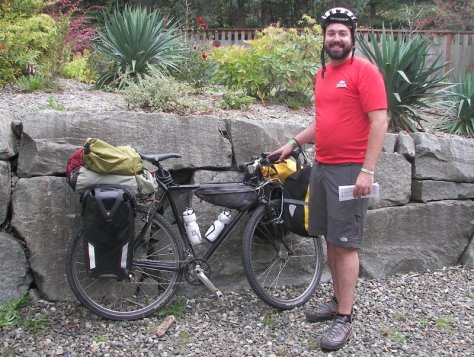
Our first fall guests were Ronnie and Linda, seasoned tourists from the Netherlands, on the last stage of a two-year odyssey that took them through New Zealand and from the tip of South America to San Francisco, where they jumped north to Alaska to make their way back south to San Francisco.

normand_helene_100_4550

Next came tandemists Normand and Helene, who had ridden from their home in Quebec to Seattle, visiting the Black Hills, Yellowstone, and Glacier parks on the way. They were on an open-ended tour, and starting their way down the Pacific Coast to see where there travels led them. Unfortunately, a week or so later, they caught the front wheel in a groove in the asphalt on a particularly treacherous section of US101 just south of the Oregon Hwy 26 intersection and crashed, fortunately neither onto the roadway nor into the guard rail, but nevertheless onto the rough shoulder. Helene was badly injured, with multiple collarbone fractures, and both suffered heavy abrasions (“road rash”). With the help of a cyclist doctor who treated them and Warm Showers host Neil in Seaside, they were able to recuperate enough to head for home. In the spirit of the generosity and comradeship of the Warm Showers organization, they lent some of their gear to another tourist who had been victim of theft. Sadly, bicycle tourists are not immune to theft, and the density of bicyclists along the Oregon Coast makes it a prime target area for thieves. Leaving a loaded bike unattended for even a few minutes invites disaster. You can read more of their epic and tragic journey at http://www.crazyguyonabike.com/doc/?o=Sh&doc_id=12201&v=3PV (It’s in French, with some English translation)

We have great sympathy for Normand and Helene, having survived a low-speed tandem crash ourselves in the spring of 2013. Any bicycle crash can result in serious injury or death, but a tandem crash is particularly dangerous because of the increased weight and momentum. Plus, while the captain may sense the impending fall and brace for it, the stoker may not be aware of the accident until striking the ground with great force, adding disorientation to injury. While most of US 101 through Oregon has a wide shoulder, there are still places where repaving has left a rough or partial shoulder. Slides are very common also, opening cracks parallel to the road along the edge. No matter how fast tandems travel, they are still no match for cars and trucks, so it isn’t always possible to move into the traffic lane when confronted with damaged or substandard shoulder conditions.

We had a few other reservations that didn’t pan out, when the tourists stopped short of Shelton because of rain. Then we had some who were almost drop-ins, with a few hours notice, when mechanical issues or weather made Shelton the only practical destination for the day.

eric_100_4552

Eric called us from downtown Shelton, in early evening. On his first day of his tour from Seattle to San Francisco, less than 20km from the Bremerton ferry, his chain broke. He got a ride into Belfair and bought a chain at the hardware store, but it wasn’t the right size for a 9-speed cassette, so he called us and his rescuer ferried him on to Shelton in search of a non-existent bike shop, and then to our house. The next morning, Eric and I took a car trip to Olympia to our favorite bike shop, Falcone’s, to pick up a genuine Shimano Deore 9-speed chain, then back home to install it and send him on his way, with a caution to pull the power when shifting. The old chain was just at the 75% wear mark, where shifting becomes difficult and the chain does not drop smoothly into gear, and it sounded like a shift under load did it in. He now has a spare link, as most chains are a bit longer than needed. We also carry a spare link and chain tools when we tour.

gina_100_4555

Gina, like Normand and Helene, was starting the Pacific Coast leg of a cross-country tour, having left Seattle after a five-day layover. She had started from Madison, Wisconsin, picking a route that led her to homes of college friends along the way, and plans to reach San Francisco in the next few weeks. Amazingly, she had camped at the city park in Odessa, Washington, just a block away from Judy’s brother’s house, on her way to Moses Lake. Gina had planned to make it to Elma for the night, but fought blustery and cold headwinds from Bremerton, so called us from Belfair in midday, arriving just before dark. We helped her plan the next day’s route. She was an early riser, and headed off into the mist just as the city road crew arrived to start re-configuring the pavement in front of our house.

We also quickly packed up and left in the car, dropping the cat at Just Cats Hotel on the way to Odessa to resume our postponed fall road trip, “in progress,” skipping the Montana-Idaho legs of our plan. So, we managed to host a couple more tourists than we would have had we not been forced to postpone our planned trip due to medical reasons. But, by the time we return at the end of October, the season should be over, as rain and frost discourage all but the most dedicated of tourists. Already, the days are getting too short to make good progress, and hypothermia due to damp and cold conditions is an ever-present danger in case of mechanical breakdown or even just plain exhaustion from wind and hills. Many of the RV parks and campgrounds are closed for the season, and motels, though cheaper in the off-season, are still expensive when you can only travel 60-100km per day on short days in bad weather.

As for us, we are looking forward to a winter of indoor training and a spring of trail riding before adventuring out on the road next summer, should our health hold and my blood-thinner regimen end on schedule. We certainly don’t need to risk another crash or significant road rash. The incident that postponed our trip was a four-day bleeding episode that abated only when the dosage was reduced.

So, this year’s Warm Showers guest list included only 17 overnight guests and one lunch guest (a rider who stopped short the day before), in contrast to last year’s 44 overnight guests plus a dog and a repair assist. This year saw the earliest arrivals, in January, and two tandem teams. Of course, we were closed to guests for three months during peak touring season due to convalescence from my heart surgery, and unfortunately had to cancel several reservations because of that. Cyclists ages weren’t in as wide a range this year—most were late 20s to early 50s: most years range from infants to septuagenarians.

Shelton desperately needs either more in-town Warm Showers hosts or a decent bicycle campground. We feed our guests, so we spend a bit extra for groceries, and many of our guests restock supplies before arriving, so cycling is a non-insignificant part of the summer tourist economy. Many cyclists stay at local motels, either because of lack of alternatives or because that is their style of travel. Some find local lodging through the Couch Surfer web network, but that, in our experience, is a bit more bohemian than the cyclist-only Warm Showers network, and not as desirable for a lot of older tourists. Many more would stay at an in-town or nearby campground if one was available, rather than pushing on to Elma or Olympia or, as many Canadian and European tourists do, simply go off-road onto forest land and pitch a tent out of sight of the road, a practice we try to discourage in Mason County.

As for us, we may not be available for hosting much longer, as we plan to downsize, which will entail yet another move, and to travel more during prime season: the hosting versus guest ratio stands now about 17 to 1, so we could “collect” a few nights as guests over the next couple of years without guilt. We also plan to move fairly close to bike trails and public transit, and will most likely have a guest room yet. Next year depends on how soon we can unburden ourselves of way too many books and other possessions and when and for how much we can sell our properties in Shelton and Montana. Our ideal is to pare down to what will fit in the bike trailer, but that isn’t practical, so we will also need to find another place that fits our projected life style through our 70s.

Cat Talk

Delia1_w

It is the last full day of summer, the longest and driest in the 24 years, off and on, I have spent in Washington State since 1980, and certainly in the five years Delia, our 18-year-old cat, has lived here. She has lived with us for the past 14 years, during which time she has adapted to living with humans and struggled with communicating with us, or at least teaching us to interpret Cat. She hasn’t always been quite so vocal, but during our frequent travels over the past few years, she has had ample time to observe other cats, among her fellow guests at the Just Cats Hotel, and to duplicate their vocalizations, particularly, such phrases as, “I’ve used my litter box: clean it now!” And, “It’s 4:30am—time to make a fire and sit by it.” Language, after all, is but a sequence of sound tokens and context, with meaning a mutual understanding among the speakers and listeners. And, cat talk has a simple grammar—every statement is a demand for some action on the part of the human half of the conversation.

Most of her conversation is in body language, though, and we have learned that, as a pad between her and a lap, she likes quilts best, having lived in a household where quilts are made: before she was banned from the sewing room, she would crawl onto the sewing table and lie on the half-finished quilt top as the blocks were sewn together. Her next favorites are handwoven wool coverlets, a fairly new addition to the handcraft repertoire. The crocheted afghans, gifts from “Auntie Bing,” on which she spent so much time earlier, are now rejected outright as too claw-catching. We are frequently beseached to join her in the living room to provide a platform for proper use of a quilt, preferably in a recliner by the fire. However, this summer, I have put a screen in my office window and placed her scratching platform next to it, so she sometimes consents to be “office cat” to be near her people as well as near the porch.

This summer, while recovering from open heart surgery, I spent less time rushing about or sitting at the computer, and more time sitting on the porch, to the delight of the cat. Our current base camp in our life journey is a 1920s bungalow, of the classic design where the porch is under the natural roof line rather than a mere covered entryway, forming a room with three sides open to the outside. Delia has always enjoyed the porch as a place to get out of the rain while trying to get our attention to be let back in after her daily inspection of the grounds, but quickly adopted it this summer as part of our living space.

Of late, since I have recovered enough to focus on other tasks, Delia has indicated more and more that, no, she doesn’t want in, she wants us to come out, to sit with her on the porch to enjoy the mild summer. So we go, with lunch or books, and enjoy the sun and fresh air. She sits under our chairs or the patio table we moved up for the season, or on a convenient lap.

Delia2_w

So it was on this last day of summer—she all but begged me to come out and sit with her. Judy was busy in the house, so Delia sat in her chair, the one in the sun, where she could look out over the low wall toward the street. I had sat there, but Delia indicated that, no she didn’t want to sit on my lap, she wanted to sit in the chair, so I moved back to “my” chair on the other side of the table, whereupon she curled up in Judy’s chair and assumed that regal stone lion pose seen on the entry to libraries and great houses, while I was left alone with my book.

As the afternoon wore on and the sun moved around behind the house, the breath of Fall settled on the porch, prompting me to retreat to the house. Delia remained, and pleaded with me through the office window to rejoin her. I put on a jacket and went back outside, but soon felt the deepening chill with the sun falling below the hill and shadows lengthening. This time, Delia reluctantly followed me into the house, closing the door on summer one last time.

At nearly 18, summers are precious to a small cat, something that I, in my 70th summer, can also appreciate. The rain came at last, but briefly, during the night, and fall colors began to appear with the gray dawn. Winter is coming.

Delia3_w

Musings on Unix, Bicycling, Quilting, Weaving, Old Houses, and other diversions

%d bloggers like this: