Road Trip 2019 Part 1, chapter 1

Despite being on a budget–truly beginning to realize what living on a fixed income in an inflationary economy means–we have big plans for 2019.  We did postpone our usual annual trip to the Southwest this winter, because we planned to attend the biennial weaving conference in our own Pacific Northwest.  However, since the conference this year is in Prince George, BC, 1000 km to the north, that event is part of a major road trip, which will be Part 2.

Part 1 is the result of our upgrade to our vacation shares a couple of years ago, which netted us, as a bonus incentive, two “free” weeks in the RCI vacation network.   Collecting on “free” means being at the whim of the sponsor: we found few resorts and time slots where we could use the coupons, where and when we were willing and able to go.  So, here in the suddenly blustery end of April, we find ourselves headed east, for a week in Iowa, followed by a week in Ontario, north of Toronto.  We visited the area in Iowa in 2017, close to the Minnesota border near where I grew up, and we did enjoy the bicycling and being close enough to visit relatives still in the area.

The Canadian part is a compromise: we have on our bucket list plans to visit Eastern Canada, Ontario, Quebec. and the Maritime Provinces, so this gets us at least a consolation prize in that category,  We don’t have time to explore, but will at least get a taste of what the eastern half has to offer.

Our first day on the road, we realized that winter is not done with us yet, running into hail and snow over Snoqualmie Pass.  Our plans to camp in Idaho to go bicycling got derailed a bit as the forecast was for freezing temperatures, and we experienced high winds all the way across Washington, settling in for the night at a motel in Coeur d’Alene, where, indeed, it did freeze overnight.

Day 2 dawned very cold, below freezing. But, with promise of lower wind and mid-morning temps in the middle single-digits (Celsius), we set off from Coeur d’Alene after coffee and fuel (under $0.80USD/liter!), we set out over Fourth of July Pass into the Silver Valley, with hopes of being able to ride another segment of the elusive Trail of the Coeur d’Alenes.

After considering options, we decided to just go ahead with Plan A (or Plan B, I forget which) and park at the Pine Creek Trailhead near Pinehurst and ride west until we couldn’t take the cold anymore. Despite being rewarded with great river views, 7.5 km was the frostbite limit today. We turned around at Milepost 44 and headed back, deciding not to stop at the famous Snake Pit bar and café at Edaville, but just press on back to the truck.

Eschewing the ambiance of the Snake Pit, we had lunch out of the shopping bag in the Walmart parking lot in Smelterville, cruised Wallace, and headed over Lookout Pass for an early evening in St. Regis, Montana.

During our grocery stop at Walmart, a new toy stuck to us: a dashcam for the truck.  It was “only” $25.  Of course, we updated the 8GB memory chip with a 32GB chip from our camera stash, but then needed yet another memory stick to hold all the output until we can review and edit it.  Most of the clips will be thrown away, we assume, but the sheer volume of data makes it impossible to review and edit in real time while traveling.  Hoping to include some windscreen scenery to add to our bicycling video travelogue.   Converting the AVI format to MP4 reduces the size of the storage required, but the first run took nearly 20 hours.

Wall decor at Liquid Planet’s main store on Higgins Avenue in the heart of Missoula, a few blocks from the headquarters of the Adventure Cycling Association, and 50 km south of the Garden of One Thousand Buddhas, one of the largest Buddhist shrines in North America.

The morning of Day 3, we packed out to frost on the windscreen and headed for Missoula, where we indulged in coffee at Liquid Planet, lunch at Good Food Store, and a trip to the Bicycle Hangar for a new kickstand for our bicycle, all familiar haunts from when we lived in the area and from previous visits.  The bicycle repairs were necessitated by the old kickstand falling off the bike when we unloaded it at the trailhead the previous day, the threads stripped after six years of heavy use and a slightly short bolt.  I hit up Montana Ace Hardware for a new bolt the right length, while Judy checked out the Book Exchange nearby, where we still had an open account.

We paused in our travels for a couple of days, visiting with friends in the Bitterroot Valley, staying with our longtime quilting friend Connie in Florence.  Visiting Hamilton to catch up with Theresa, a bead artist friend, netted us a chance encounter with another quilter and lunch at the Cherry Street Cafe, with an awesome crêpe and a mug of coffee from next-door Zaxan coffee roasters, meeting the new (to us) owner of the Cafe, finding out she once lived near us in Washington.  Alas, we did not get any dashcam views of the Bitterroots, having left our new dashcam back at our host’s house.

Day 5 dawned cold, below freezing, time to move on.  We spent half the morning visiting and packing.  We said our farewells and headed north to Missoula.  We stopped again at The Good Food Store, where we chose the Wok Bowls.  We got an insanely huge amount of food for not much money, enough to qualify as a Buddhist monk’s daily begging bowl meal.  Judy got a box for half of hers.

A stop at Costco to take on another 85 liters of petrol, as we were eastbound, leaving Missoula in early afternoon.  We stopped at the truck stop in Rocker, where Judy found a stretch head band to protect her ears on our next bike ride, having discovered that winter was still upon us.

Butte showed us a scattering of snow on the slopes of the Rockies, but the road was dry as we climbed over Homestake Pass.  Of course, we stopped at the Wheat Montana bakery before making our way to the Missouri Headwaters State Park for the night, intending to ride the paved bike trail to Three Forks in the morning.

Day 6: we woke at dawn, dry camped at Missouri Headwaters State Park, with the overnight temperature near freezing.  We were cozy in the van, though.  After dining on stiff cinnamon rolls we bought at Wheat Montana the evening before, we settled our tab with the camp ranger, unloaded the bicycle, and headed off in the crisp, cold morning on the Legacy Trail toward Three Forks, with the thought of coffee.  The trail was one of the great ones, following the Montana Rail Link tracks under I-90, then around several ponds adjoining the Headwaters Golf Course, where the off-road bike trail stopped.  We picked our way through the neighborhoods rather than ride the arterial, eventually riding down Main Street.

Judy declared it too cold to get coffee and then back on the bike, so we headed through the neighborhoods on the shortest route back to the trail, where we were treated by flocks of little yellow-breasted birds fleeing the trail in front of us, as we passed a flock of white pelicans swimming close to shore, sheltered from the wind, which, for us, was a tail wind to push us back to camp. where we packed up and drove to the Remuda Coffee Shop, where we had passed on our bike shortly before.

With our bicycling goal for Montana this trip out-of-the-way, we headed east, pushed by the wind, stopping for fuel and lunch in Billings, then south through the Crow reservation to US212 and east through the Northern Cheyenne, cutting across a corner of Wyoming into South Dakota.  We skirted black rain clouds the entire day, with the mist occasionally dipping close enough to the ground to use the wipers, coming out into sun at the South Dakota border.  Our quest for low-cost lodging took us to a motel that shall remain unnamed: the key card machine wasn’t working, so the manager let us into the room and we took turns shuttling our belongings in and out.  The WiFi had good signal and bandwidth, though.
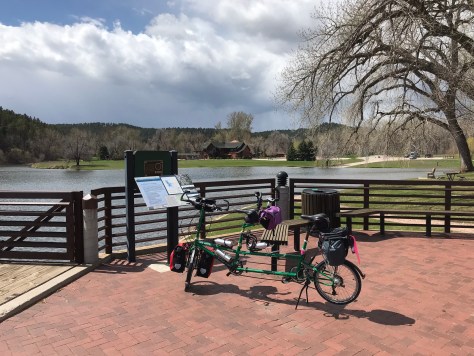
Canyon Lake, along the Rapids Creek Trail. the sign behind the information plaque shows the high water mark in the 1972 flood. We managed to outrun the rain clouds in the distance on an 8-km sprint back to the truck.

Day 7 found us at the Green Bean for coffee and breakfast in Belle Fourche (Bel-FOOSH, as we discovered after mispronouncing it for years), after which we headed to Rapid City to ride the Rapids Creek bike trail.  The day started off sunny and cool, which turned stormy and cold as we reached the west end of the trail, so we charged at full speed (which is not much, for us) back to the truck, getting the bike put away and us inside before the rain came.

We had planned to ride the entire trail, but 17 km was a bit over half.  We looked at the weather forecast and decided to try the rest the next day.  To fill up the rest of the afternoon, we visited the  South Dakota Air Museum at Ellsworth Air Force Base nearby, before checking in at yet another budget less-than-camping-fee motel, where we found it necessary to change rooms after being assailed by unidentifiable and disagreeable odors on opening the door.  The upper floors were at least tolerable, and the breakfast was acceptable.  Thinking of camping…

On the Rapids Creek Trail. The underpass under the bridge ahead was closed due to high water, but drivers were courteous where we had to cross roads along the trail.

Day 8: A sunny day!  We packed out, changed into our bicycling kits, and headed back to the creek trail.  On a sunny Saturday morning (May the Fourth be With You, for Star Wars fans), the trail was busy.  The National Guard was out in force, some jogging with heavy packs, most just sauntering along, in the guise of weekend training hikes.  Bicycles, moms and at least one dad with strollers, dog walkers, some elderly with electric scooters or bikes and trailers, an assortment of mountain bikes and road bikes, and kids on bikes wobbling along.  And, of course, the usual cityscape assortment of homeless, addicts, and pushers.  At one point, we had to detour around an aid car, apparently summoned for an overdose victim on the bridge in front of the Civic Center.  We put in another 16km, by taking alternate loops and side paths, plus a short section of yesterday’s ride before packing it in.

“Destiny,” a 15-meter-high statue at the rest stop overlooking the Missouri River at Chamberlain, South Dakota.  The northern plains indigenous people learned to make quilts from the European settlers, to replace hide robes after the bison had been hunted to near-extinction..  The six-point star pattern is now traditional for ceremonial quilts.

Bike stowed, we headed to the nearest Starbucks, which, due to a mass call-in of sunny-day sickness, was only serving drive-up customers.  Bah! Off to another near our motel, refuel at Safeway to get the discount, and off on the freeway to Mitchell, home of the one and only (should we be glad?) Corn Palace.  We thought about camping, but the tent spaces were soggy, and the regular campsites were nearly as expensive as motels, so we opted for one of the last motel rooms in town–graduation at the local college this weekend.  This time, the budget motel was very clean, and for the extra $10 we get breakfast and fast WiFi.

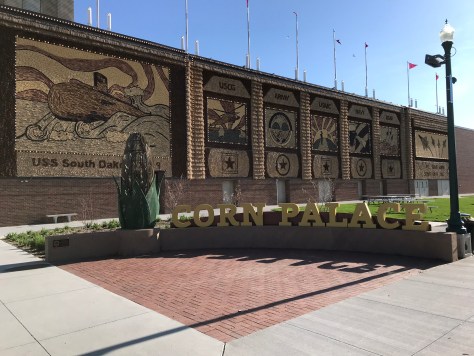
The “One and Only” Corn Palace, in Mitchell, South Dakota, a large auditorium decorated inside and out with murals made entirely of ears of corn and corn stalks, in natural colors.
The murals are changed every year. This year’s theme is South Dakota military contributions, to celebrate the christening this year of SSN 790, USS South Dakota.

One more day on the road and we hunker down for the next five days before again heading east.  So far, we’ve gotten in a few bike rides–short, but, then, we’ve had long drives before or after, along with unseasonable cold and the usual spring rains.  To be continued…

GOTO Considered [Rarely] Necessary

My answer is below, but, surprisingly enough, only a couple of days later, I found it expedient to use a GOTO in a PHP script, admittedly to fix a logic problem that wasn’t very well thought out.  In a while() loop, a test at the end needed to start a new output section, but the current data set needed to be put in the new section.  The expediency was to use the initialization code to start the new section, which was at the top of the loop, but allowing the loop to cycle would read a new data set, so the “quick-and-dirty” solution was to jump to the top of the loop without reading the new value.  Problem solved, and preserved the integrity of the code block, which was the main problem with GOTO in unstructured programs, back in 1968 when Edsgar Dykstra gave his infamous “GOTO Considered Harmful” proclamation.

The only time I have used GOTO has been to implement a decision construct not supported by the language. Of course, GOTO was necessary in linear programming languages which did not have syntactic constructs as we use in structured programming. All compiled programs have a GOTO in each and every looping or decision construct, but in the resulting output code. When it is necessary to use, it must be a construct defined in a safe manner, rigorously applied. Usually, this would be to stop execution in the middle of a code block by a GOTO to exit the block, something which most structured languages already have, in the form of a ‘break’ statement, or similar keyword. I could imagine a deeply nested decision tree construct where GOTO could be used for clarity, but there would probably be another way to write such a construct to be unambiguous.

One such example in C/C++ I could envision would be to construct a type of switch construct that accepted strings instead of integers as case arguments, where GOTO took the place of the break clause. I had used a similar construct in COBOL successfully, to build a switch-type operation, which doesn’t exist in COBOL, such that, once a test succeeded, the rest of the tests would be skipped. (Disclaimer: I took a job writing COBOL as a last resort, around 1990, in the middle of changing careers from systems engineering to software engineering—not a recommended choice: wrote COBOL by day at work and C by night at grad school).


Afterword:  Here is a snippet of the code block…

  
while ($fil = readdir($subdir)) {
newpage:
    if (is_dir($fil)) { continue;}
    if ( $row > 8) {
.
.
.
    if ($column >= 5 ) {
      $column = 1;
      $row++;
      print ("\n");
      goto newpage;
    }
.
.
.

The Parkins Report: Events of 2018

We set the tone for 2018 with a bike ride on January 1. Judy made a resolution for us to ride every month in 2018, which we are happy to report that we have kept. This year, Judy rode over 640 miles (1043 km), and Larye rode over 750 miles (1221 km).

“Wait,” you say, “don’t you guys ride a tandem?” Yes, we do, but Larye decided he wanted to try for a birthday ride this year, in honor of his 75th. Judy says she’s not old enough to ride that far, so Larye had to train for a solo ride. In the end, time just caught up with us, so Larye compromised with a 75 kilometer ride.
Larye’s solo rides,  3 on the old Specialized commuter, and ending with a 76 km (47-mile) Idaho loop on the “Lean Green Machine,” the Bike Friday in single-bike mode.

In order to satisfy our goal, we took the bike with us in the van on our Southwest tour in February, riding in Albuquerque, Yuma, Seal Beach, and Huntington Beach. We offset the fuel bill for the van with a few nights camping along the way and staying with relatives. The budget cutting plan was lost when our van, with the bike inside, was impounded in Anaheim because the parking permit got covered up on the dash. After retrieving the vehicles for a fee equal to our fuel bill to get home, we dispelled our rage by riding down one of the concrete-lined river channels in the L.A. basin. We quickly realized we didn’t have any problems, as we passed many homeless camps along the way.

Our van travels took us across what we have called the Southern Exclusion Zone in New Mexico, Arizona, and California. We got mistaken for coyotes when our bike, with helmets hanging from the handlebars, looked to the border patrol like a van full of illegal immigrants. We passed a total of five border patrol checkpoints in our travels, at three of which we had to show papers to remain in the United States, though we never left the country at the other points.*

The primary reason for our winter travels, of course, was to visit relatives, which we did. But, as our family grows and scatters, it wasn’t possible to schedule time for all, because of their work and travel schedules. We did get to meet the newer members, though.

Since we planned to stay near home most of the rest of the year, we broke tradition and signed up for several organized bike rides: the “Your Canyon For A Day” ride through the Yakima River Canyon to benefit Crimestoppers, which was great fun; the “Tour de Mason Lake” in Shelton, benefiting the Karen Hilburn Cancer Fund (about which, more later); and, “Ride the Willapa,” an overnight ride to benefit trail improvements on the Willapa Hills Trail, a 60-mile-long state park, mostly gravel trail between Chehalis and Raymond.

Although we thought about riding the 50-km circuit on the TdML this year, we again opted for the 35-km, fortunately turning around at the break stop, as the frame broke on our Bike Friday tandem on the way back, 10 km from the finish line. We were scheduled to head for Montana the next day, so, after hitching a ride to retrieve our van, we swapped bikes at home, once again taking our ancient but reliable Santana.

Although the Bike Friday eventually got repaired, Judy decided it had run its course, and we rode the now 32-year-old Santana the rest of the year.  Larye later converted the repaired Bike Friday to single-bike mode.

A snapshot of the last rides of the Mean Green Machine (as a tandem).  January-June 2018

We had intended to use the Santana for the Ride the Willapa gravel ride, anyway, having made a practice run earlier in the year on the Friday, realizing it still wasn’t very good on gravel. And, since it was a supported tour, we ended up camping in our tent for the overnight.

Arriving late at the campground, we got a site with a slight slope, having to periodically crawl back up from the bottom of the sleeping bag a few times during the night. And, of course, abandon vegetarianism for the day, as rural Washington doesn’t serve our kind, either in town or in camp. The cover picture was taken when we stopped for ice cream at the Doty, WA General Store a few miles from camp.

In July, we made an impromptu tour of the Olympic Peninsula while the city repaved our street . We camped four nights and rode near camp three days. We were pleased to find that seniors pay only $10 to camp in national park campgrounds.

As usual during the prime touring season, we hosted bicycle tourists from early spring through late summer. Guests came from Brazil, the U.K, Germany, New Zealand, and Spain as well as around the U.S., and in a range of ages from early 20s to mid-70s.

On a quick trip to Montana in June, we attended a national aviation fly-in, visited friends and relatives, and rode our bike. We made a quick no-bike trip to Idaho to attend a wine festival with relatives. Another Idaho trip in September gave Larye a chance to ride his 75-km metric-age while Judy and friend Char went thrift shopping.

After two years of living with our fold-up sleeping platform in the van, we remodeled with a telescoping design with foam cushions that transformed into a sofa for more comfortable camp seating than sitting in the front seats. We also insulated and covered the rear side windows to cut down on drafts from the windows and keep the bike from hitting the glass.

Our bike rides continued into the fall, with an excursion to the San Juan Islands. We decided the hills on Orcas were too steep to ride, so we hiked mountain trails instead. On the way home, we camped overnight on Lopez to ride the flattest routes in the archipelago, We topped off the season with chilly short rides in Shelton and on the trails in Olympia, where we started the year.

The second half of the year, we rode our old Santana tandem.

Reflections

So it goes. Obviously, we remain reasonably healthy for old folks entering their fourth quarter-century. We attend yoga sessions when we can, and Larye even led a couple of sessions this spring when all the other regular leaders were out of town. Our bicycle excursions tend to be a little shorter than in days gone by, and our daily driving distances likewise get shorter.

We missed a lot of weaving guild meetings this year, but are still active and plan to do more fiber projects in the coming year. Judy sold a number of items at the fall show and sale.

We’re encouraging relatives to visit us next: Matt and Darice did visit from Wisconsin, (Matt twice, briefly). We have a couple of ambitious road trips planned for 2019 that don’t pass by too many relatives, so that will be the only way we will see many this year. We have also made contact with long-lost cousins in the last few years, on Judy’s side of the family, and went on a camping trip with some over Memorial Day, and have others on our list for 2019.

We enjoy visiting with and entertaining bicycle tourists, but too many in one week does tire us, and, though we count the hosting cost as entertainment expense, it does add up. Prices keep going up, but social security payments remain pegged to the price of cat food, so we realize we have to keep cutting corners somewhere as our retirement savings dwindle.

We lost a cousin this year, too young, and some friends, one tragically, one unexpectedly, so we plan ahead but realistically live one day at a time. The goal is to get very, very old, very, very slowly, or, as the late George H. W. Bush used to say, “… to die young as late as possible.”

We wish all a happy holiday season and joy in the year ahead.

Judy & Larye

* Little-known fact (except for those who live there): ICE patrols cover a 160-km zone within the borders of the U.S., with right of search and seizure of suspected undocumented persons. There are 33 permanent checkpoints, most on the southern land border, but also some on the northern border, primarily in the east.

Warm Showers 2018

A typical morning scene: a round of photos and sendoff for our guests (Emilie and Sheena), as seen from our webcam.

2018 was a typical year for our Warm Showers activities.  We hosted 29 bicycle tourists this year, turned down a half-dozen or so that passed through when we were out traveling or bicycling ourselves, and a few who made inquiries but ended up bypassing us  due to routing or scheduling.

Our first guest of the season, Luci, had traveled two years from Brazil, intending to tour Canada as well.  However, she ran into a stumbling block when Canada refused to issue her a visa.  With her US visa expiring, she retreated to Mexico and is still planning to continue when and if she can get permission to enter Canada.  Meanwhile, she has seen much of the U.S., thanks to the many friends she has made in her journey.

Our next guest, Liz, a British free-lance journalist, had traveled from the U.K. via Europe and Asia, continuing her trip down the U.S. coast to Central America before returning home to the U.K.

Sheena, from Maryland, and Emilie, from New Jersey, had met on a Bike ‘n Build crew a few years ago and decided to tour together down the Pacific Coast.  The discovered, to their surprise, while looking through our guest gallery, that two others of their crew had stayed with us when they continued touring after the group had reached Seattle.  We narrowly averted a disaster when Emilie slipped on the top stair and took a bumpy ride down to the living room, fortunately unhurt.

Tom and Becci, originally from the UK, but living in British Columbia lately, passed through in early June on a tour of the Pacific Coast.

Frank, from Germany, convinced his Swiss employer that an English immersion experience would help him with his new assignment as sales rep to English-speaking countries, choosing a bicycle tour down the West Coast as the best way to do that.

Charlie and Becci, both veterinary surgeons from the UK, took an interesting approach to touring, ordering new bicycles delivered to the U.S., then riding them from Vancouver to San Ysidro, California, where they sold the bikes and continued their tour by public transit to Mexico and Cuba, where they had very interesting (and amusingly related) adventures and volunteered their skills at veterinary clinics (albeit clandestine ones in Cuba, where small-animal practices are not licensed).

Ramon, a teacher from San Diego, and Peter, a pediatric oncologist from Indiana, arrived separately and went their separate paths the next day, though both headed south.

Daniel and Claudia, from Germany, had pedaled across Europe and Asia, then north through the U.S. and Canadian Rockies before heading back south along the coastal and Sierra Cascades routes.  When back at home, Daniel is a neurologist and Claudia is a political science graduate student.

Jennie and Daniel, aspiring actors from the East Coast, started their Transamerica tour in Arlington, WA, headed down the coast to the western terminus at Newport, Oregon to begin heading east to New York.

Tom and Amanda, from Alaska, were “drop-ins,” contacting us by phone late in the day after realizing they weren’t going to make it to their intended stop.  We usually prepare a meal for expected guests, but Tom and Amanda arrived late, so cooked their own.  We still got in a good visit.  Tom has had several pieces published in Adventure Cyclist, the membership magazine of Adventure Cycling.  They were on a tour around the Olympic Peninsula starting from Seattle.  We had just completed a car-bike camping tour around the same route, in the opposite direction, so gave them some tips, and got good feedback from their experience.

Yanouk, from Montreal, had ridden across Canada with a friend from the Gaspe Peninsula to Vancouver, then solo to Vancouver Island and around the Olympic Peninsula before returning home to continue his university studies.

Bill and Dave, Christian pastors from Oregon, on a short tour together in the Pacific Northwest.

Neeka and Kegan, from New Zealand.  Kegan has an outdoor job, so they devised an ingenious plan to spend  a couple New Zealand winters in Canadian summer to combine work and touring, intending to ride to San Francisco before flying home to New Zealand in time for spring building season.  Unfortunately, one of their excursions over the summer took them to Port Angeles, where the clock started on their U.S. visa.  After I asked them about the timing, they checked their visa and discovered they had mere hours to get back to Canada by bus and train before it expired.  Hopefully, they will be able to return to explore the U.S. next year.

Chris, from Colorado, made a fast tour of the Pacific Coast on her recumbent, by virtue of being a very early riser, getting on the road well before sunrise.

Alain, from Montreal, arrived the same day Chris did, but from a different route, delayed slightly by knee issues.

Carlton, from Michigan, and his friend Rachel, fellow travelers who met on a group tour several years ago, had traveled with a group of other cyclists from that first group down the Canadian Rockies, splitting off to ride the Washington Parks Loop on their own, arriving from Yakima via Mount Rainier and Elma on their way to Seattle.

Connie, from Colorado, and  Isabella, from Oregon, who met on a supported bike tour of Puerto Rico years ago, decided to tour the Olympic Peninsula Segment of the Washington Parks Loop route, with a side trip to the San Juan Islands.  The biggest problem they had in planning was where to leave their car, as the loop brings them back to the starting point.  We don’t have room to park extra cars, so they ended up starting their tour in Montesano, 60 km west of us.  Connie’s Bike Friday New World Tourist is the first BF in our garage besides our own “Q” tandem.

David, from Spain, toured across Canada from Montreal and was headed down the Pacific Coast on his first North American tour.  He was quite the celebrity on the Warm Showers network, as he was the first Spanish tourist most of us had hosted. I ended up picking him up near the airport north of town, to spare him the hill climb to our house and the rush-hour traffic through town, made worse by the extensive road and utility repairs that have made navigation across town interesting this summer and fall.

So, another season under wraps.  We had a few requests in October, as we usually do, but weren’t home, so no guests in October.  2018 brings our total number of guests hosted since we joined Warm Showers in 2011 to 216.  This year brought us guests from two new countries, Brazil and Spain, and cyclists from a variety of professions, as usual, including journalists, physicians, teachers, religious leaders, students, and retirees.  Yes, our food, water, and electric bills go up a bit during “the season,” but we do enjoy sharing our mutual passion with these world travelers.  With some, our contact is brief, but others we keep in contact with for years, passively through their blogs, or actively on social media.  One of last year’s guests is nearing her goal, the southern tip of South America, currently entranced with the scenery and people of Chile.  An early guest from 2011, now 76, continues to tour around the world, sharing his photos and stories in his blog and on Flickr.

The Curmudgeon Abides

This month marks four years since I finally stopped renewing consulting contracts, which made me officially retired.  Since then, I have continued to maintain my pro bono client lists, and took some time to learn enough Python coding to put up a custom webcam at home, but have let my professional organization memberships lapse and do less coding than ever.  I have continued to create bad videos of our too-infrequent bicycle rides, but the technical skills are gradually eroding without some stimulus to keep up.

Recently, that stimulus came with signing up for the Quora social media site, in which participants can ask questions about random subjects, which get directed to members who have listed some level of expertise in those particular subjects.  So, I get asked questions about software engineering, Linux, operating systems in general, and other related fields which are fading from memory, forcing me to do a bit of research to verify facts I think I know for sure, but which invariably turn out to be not true [or at least, any more].

As a result, my rambling and sometimes oblique discourses on things about which I know very little, but about which I have strong opinions yet, get thrust upon the world, or at least the segment of the Quora community interested in such things.  Some questions are inane, badly formed, or prompt me to ask myself, “People do that now?”  At any rate, a lot of questions get multiple answers, and the answers are ranked by how many members (which may or may not include the original member who posed the question) “upvote” a particular answer.  Quora tends to encourage continued participation by announcing who has upvoted your answer, but that is tempered by statistics showing how many people have seen your answer.  Which, if you weigh that against the paucity of upvotes, means most users glanced at it and moved on.  At least I haven’t seen any “downvotes,” yet.

The social engineering model is fueled by advertising: if users bother to read your post past the opening paragraph, they are greeted by an advertisement before getting to see the rest of the response.  So, Quora has a vested interest in getting lots of responses to questions, and generating lots of questions to be answered.  A large percentage of the questions I get fed are apparently generated by an AI algorithm rather than a real person.  The majority of questions submitted by real people are ones that come from those interested in how to advance in the field, or aspiring programmers curious about pay scales.  Students wonder about the downside of struggling to become a code monkey: how to advance without a formal education or survive in the industry long enough to pay off student loans.  Some, I assume, are looking for answers to class problems without doing their own research.

There are the usual Linux versus Windows arguments, and some loaded questions, possibly posed by ringers to justify promoting a point of view.  A number of the respondents to questions have impressive résumés, and are much better qualified to answer the questions authoritatively than I or many of the others that offer what are clearly biased opinions not grounded in fact.  Many of the questions appear to come from practitioners and aspirants who are in the global marketplace, not many with down-home American monikers like Joe and Charlie, which leads me to fear that the U.S. heartland just isn’t growing a lot of technologists these days, but have relinquished progress to ambitious immigrants and the growing tech sector in the developing world.

So it goes.  Besides keeping my personal technical knowledge base current, and maybe passing on some historical lore to the new generation of coders and admins, I’m preserving a tenuous connection with the community, albeit virtual rather than face-to-face.  However, after a long career of being either the lone “factory rep” at a customer site or the lone Unix guy at a Windows shop, dependent on USENET or other on-line forums for community, it isn’t much different.  It’s as close as I can get to being part of a “Senior Net,” offering advice and guidance as a community service.  And, I get to learn new things, or at least remember the old ones better.


Musings on Unix, Bicycling, Quilting, Weaving, Old Houses, and other diversions

%d bloggers like this: