The Quarantine Diaries, Phase I

Taking a mid-ride break at Truman Glick County Park, Matlock, WA

Life under the “Shelter In Place” quasi-quarantine in the pandemic of 2020 is not much different than “Real Life” for us. Having had home businesses over the last 10 to 20 years, we’re well-equipped to keep busy without leaving the house. We’ve settled in to our hobbies, Judy working on her art journals and me, well, mostly surfing the web, communicating on various forums, working on software and web sites, editing video from our bicycle outings, cooking, and a bit of cleaning now and then. And we have gotten out on our bicycle twice since the “Troubles” arrived at our doorstep. The only thing changed is we don’t see other people, except for rare forays out for food and necessities, armed with a short list to get in and out quickly. We are more fortunate than most people, because, as retirees, we have a guaranteed subsistence income, for at least as long as the government remains solvent and functioning. Our retirement savings are in free-fall with the market crashing, but we typically use those funds for travel, which isn’t happening for the foreseeable future. Also, because we are moderately active seniors, with no chronic diseases, we don’t fall into the compromised health conditions which make many people in our age group less likely to survive the pandemic.

The 2019-nCov/SARS-CoV-2 virus (AKA COVID-19, AKA Coronavirus) now sweeping the globe caught us more or less unawares. A few weeks ago, we heard of the outbreak in China, then an inexplicable outbreak at a convalescent home in Kirkland, WA., 200 km away, which we followed with interest, as we had visited a friend there four years ago when she was recovering from a life-threatening diabetic issue. Then, cases started popping up in communities near Kirkland. Containment appeared to be uncertain, yet, here in the South Sound, life and business continued as usual—for a while.

Monday, March 9, Judy had an appointment for a regular 2-year screening, so we blissfully headed to the clinic in Olympia. We were greeted at the door by a staff person handing out masks to people who declared a fever or cough. We, being healthy, declined. The hallway to the imaging department passes by the overflow waiting area for the Urgent Care clinic, which is always cause for concern. Seated in the waiting area for Judy to be tested, I began to question the wisdom of both of us going into the center, while only one needed to be seen.

In the next few days, the contagion spread, with cases appearing in isolated areas, including in counties adjacent to our remote one, tucked up in the forests and bays between the Olympic National Park and Puget Sound. The contagion spread among people who, like the patients at the Kirkland facility, had not traveled to China: the news reported that the incubation period before visible illness was long enough for people to spread the virus to many. And, it was also obvious that, unlike other zoonotic viral diseases, COVID-19 spread easily person-to-person, rather than animal reservoir to human. Nevertheless, on Tuesday, March 10, we went to yoga class at the Senior Center. The room is large enough for 2-meter spacing of mats, so we thought it would be OK. We even went out to dinner one day last week, though at a restaurant that is mostly take-out, with few eat-in customers. We may order from them as the nationwide isolation continues, if they continue to remain open.

On Wednesday, March 11, we delivered a refurbished bicycle to the current Holly House resident, an artist from Tucson, AZ. We’re on the board of Hypatia-in-the-Woods, a non-profit that maintains a cottage retreat for women in the arts, and help maintain the facility as well as meeting with the artists during their stay and keeping the web site up to date. We also had our 11-year-old grandson for the day, during parent-teacher conferences while our work-at-home son was on a business trip out of state and our daughter-in-law was busy with the final days of the state legislative session. We went for a walk, to Dairy Queen, and to the Senior Center thrift shop to look for craft items. There was talk of self-quarantine for people who might have been exposed. Since the spread of the disease seemed imminent, and children and travelers seemed to be carriers, we elected to start a self-imposed semi-quarantine, i.e., limit our social interactions to close associates.

On Thursday, we met with other members of our programs and workshops committee for the Olympia Weavers Guild at an Olympia Fire Station to reserve a meeting room for an upcoming workshop in late March, only to be told that, minutes earlier, they had been directed to not make new reservations, due to the growing move to limit social contact to slow the spread of the disease. The next day’s scheduled guild meeting in Tacoma had already been cancelled, and the cascade of cancellations was just beginning.

Over the next week, normal life came to a crashing end: A granddaughter, on vacation in Chicago for St. Patrick’s Day celebrations, caught one of the last, nearly empty flights home to El Paso, after the bars and restaurants closed and before Midway Airport closed because of staff illnesses. She is in self-quarantine at home, as a precaution, since she works in a home-health agency. Meanwhile, the pandemic has arrived in El Paso. In all the organizations to which we belong: Tacoma Weavers Guild, Olympia Weavers Guild, Friends of the Shelton Library, Mason County Senior Activities Association, and Hypatia-in-the-Woods, a flurry of communication among the boards started canceling the rest of March scheduled events, then extended to April cancellations, then indefinite closures. Public libraries and community meeting rooms closed. Schools closed. We made a quick run to a local open-air produce stand to get fruit and vegetables, where customers tend to arrive one at a time. Word of hoarding of household supplies, particularly paper products, kept us from even trying to replenish our dwindling supples, going into rationing mode. We decided only one of us need shop at a time, and I made a quick trip to the grocery for dairy products, visiting only the one aisle and using the self-checkout, to reduce close contact with others.

The weather cleared on Sunday, the 15th. And we went for a walk in our neighborhood, which has become a sort of springtime ritual with us in the ten years we’ve lived here. We walked down the middle of the streets (there are no sidewalks), up the steep hills to the summit at the water standpipe and the last street,16th. We saw a few people, who waved from their yards, and spoke with a woman at the community garden, from a distance.

On Monday, we got half a tank of fuel for the truck and headed to the west end of the county to ride our bicycle, on a paved loop from the tiny settlement of Matlock (C-store, post office, and Grange Hall) north into the foothills of the Olympic Mountains. Meanwhile, the governor directed everyone over 60 to “shelter in place,” i.e., stay at home, don’t go out, get delivery, etc. This is not practical, of course, so we decided our “shelter place” is on our tandem bicycle, on empty roads. We went out again on Thursday, same place, different course. This time, we visited the still-closed Truman Glick County Park, with permission from the caretaker, with whom we spoke at a careful distance.

Life will not be the same. The pandemic is sweeping across the country, exponentially: it hasn’t yet been two weeks since the first of us decided we would all need to quarantine for at least two weeks after random proximity to groups of people. Quarantine can’t practically be complete. We still have a lot of stored food supplies, but not enough variety to assemble balanced meals over time, so we will still need to venture out for perishables and staples we run out of. To support the state ban on social interaction by senior citizens, the local grocery is reserving two two-hour time slots a week as a respite from the Elder Ban, as we call it, alternating with labeling it “house arrest.” We had a brief scare coming home from our bike ride when a sheriff’s car behind us pulled our van over just outside town. But, it turned out he was just signaling to let another police vehicle pass, on its way to a call, and he pulled around us and continued on. The “Elder Ban” is not put in place to protect us older citizens, but to protect inadequate medical facilities from being overwhelmed by patients most at risk for dying from the disease. In some parts of the world, bicycling has been banned on the premise that bicycle crashes are common enough to overwhelm the medical facilities.

In less than two weeks, we have gone from “normal” life with scheduled activities and travel plans to nearly virtual shutdown. All our activities have been canceled at least through May, libraries and dine-in eating establishments shuttered, schools closed, and travel ground to a halt. Early on, we canceled a planned vacation that was to have started on March 22, and the resorts have all shut down by now, anyway. We have no illusions that these drastic actions will stop the pandemic, The social isolation practices will merely slow it, so that when we do get sick, and we will, that the medical facilities will have the equipment necessary to keep the staff safe and provide adequate treatment to those mostly likely to survive.

Meanwhile, we will continue to maintain contact with our social circles and organizations by email, Facebook, and other electronic media. We will continue to ride our bicycle, on isolated country roads. We had a list of cycling events scheduled this summer in which we were thinking of participating. We’ve participated in those before, and put up with the crowds more than socializing, riding on our own rather than groups, so we may just take the route maps and ride the routes at some random time, and hope that too many others didn’t have the same idea. We have our van outfitted for camping. Unfortunately, we don’t have self-contained sanitary facilities, so will need to take precautions when using public facilities, if indeed the established campgrounds remain open through this crisis. Or, we could opt to revert to the bucket of wood shavings and peat moss we used at the Montana cabin as a litter box for people. Difficult problems require creative solutions.

Grant Goplen

It’s been over 100 years since the last major pandemic that touched the lives of most of the country. My grandfather, Grant Goplen, a young potato farmer in sparsely-populated northern Minnesota, died in the 1918 pandemic, but my grandmother, mother, and two uncles survived, their lives changed forever. My grandmother moved away, remarried, had another son and daughter, and lost her second husband to an infection that would be treatable today. She raised her five children alone during the Great Depression, running a boarding house for railway workers. Her children grew up: one son became a successful corporate businessman, two started their own construction company, and my aunt became a nurse and served during World War II. My mother, the middle child, became a housewife, marrying her oldest brother’s best friend, a young man from another single-parent family that survived the pandemic but fell apart on the eve of the Great Depression for much the same reasons families fall apart in good times and bad.

Life will go on. Some of us will die, but the rest will adapt, and many will prosper. The pandemic of 1918 spread throughout the world because of the new mobility of steamships and world war that put populations in motion with soldiers and refugees, and touched everywhere despite the relative isolation of small towns. The pandemic of 2020 has the potential to be much worse because of the mobility of automobiles, jet planes, the much higher population density, and the length of the invisible infectious period. And, with the pressure of climate change coupled with population density, new viruses evolve rapidly, so this is only the worst so far of multiple waves of pandemics that have come and will come.

Economies will crash, governments will falter, maps will change. Fortunes will be lost, fortunes will be gained. Famine, war, and anarchy will follow the worst. And, through it all, climate change will continue, even if the fossil fuel economy crashes. Forest fires will continue. Survivors will heat and cook with wood or coal, once again. Processes started will continue unabated with no means for mitigation: glaciers and permafrost will melt, raising sea levels and pumping even more greenhouse gases into the atmosphere. One thing is certain: nature is forcing humanity to change in ways we were unwilling to do when we felt we were invincible masters of the universe.


Coda:

It is now Tuesday, 24 March, 2020. We’ve been mostly in the house, with a few forays out to walk to the top of our hill and back. The produce market is still open, and I went to the grocery this morning during the assigned Senior Shopping Hour. It was a bit more crowded than I would have preferred, but edging around others and not getting face-to-face with anyone seemed to work. I wore an exam glove on one hand to push the cart, open freezer doors, and operate the self-service checkout screen. Since it was mostly other old people, I didn’t have any competition for the self-checkout. I’d used it last week, but this was the first time to use it with loose produce that had to be weighed or counted, and I figured out why kinds of motions made the robot happy: don’t put your reusable bags in the bagging area until after scanning the first item, etc.

Our grandsons from Olympia needed to be out of their house when their house cleaner came yesterday, and both parents still need to be away from home for work, so we got the grandparent duty. Fortunately, they can drive themselves now, so they just showed up for the afternoon, and left when it was time to go home. It seems like yesterday we had car seats and booster seats for when we had to pick them up. There’s no school for them, of course. The younger one (11) has some on-line learning, and likes to do paper and bead crafts with Granny when he’s here, but the high-schooler (the driver, 16) is on his own, spending a lot of time in Multi-User Online Gaming with his friends. Goodbyes were awkward with the “no-hugging” policy, but Granny couldn’t resist a no-skin hug. Does this reset our 14-day isolation?

Dutch-oven bread, baked in very hot oven.

This week is rainy, limiting our opportunity for outings. We’ve ordered a few things on-line for parcel delivery, but toilet paper is completely out of stock, despite quotas at the wholesale club. I’ve been baking bread, and we have a good supply of flour, but the store shelves are empty of flour. The two trips I’ve made to the grocery since the lockdown started have been direct, pick up what’s on the list, and check out, as quickly as possible, so I don’t know how the other supplies are holding up. Produce is plentiful, and we buy other items locally that we would normally get at the wholesale club, to avoid trips to the city.

In addition to ordering things online for which we would normally go to the store, we boxed, weighed, measured, and purchased and printed shipping labels for a set of journals Judy needed to send to a vendor in Tennessee, and dropped it on the counter in the post office, avoiding the six-foot spacing marks in the line and face-to-face time with the clerks. We’re doing what we can to reduce the number of bullets in the chamber in the Coronavirus Roulette game. Anecdotal evidence suggests that most of the infections spread through random close encounters. Minimizing those encounters is a strategy to slow the spread of the pandemic until the medical supplies can catch up with demand. Eventually, continued exposure, no matter how brief or infrequent, will put a viral bullet under the hammer.

The social obligations in this brave new world are sorting themselves out. Email has been a staple, but some of the organizations in which we are on the board or in small special-interest groups are talking about video conferencing, so we’ve installed Zoom on all our devices in preparation, and I’ve revived my dormant Skype account for one-on-one alternative to Apple Facetime, which we also haven’t used since Judy’s brother-in-law died last year. Yet another way life will change. But, we’re ready for that.  We have the technology.

Evolution of the Personal Computer – a Remembered History

The following is an article I wrote on Quora in response to a question about the evolution of the personal computer.  Looking back at the 45-year history of the “personal confuser” as we sometimes call those devices we now can’t seem to live without.  Realizing that most of the population was born into a world where the PC has always been there, it is sometimes important to remember where we came from and how we got here.

Soon after the development of the microprocessor, in the early 1970s, the Altair 8000 appeared on the market in 1975, powered by the Intel 8080 8-bit CPU. Many more 8-bit machines followed, coupled with keyboards and CRT monitors, though many of the early machines intended for home use used television sets for monitors, connected through a video to TV converter outputting an NTSC signal on VHF channel 3 or 4.

Commodore introduced the PET computer, a complete unit with keyboard and monitor in one desktop case, which ran a version of BASIC as an operating system. In the early 1980s, a home version, the Commodore VIC-20, was introduced, with the computer built into an enlarged keyboard, with a cartridge tape drive for data, and video output to an optional CRT monitor or a TV converter. These machines had a whopping 5KB of memory.

A number of smaller, more portable machines appeared, all with BASIC as the operating system, stored in various incompatible byte-code forms. Tandy Corp. sold the Radio Shack TRS-80 (which stood for Tandy Radio Shack w/ 8080 CPU), which promptly got the moniker “Trash-80” from critics. Chip-maker Texas Instruments, which had earlier killed the mechanical slide rule market with their hand-held calculators, came out with the TI-99 computer. Another low-cost compact machine was from Timex. Most of these machines used the MOS 6502 8-bit microprocessor, or the Zilog Z-80.

Steve Jobs and Steve Wozniak came out with the Apple computer, which, in Jobs’ inimitable marketing instincts, was named Apple II in the production model, to give the impression that it was a new and improved version of an earlier model, actually a prototype built in a wooden box. Apple would become one of the most successful of the early personal computers.

About the time Jobs and Wozniak were tinkering, Gary Kildahl, also in California, was experimenting with uses for the 8-bit Intel microprocessor, came up with a loader and command shell for a Winchester hard disk, which he named CP/M, Control Program for Microprocessors, introducing the concept of a block-structured disk operating system and a command shell that wasn’t BASIC. Prior computers were capable of running machine-code programs directly in addition to BASIC, but CP/M was the first to emphasize using binary programs on disk as the primary operating mode.

Some of the first commercial CP/M machines were the Osborne I luggable computer, which featured a 360-KB 5–1/4″ floppy drive, a 16×64-character CRT terminal, and a detachable keyboard in the lid of a suit-case-sized case that weighed over 15 kg. Kaypro came out with a similar form factor CP/M machine that was more suitable for desktop use, with a larger display screen and keyboard.

With the introduction of the 16-bit 8086 CPU from Intel, IBM became interested in adding a microprocessor-based system to their business line of mainframes and terminals, first approaching Kildahl’s Digital Research, developers of CP/M, and Bill Gates’ fledgling Microsoft, which had gotten its start writing BASIC interpreters for the Altair and other hobbyist microprocessor-based systems, and had recently acquired a 16-bit independent rewrite of CP/M, which, with the addition of some concepts from Xenix, a micro-processor-based version of Unix that Microsoft had licensed, became MS-DOS, the Disk Operating System. IBM adopted MS-DOS as PC-DOS for its new personal computer, the IBM PC, which featured an open system design that allowed third-party vendors to develop add-on hardware and write device drivers for it, which, of course, led to the proliferation of “IBM clones” from many different manufacturers.

By this time, the successful marketing of the Osborne and Kaypro CP/M machines and the Apple II had spawned a flurry of software development companies building business software that would run on the desktop without requiring a mainframe back-end, including spreadsheets, project planning software, and word processors. Stand-alone word processing workstations had sprung up with the microprocessor revolution, but were single-purpose machines, relegated to the “typing pool” at large corporations and document-preparation companies. With the introduction of a desktop machine from IBM, then the largest computer company on the planet, those vendors quickly ported their products to the 16-bit MS-DOS platform, and CP/M faded from the market, in part due to the untimely death of its founder.

Microsoft solidified its grip on the personal computer operating system market with exclusive contracts with various PC manufacturers. Apple focused its market on education and the arts, moving to the wider word-size market with the Motorola 68000, a 32-bit CPU with a 16-bit data bus, and a graphical desktop system based on the Xerox Palo Alto Research Center (PARC) Star project. The Macintosh was introduced in 1984. Microsoft countered with the Windows desktop environment running on top of MS-DOS soon after.

IBM commissioned a new graphical operating system to replace the Windows environment as 32-bit CPUs came into wide use in the early 1990s, but disputes between IBM and Microsoft led to the split into OS-2 on the IBM side and Windows 95 on the Microsoft side. Microsoft’s grip on the generic PC market won out, with OS/2 gradually fading away with the incompatibility between OS/2 and Windows 95 and Windows NT.

On the Unix side, Microsoft sold Xenix rights to the Santa Cruz Operation early on, which, after porting to 32-bit, became SCO Unix, but never got our of the small niche as a multi-user solution for small to medium-sized businesses. The mainframe Unix of the 1980s ported to high-end 32-bit microprocessor workstations used in academic and scientific research.

In 1990, Linus Torvalds, a college student in Finland, desiring a 32-bit alternative to the 16-bit micro-kernel teaching tool, Minix, built a new Unix-like monolithic 32-bit kernel, around which he and developers all over the world wrapped the GNU software collection from the Free Software Foundation, creating the GNU/Linux operating system, which has, in the 21st century, captured the network server market from Unix and replaced the Unix workstations on desktops of developers and research scientists, as well as taken over the hobby market started with the Altair 8000 in 1975, with re-purposed former Windows machines and the proliferation of tiny single-board computers, led by the Raspberry Pi.

The adaptable Linux kernel also became the core of Google’s Android operating system, which, along with iOS, the embedded version of the now BSD-Unix-based operating system adopted by Apple at the turn of the century, drives all the world’s handheld computing devices, the ultimate personal computers most of us carry with us everywhere, disguised as telephones, pagers, cameras, and music and video entertainment devices, as well as portals to the World Wide Web. Microsoft’s Windows system remains the default OS for the desktop and laptop environment, and the core server operating system in corporations—for now.

Warm Showers 2019 — A Sabbatical Year: No Guests

In a departure from the last 8 years, we had no Warm Showers guests in 2019. About the time the season normally starts, we went on tour. With our tandem in the van, we traveled through Idaho, Montana, South Dakota, Iowa, Minnesota, Wisconsin, Michigan, Ontario, and Illinois, staying a few days here, a week there, or just overnight, riding our bike where there were trails, with some camping, some motels, some AirB&Bs, or staying with friends, over a month “on the road.” After only a week at home, we were off again in our van/bike rig, alternately camping and staying at motels on our way through British Columbia and Alberta, spending some time at Prince George at a conference and with relatives in Dawson Creek.

Returning home on the first day of summer, we planned to receive visiting relatives, so stayed off the roles at Warm Showers for a few more weeks. Then, when we finally hung out the shingle, Judy became ill: we had to cancel a reservation for what would have been our first guest, in mid-July. After she spent 10 days in hospital and a month of post-surgical convalescence, we went on another camping/biking trip, to Oregon, coming home to prepare to receive yet another family visitor, so we decided to simply cancel the entire season, and will be open to receive Warm Showers guests in the spring of 2020.

Looking back over the past eight years, we have had well over 200 guests, ages 8 months to over 70, one to seven at a time, couples, friends, fellow travelers, adult child and parent, and families, including a few dogs, 25 to 50 guests a year, depending on how much travel we did during the season, which basically runs from March through November, and other factors, such as the summer five years ago when I was recovering from cardiac bypass surgery, which shortened the season.

This year, we’ve had to satisfy ourselves with keeping track of the many former guests with whom we still keep in contact, through Facebook or their personal blogs:

  • Peter, who turned 70 on his epic trip from the Yukon to Argentina, a nearly two-year journey, and who, at 77, still tours, popping up here and there around the world.
  • Sarah, who turned her first solo tour–from Seattle to Santa Barbara, when we first met her–into a career as a bike tour guide and semi-retirement as a world traveler and blogger, sending missives from Argentina, India, and Spain, among other places, in her blog, at http://www.honoringmycompass.com/
  • Bastien, who became enamored of the kinetic sculpture races in northern California and came back the next year to participate, and who achieved the goal back home in France of riding 500 km in under 24 hours.
  • Normand and Helene, who cut their 2014 tour short with a crash near Seaside, Oregon, and who later rode from Calgary to Argentina on their tandem, during which trip Normand turned 60, and who just finished a grand tour from Turkey to France through the Balkans, Italy, and Switzerland, through the mountains.
  • Glen and Bobbie, in their 60s, who returned home after a trans-America tour to hike the Appalachian Trail and this year just completed a triathlon.
  • Megan, who, with her friend Gordon, from Scotland, cycled from Alaska to Argentina and spends her summers off from teaching in Wisconsin to travel the world on humanitarian missions.
  • Eric, who called us at the end of a list of 24 other hosts, stranded in a late fall storm 60 km away, 10,000 miles into a tour around the U.S. We picked him up and sent him off dry the next day. We since visited him when passing through Moab, where he worked at a bike shop. He now lives in Colorado and has twice participated in and finished the Tour Divide, which follows the Great Divide Mountain Bike Route, a self-supported 2745-mile bicycle race from Banff, Alberta to the U.S.-Mexico border, on trails and forest roads.
  • Chris, who cycled all 50 states and has published the first of several volumes of conversations with people he met on the way, starting his own publishing company in the process.
  • Marge, from France, who bicycled solo from Canada to Argentina, sporting each country’s flag in turn on a staff and mount we gave her with the U.S. flag we carried on our East Coast tour in 2016.
  • Klaus, a medically retired mining engineer who wandered the Australian Outback with two camels for 11 years before collecting a pension and traveling the world on his bicycle: he wasn’t a Warm Showers member, we met him at a bakery on a rainy day and invited him to stop for the night.
  • Bryan, a professional cook, who stayed an extra day and cooked for us, surprised that we had equipment for southeast Asian cooking.
  • Isabella, whose host gift to us was a pair of bike socks from a previous supported tour, which I often wear.
  • Jayshil, who passed through from Canada returning to New Zealand years ago, now lives in Melbourne, Australia.  He regularly rides 100 km “training rides” and toured Iceland this past summer.
  • Michael, who passed through with his college classmates after graduation, went to Africa with the Peace Corps and has completed medical school.
  • Angela, from Canada, who found us through a Facebook forum, recommended by:
  • Nico, an Iowan who has settled in Portland, and who returned several years later to introduce us to his fiancé.
  • Lauri, another host a day’s ride away, with whom we have shared guests on adjacent nights, follow each other on Facebook, and have yet to arrange a ride together, but soon…
  • Lindy, an award-winning weaver from New Zealand, who altered her itinerary to stay with us when she discovered we were also weavers.

Many guests for whom English is a distant second or third language, conversing through electronic translators. And many more, who have stayed, become family for the night, and moved on, sometimes turning up in other guests’ stories as met on the road or through Warm Showers as hosts or guests in other parts of the world, and some who have returned to “normal” but interesting lives as extraordinary people who once ventured to challenge themselves by traversing a continent under their own power, on a bicycle.

As it stands, now, we are looking forward to meeting our fellow cyclists again starting in Spring 2020, and extending ourselves just a bit more in our own adventures, inspired by our guests.

Road Trip 2019: The Bicycle Video Diaries

Road Trip 2019, parts 1 and 2 are now completed.  One of the goals for our road trips in our 70s is to ride our tandem bicycle on great bike trails and routes across the U.S. and Canada. This trip was no different: we took time out to ride parts of:

  • Trail of the Coeur d’Alenes in Idaho
  • Missouri Headwaters Trail in Montana
  • Rapid Creek Trail in Rapid City, South Dakota
  • Iowa Great Lakes Trail around Lake Okoboji and Spirit Lake
  • Simcoe Loop Trail in Simcoe County, Ontario, Canada
  • Great Lakes Shore Trail along Lake Ontario near Bath, Ontario
  • Pheasant Branch Trail in Middleton, Wisconsin
  • Trail of the Coeur d’Alenes again
  • Shelton Valley Loop, a quick ride at home between the two parts of our road trip
  • Bear Creek Trail in Grande Prairie, Alberta, Canada
  • Canyon to Coast Trail near Chilliwack, British Columbia, Canada

Our total riding distance between the start of our adventure and the end was just a few meters shy of 340 km, while the bike rode nearly 15,000 km in the back of the van in that time.

As we usually do, we document most of our bicycle adventures with a video diary.

Edaville,Trail of the Coeur d’ Alenes from Larye Parkins on Vimeo.

This was a very cold morning near freezing, at the end of April, so we rode a very short way down the trail and back, from the trailhead we rode up the trail from last year.

Missouri Headwaters from Larye Parkins on Vimeo.

We camped overnight at the Headwaters State Park, where the bike trail ends, and rode into Three Forks in the morning.  It was cold, so we didn’t stop in town, but drove back in the car after the ride for our morning coffee.

Rapid Creek part 1 from Larye Parkins on Vimeo.

We drove a short way, from Belle Fourche to Rapid City, intending to ride the length of the trail.  We rode from the Founders Park, near downtown up the creek to the end of the trail, racing back to the car ahead of a rain storm, cutting our intended ride a bit short.

Rapid Creek, part 2 from Larye Parkins on Vimeo.

We stayed in Rapid City overnight, then started early on Saturday morning to ride the rest of the trail, again starting at Founders Park.  Bridge repairs near the end of the trail cut this ride a bit short, too, so we retraced a bit of yesterday’s ride and a spur trail to the north.

Okoboji2 from Larye Parkins on Vimeo.

In 2017, we rode most of the way around Lake Okoboji, anti-clockwise, from the east side, when we had a tire failure.  A runner on the trail gave us a ride to the bike shop, where we got the bike tuned and new tubes and finished the loop.  This year, we started on the west side and rode clockwise, completing the loop with no problems.  We didn’t know it then, but my cousin Jack Parkins lives at the top of the hill on the on-road segment of the trail south of the lake: we visited them a few days later.

Spirit Lake – Loon Lake from Larye Parkins on Vimeo.

Instead of riding from our resort and repeating almost half the previous ride, we drove to a trailhead in Spirit Lake and rode up the west side of the lake and took the Jackson County [Minnesota] trail to Loon Lake, where I spent several summers camping as a Boy Scout, in the 1950s.

Tay Shore Trail from Larye Parkins on Vimeo.

After some rainy weather that kept us off the mostly gravel trails near where we were staying, we drove up to this paved trail, which was very nice, but the rain caught us at the turn-around point near Midland. Still, it was a good ride.

Wasaga Beach – Collingwood from Larye Parkins on Vimeo.

This was quite a drive from our lodging, but was a route mostly on paved roads.  We had driven through Collingwood on the way to visit Own Sound a few days before and decided not to ride the gravel rail trail beyond Collingwood.  This one took us through beach home neighborhoods and through the Sunset Point Park on Georgian Bay, Lake Huron.

MillenniumTrail, Orillia, Ontario from Larye Parkins on Vimeo.

A short segment of the Simcoe Loop Trail, designated the Millennium Trail, runs along the shore of Lake Couchiching in Orillia. We rode this on Saturday of this long holiday weekend (Victoria Day), so there were lots of people out.  We also encountered thick clouds of midges, and had to stop and clean them out of my eyes, nose, and beard.

Loyalist Parkway from Larye Parkins on Vimeo.

We left the Orillia area on Sunday during the Victoria Day holiday weekend, driving east to Peterborough and then south to Bath, where we stayed at an AirB&B.  In the morning, we rode west from Bath along the shore of Lake Ontario before joining the heavy traffic into Toronto as holiday travelers returned home.

Pheasant Branch 2019 from Larye Parkins on Vimeo.

We had ridden the Pheasant Branch trail, near our son’s house, in 2015 and 2017 and counted it as one of our favorites.  We were appalled to find that the trail had been almost totally destroyed in a flood in August, 2018.  Fortunately, most of the bridges had been restored, but it was largely rough gravel and sand down through the canyon, so we returned via the city streets.

Trail of the Coeur d’Alenes: Cataldo MP 39-44 from Larye Parkins on Vimeo.

On the way home, we camped in Cataldo, Idaho, taking an early evening ride up to where we had turned around on that freezing April morning more than a month ago.  Passing our campground to ride farther down the trail, we spotted a young moose headed toward the trail through the campground.  We stopped for a few long-distance photos, then pedaled on.  We hadn’t gone too far when the  storm clouds building to the west flashed lightning and a very close thunderclap.  As it was warm and humid, we hadn’t packed our rain gear, so we turned around and sped back to camp.  However, the rain passed to the northwest.  So, we have a 10-mile section from mileposts 29 to 39 yet to ride on the lower half of the Trail of the Coeur d’ Alenes, plus the section from Osburn to Mullen through Wallace on the upper end.  The weather has never cooperated with us: it’s taken us 15 years to complete 96 miles of the 144-mile round trip ride on this trail, and 61 of that was the first time, in 2004.

Shelton Valley Sunday from Larye Parkins on Vimeo.

When we really need a bike ride and don’t have time to drive to a trail or rural area, we ride the 10-mile loop through downtown Shelton and around Shelton Valley, just west of town.  We can choose to ride clockwise or anti-clockwise, and there is enough climbing to give a good workout.  This was an anti-clockwise run.

Grande Prairie from Larye Parkins on Vimeo.

We thought we might get to ride some on the way to and in Prince George, but the weather didn’t cooperate on the way up and our weekend was entirely taken up with the fiber arts conference.  Then, we stayed with relatives on a gravel road west of Dawson Creek, so there wasn’t much opportunity there.  But, we found this delightful urban trail down the creek running through the middle of Grande Prairie, Alberta.  We camped next to the trail, but the wind was too strong to ride the afternoon we arrived, so we broke camp in the morning and rode from the parking lot at the mid-point of the trail.  The trail was a good workout with curves and rolling up and down the sides of the canyon, with a lot of children in summer programs along the trail, so we took the city streets back to the van, driving another 175 km south to our next stop: we should have pressed on another 150 km, as we drove that the next morning–in a late June blizzard along the Rocky Mountain Front.

Chilliwack–Fraser Valley from Larye Parkins on Vimeo.

Our last ride started where it all began, 33 years ago.  In 1986, one of our first big group rides was an 80-km (50-miles, a “Semi-Century”) ride from Nooksack School in Washington State, down the Sumas River, across the border to Chilliwack and return.  This trip, we parked on the north side of Chilliwack and rode the dyke along the Fraser River to the Rosedale-Agazziz Bridge and back along the Camp Slough, reminded on the way back of the persistent wind that blows up the Fraser valley: that long-ago ride, we fought the wind all the way back, 40 km, arriving an hour later than the rest of the quite large group, though we had been with them at the turn-around.  Choosing to ride along the cottonwood-lined slough was a good choice: we had much less wind.

Road Trip 2019: There and Back Again

Road Trip 2019, Part 2, Chapter 2: Points North; The Long Way Home

Day 7, Fathers Day: Prince George, BC.  We are up early, the first in the breakfast room at the hotel, then pack out and head for the Hart Highway, BC 97 North. We stop at Sav-On for more groceries and Starbucks for our morning coffee. Heading north, we stop for fuel before leaving the Prince George metro area, then cruise the long empty road north. We stop at Mackenzie Junction for a lunch of convenience store fare: muffins, bottled Frappaccinos, potato chips, and yogurt from our grocery stop. I am stuffed, and have used up most of my daily calorie allowance in one take.

Raven, MacKenzie Junction, BC

After Mackenzie Junction, we pass the roadside notice: “Check Fuel, no service for 148 km.” We’re still good, and press on over Pine Pass in some of the most spectacular mountain scenery this trip, through the foothills to Chetwynd, festooned from end to end with fantastical and whimsical chainsaw carvings, the fruit of many years of contests. We stop for photos at Carver’s Row, then off to Tim Hortons. I get a cappuccino, Judy gets a pastry, and we use the WiFi to phone ahead for directions to our hosts, Janet and Dwight. We make the turnoff, but overshoot the driveway, doubling back just as they prepare to drive out to intercept us at the highway.

Janet and Judy, on the corduroy road to the cabin.

Janet and Dwight recently sold a B&B south of Dawson Creek and have moved into their weekend cabin off the grid west of Dawson Creek. But, they have built a utility shed near the road and brought in power, so we have power for our refrigerator and phone recharging. There isn’t any level place to park, but we do the best we can and put up with a slightly tilted bed. Their main cabin is deep in the woods, cozy, but has only solar power. No well, so they truck in water and ration it. We’ve done worse, at our former cabin in Montana, so we’re in luxury compared to that.

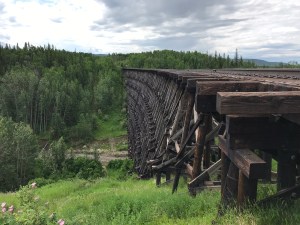
Rail trestle at Pouce Coupe, BC

Day 8: We explore Dawson Creek, taking in the visitor center, where we collect lots of maps we should have already had, and get some ideas of what to see in the area. The local art gallery is first, with an excellent pottery display from the local potters guild, and a historical photo display of the Alaskan Highway construction in 1942 by the U.S. Army (with coöperation from Canada) to deliver war supplies to Alaska by land. We’re interested in several bridges: the first is a railroad bridge south of town, in the village of Pouce Coupe, [Poose KooPAY] which we eventually find and venture out on part way: it’s perfectly safe, as railroad trestles go, but the gaps between the ties are unnerving, so we don’t cross.

Kiskatinaw Bridge, looking back toward Dawson Creek.

The second bridge to explore is the Kiskatinaw Bridge, on the old Alaska Highway, the last wooden bridge to survive from the 1942 wartime construction of a land supply route to Alaska. It’s curved, as many wooden bridges are, to add stability. The deck and trestles are still sound, but the timber curbs along the inside edge are worse for wear, possibly from vehicles sliding into them in icy conditions, and partly from dry rot. We park in the turnout at the near end of the bridge and walk across. Local traffic zooms across like any normal modern bridge, but we don’t.

Alaska Highway Mile 0, Dawson Creek, BC. BC 97 now follows the route of the original Alaska Highway.

Turning around, we head back toward Dawson Creek, with heavy weather looming to the west. We turn off the highway into the downtown to photograph the “Mile 0” post in the center of town, top off the fuel, and head back west to continue our visit. We retire to our van fairly early: our hosts have been busy working on the buildings. The rain starts as we settle in.

Day 9: We’re on the eastern edge of the Pacific Time Zone, so it’s light out at 4:30 am. Camping in our host’s large rural compound means we don’t close the curtains, so we’re up before 5:00. We had tentatively planned to visit a dinosaur site to the south, but decided $50 worth of fuel and most of the day to look at dinosaur footprints wasn’t worth it. We elect to move on, then, and explore a bit more of Alberta instead.

We pack for travel and the four of us head into town for breakfast. Surprisingly, the fast food franchises in Canada offer plant-based sausage alternatives with the egg and muffin (no, it isn’t that franchise, the one with the clown, but one we don’t see often anymore in the U.S.–A&W) A statistic I read the other day says that 10% of Canadians are vegetarian, so it now isn’t surprising to see vegetarian options at most eating establishments, unlike the U.S., where many people view not eating meat as unpatriotic and unwholesome, or just plain weird.

Beaverlodge, Alberta

Too soon, we part ways, heading toward Alberta, where we stop for a photo-op with a giant beaver statue at Beaverlodge, then off the freeway for a hike through Saskatoon Island Provincial Park, which hasn’t been an island for almost 100 years. We have decided to check out Grande Prairie, the largest city on our route: the Rotary has a campground near a bike trail. We check in to the campground shortly after noon to make sure we get a good site, then head downtown for lunch at a Pita Pit, which one can find in almost any Canadian city of reasonable size. Like our penchant for stopping at Starbucks when we travel, we know what’s on the menu and we don’t have to guess if they will have food we are willing to eat.

After lunch, we take in the historical museum, including pioneer buildings collected to save them from the ravages of time, decorated with the trappings of everyday life of the period. We also track down the pioneer hospital museum. Surprisingly, the first hospital in Grande Prairie opened in 1911, in a log cabin, with six beds in a tiny cabin, later expanded into a large log home after a proper hospital was built. The new house was still log, but covered with ship-lap siding and plastered inside so it looks like a “modern” stick-built house, a treatment that was fairly common in the early 20th century as log homes became associated with primitive living and hardship.

We had considered taking time this afternoon to ride the bike trail, but the 40-km/hr winds that had buffeted us since leaving Dawson Creek and continued full strength for the rest of the afternoon discouraged us, so we settle into our campsite: tomorrow promises calm, but cool weather, ideal for us for a long-overdue bike ride.

Grande Prairie Regional College, across the Bear Creek Reservoir, at the upper end of the bike trail along the creek through the city, and across the bridge from the campground we stayed at.

Day 10 dawns overcast and cool, but the wind has subsided, so we dress in our cycling kits, break camp for breakfast at Starbucks, and park at the museum we visited yesterday: the bike trail runs in front of the museum. We could have ridden from camp, but we didn’t want to be rushed to make it back by check-out time. This turns out to be a good choice: we do a warm-up loop around the reservoir, where the campground is the highest point, then head down the creek under the main highway and westbound rail bridges, across the creek, then up and down, climbing high above the creek bed, then crossing and climbing up to the city streets. We decide to make a loop instead of retracing the up and down route through the canyon, following a bike path toward the downtown, then on less-busy streets through the city center, around the provincial government complex, and back into the park north of where we parked.

A bridge over Bear Creek on the Bear Creek Trail, Grande Prairie, Alberta.

Back to Starbucks for lunch: there are other places to eat, but we know the menu and they have electrical outlets for computers and decent WiFi, so that’s where we end up often on these road trips. After lunch, we top off the fuel tank, restock our tiny 12-volt refrigerator at Sav-On and head south on Route 40, 173 km of no services. We pass many natural gas wellheads and drive through several large road construction projects, where passing lanes are being built on this lonely highway that rolls up and down across the Rocky Mountain foothills. Dark clouds gather, and we drive through a few rain squalls. Snow-capped ridges and peaks appear ahead through breaks in the clouds.

Grande Cache, a coal mining and timber town on the Big Horn Highway. Alberta, 150 km from the next nearest town.

As the GPS counts down, we pass a coal mine, an industrial facility on the banks of the Smoky River. The hillsides above the highway are deeply terraced, with nearly vertical coal veins sprinkled across the gouges in the mountain. The road crosses the river and climbs steeply into the town of Grande Cache, the only settlement in the middle of this 325-km-long stretch of highway. We stop, check out the municipal campground, which is gravel, with a long walk uphill to the washrooms, and the WiFi winks out as we approach the nearest available site. The weather report predicts several days of continuous heavy rain. Unpaved roads in Canada tend to turn to gumbo in rainy weather. We walk back to the office, thank them for their time, and drive back over the hill to the information center, where we check motel prices on their WiFi and settle for one of the more inexpensive ones with good ratings.

We  find we have a kitchenette unit, so we cook dinner from our food stores and have plenty of room to spread out our electronics for work and recharging. We plan the road ahead: The weather forecast calls for extended rain all across the northern Rockies, so we plot a course to take us far enough into British Columbia to the south to drive through the worst of it, farther than we intended, but sight-seeing in Jasper National Park in heavy rain and cloud doesn’t seem a good plan.

Day 11 sees us off toward Jasper. Less than 20 km from Grande Cache, the rain turns to snow. Southbound traffic is far enough ahead of us that the tracks are faint, but we follow them as best we can. The snow gets heavier as we go, but tapers off about 30 km from the junction with Highway 16.

The run into Jasper is uneventful, slow at times because of road construction. Highway 16 runs through the National Park, but bypass is permitted without an entrance fee as long as one does not leave the highway. We do, at Jasper, for coffee and fuel, but are immediately stopped by a slowly-moving passing train. Trains in Canada are often several kilometers long, and this is no exception. After the long wait, we fail to find a parking spot near the Tim Hortons, so just top off the tank at Esso and move on.

Before we get too far, there is more road construction, and another delay, with a one-lane temporary bridge slowing traffic. The rain continues into British Columbia. We pass Mt. Robson, the highest point in British Columbia, but can only see the lower half of the mountain. We turn off onto BC 5, headed south. At the first town, Valemount, we spot a sign for espresso, so venture into the town and find The Gathering Place, which has good espresso and irresistible desserts.

Down the highway, we brake for a young bear ambling across the highway right in front of us. We intended to stop at Clearwater and camp, but it’s only 3:30 and Kamloops is an hour and a half away, so we make reservations at a hotel and continue on, through intermittent light rain, following the  North ForkThompson River into the city. Kamloops is a large city in central BC, with major industries including paper, plywood, and copper. Its central location also makes it a favorite for regional sporting events and academic institutions.

We check in, then walk up the street to the nearby Coast Hotel, which has an attached sports bar, Romero’s. We select a couple of vegetarian appetizers to share, a dark beer on tap, and top off with crème brûlée for dessert, skipping a main dish. It’s been a long day, and a wearing one driving in snow, slush, and rain. We’d intended to spend a bit more time around Jasper National Park, but the rain hid the mountains and, with the solstice coming up tomorrow, the summer tourist season is well underway, snow or no snow, rain or not, and we’re not comfortable around crowds, preferring to explore off the beaten track.

Day 12: We shoulder through the tour bus crowds at the hotel breakfast bar, stop after breakfast for coffee at a nearby Starbucks, and head for the Coquihalla Highway south. The truck has been running rough at idle and difficult to handle in city driving, so we’re glad to be out of the city. Kamloops is exploding up the steep hills to the south, making for crazy navigation between commercial centers terraced between residential housing.

Our relief is short-lived, however. As we climb up into the mountains in the empty wilderness, the “Check Engine” light comes on. The truck is running smoothly at highway speed, but the lack of any services for 115 km ahead and the few U-turn exits on this speedway between the widely-spaced cities gives cause for concern. A bit more than an hour later, we drop down to the junction city of Merritt, low on fuel and running rough. At the fuel stop, I notice the vehicle next to us has an auto parts logo, so I ask the driver about repair shops. He sends me next door to his shop, which, unlike the Napa parts stores in the U.S., is a repair shop. They’re busy, but refer me to a tire store on a back street that does repairs. After an hour’s wait, they hook it up to the analyzer and deliver the report: an EGR (Exhaust Gas Recycler) sensor alarm. Not an immediate emergency, but the engine will run rough at idle and dump too much nitrous oxide into the atmosphere. We elect to move on, as the repairs would mean removing the engine cover inside the passenger compartment and maybe delay us the rest of the day.

The warning light stays off as we climb up the next series of mountain passes and stop for lunch at the only roadside rest area on the route. At last, we reach the Coquihalla Summit and wind steeply down the mountain river valley to the flat alluvial plain of the Fraser River delta. We stop at Chilliwack, having planned an afternoon bike ride along the Fraser through the sloughs and farmland where it begins to spread between the mountains. It’s 3:00pm, late in the day for us to ride, but we’re determined.

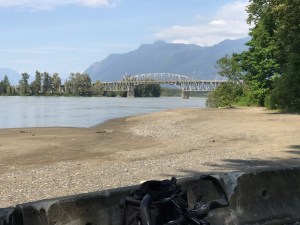
Dyke along Fraser River, part of Canyon to Coast Trail, Chilliwack, BC

The route twists and turns through residential neighborhoods, then on farm roads and finally onto a dyke, designated a non-motorized trail, part of the Canyon to Coast Route. It’s gravel, but fairly hard packed, except for 2 or 3 kilometers in the middle, past the hops fields, where the gravel is looser. The view opens up as it runs along the river near the mouth of the canyon ahead, then drops us onto a paved road that used to run to the ferry landing where the BC 9 bridge stands today.

We turn around under the bridge and head back, into the wind that consistently blows up the flat valley from the Georgia Straits, 100 km away. We follow Camp River Road, a paved farm road and alternative part of the trail, along the Camp Slough, sheltered a bit by the cottonwood trees, but it’s a hard grind against the relentless wind. At last, we leave the farms and the smells that identify this one as dairy, that one, pigs, and the other one, chickens, before we even see the barns. The road becomes more residential, and has a shoulder, of sorts, that dodges around utility poles and trees. Then, we’re through neighborhoods we rode before and back to the park and our van, 31.5 km (19.5 miles), a flat ride, but hard work after a tense day traversing the mountains in a cranky old truck.

We retrace our route back to the freeway and a short 20-minute drive to our hotel, hot, tired, and ravenously hungry. We throw our bags in the room and head for the on-premises restaurant, still in our cycling clothing. By the time we’re settled in and showered, it’s late, and we collapse into bed. Tomorrow, we head across the border toward home. Summer has come at last, and the roads, campgrounds, and hotels are filling with tourists, making travel less than idyllic. Time to be home.

Day 13: We’re up early. No complimentary breakfast in this old but upgraded motel, since there is a restaurant on the property, so we make do with microwave: reheated leftovers from dinner and instant oatmeal. We’re less than 5 km from the U.S. border, so getting there doesn’t take long, but the lane we’re in is slow: there’s only one checkpoint, while the other lane fans out to four. The Check Engine light comes on again as we creep forward over the next hour. Unlike the Canadian crossing, where the border agents are mainly concerned with your destination, whether you intend to leave anything in Canada, and whether you have weapons, the U.S. border agents want to know how long you were there, where you went, and why, and what you brought back. It always seems they aren’t happy we left the country and even less happy that we came back.

Docking at Kingston, aboard MV Puyallup.

Once across the border, we continue south on WA Highway 9 instead of following the GPS route to Bellingham, stopping in Sedro Wooley for coffee and a pastry. At Arlington, we finally turn on the GPS and join the I-5 freeway flow to the Edmonds – Kingston ferry, where we wait through two sailings before we end up the first car on the next sailing, which makes the drive to Poulsbo relatively painless, at the front of the ferry traffic from Kingston. The rest of the trip is just a long jaunt down WA Highway 3 to Shelton and home, where we quickly unload and put things away, to settle in for the rest of the summer.

Musings on Unix, Bicycling, Quilting, Weaving, Old Houses, and other diversions

%d bloggers like this: