Connie’s 80th Birthday quilt, made by the Bent Needlers.
After an eventful week visiting with relatives and preparing the cabin for sale, we at last headed for home, with a two-day detour up the Bitterroot Valley to the biennial Bitterroot Quilters Guild show and a visit with a long-time friend. The quilt show is as much about the quilters as the quilts, so we spent more time visiting than ogling the quilts. Too soon, the show was over. We helped take down the show, a monumental task that involved dozens of guild members and their families, unpinning and bagging quilts, then distributing them to their owners while others unpinned and folded the muslin display walls and dismantled the frames. The group of which we were part took down the Hoffman Challenge traveling display and repacked it to send on to the next quilt guild show, as well as taking down the muslin frame covers.
Bitterroot Valley, Montana: a wet summer thunderstorm brings heat relief instead of fire.
We stepped out of the exhibit hall into 39°C (102°F) temperatures, driving down the valley to Caffe Firenze in Florence, our favorite Italian eatery. We spent the evening and the next day with our friend Connie, resting up for the last stage of our long journey, the 900 km drive home across Idaho and Washington. On the way, we stopped in Blanchard, Idaho to pick up our camping gear duffel, which we had left with Char when we met in St. Regis last week, to make sure we would have enough room to pack the personal belongings we wanted to bring home from the cabin. I unpacked the duffel and fitted the tent and sleeping bags into the few crannies left in the back of the Jeep, now filled to the roof.
Crossing the Cascade Crest at Snoqualmie Pass, the temperature finally dropped below 30°C, but we were greeted by a projected 20-minute delay, with traffic backed up for more than a kilometer at the I-90/WA-18 junction, because of traffic detouring around the closure of WA 203 between Carnation and Snoqualmie due to a fallen tree. We left the queue, which was backed up way beyond the off-ramp, and continued on to downtown Issaquah, taking the Issaquah-Hobart road, which was congested, but at least moving, to WA-18, bypassing the Tiger Mountain Pass altogether. We also took another detour at WA-167, through Puyallup on WA-512, bypassing Tacoma and the usual congestion there. Finally, shortly after 8:00pm, we arrived back home, 1452 hours from the time we left. We were amazed by the profusion of blooms in our yard, beyond the view from our webcam. The problem with travel is you miss the evolving floral landscape at home, and only see the changes across the land if you come back the same way you went out.
After-math
Days away from home: 61
Total car distance: 13 947 km (8,717 miles)
Number of days traveling to new destination: 23
Number of states visited: 15 (WA, ID, MT,UT, CO, NM, TX, OK, KS, MO, IA, WI, MN, SD, ND)
Total bicycle distance: 288 km (179 miles)
Total bicycle climbing: 1692 m (one vertical mile)
Bicycle average speed: 16.5 km/hr (10 mph)
Bicycling days: 13
Longest bike ride: 38 km (23.5 miles)
Delia’s Just Cats Hotel bill: $690
Lodging:
Relatives and friends: 14 days
AirB&B: 10 days
Traditional B&B: 3 days
Tent camping: 4 days
Motels: 17 days
Cabin: 9 days
Timeshare: 3 days
Finally, after two years, we got to spend some time in our tiny house in the woods. We’re visiting relatives next door, as nephews, niece, and their families gather for Ben’s 89th birthday celebration. But, we also have enjoyed spending quiet evenings reading and listening to Montana Public Radio, and mornings getting the cabin ready to put on the market.
Generations – Aunt Judy explaining family pictures
Ben’s children, grandchildren, and great-grandchildren gathered, along with his niece and her family, with people arriving through the week, filling his house, tents in the yard, and vacation rentals in Polson. We were glad to have our own place to stay. We typically go into town early morning for breakfast and to catch up on email and social media, though the Safeway/Starbucks has fast WiFi but no electrical outlets. Our solar panel at the cabin will recharge phones and iPads, but not the big laptop, so “real” work requires seeking out places that have both power outlets and good WiFi. So far, the laundromat in Polson and coffee shop in Ronan are the only ones, though Judy still has issues with the iPad needing to be very close to the router and then not always connecting.
Stripped-down kitchen at the cabin…
Meanwhile, we started preparing the cabin for sale. Our retirement plan involves getting our budget downsized so that one of us can live on one income when the inevitable occurs, which means either moving to a smaller house or refinancing the “big house,” both plans requiring the cash out of our Montana property. So, we are stripping down the cabin to leave it fully furnished for future trips or future owners, but keeping or passing on some personal items, so it can be listed “as-is, fully furnished.” Tools to relatives next door to share, decor to friends who have similar tastes, books…, well, recycle or add to our home library, at least until we downsize that as well. We had thought our property might be worth more if we knocked down the cabin, but, since tiny houses are all the rage now, and the cabin is suitable for temporary shelter while building a larger house, we listed it accordingly.
A photo stop on the Skyline Drive bike trail, Polson.
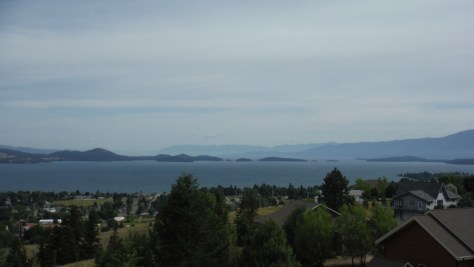
Before the heat wave came in, we drove downtown, parked at the Safeway, and rode our tandem up Polson Hill on the rail trail, then west on the new bike trail section to Skyline Drive, 140 meters (460 ft) above the city, which made for a fast and long downhill, and then a long, gentle uphill back to the car, a short ride of 14.2km (8.8 miles), but lots of climbing.
Flathead Lake, from Skyline Drive, Polson.
On Friday, eight weeks since leaving home, we took a drive west to St. Regis to meet a friend from Idaho, to whom we had promised some of our cabin decor, and handed off the goods, along with our camping gear, which we will pick up on the way home next week if we have room after repacking the car.
Looking down from the cabin loft at the reconfigured living/dining area.
Aberdeen was a major rail hub in the 19th century, and birthplace in the late 20th century of the Super 8 motel chain. We stayed at the smallest of the three Super 8 motels now in the relatively small city, and went to the “original” to use the guest laundry services, so got to tour the city on the back streets on the way. In the morning, we backtracked to the east side of town for our morning coffee fix, then off toward Montana, crossing the Missouri at Mobridge, one of the few bridges across the river, and into the Mountain Time Zone.
We had early lunch/late breakfast, depending on which time zone you came from, in northwestern South Dakota, where a poster on the wall proclaimed this “Reagan Country,” a reminder that the Conservatives are determined to turn the clock back at least 40 years, and have succeeded in some parts of the country. For us, that would mean a world without Starbucks or the Internet, among the other more political issues, so we quickly moved on west in search of the 21st century again.
Espresso at Lawler’s Coffee and Tea, Baker, Montana
A brief passage through the corner of North Dakota and badlands reminiscent of the Badlands of South Dakota and the Teddy Roosevelt Park further north, and we were at last back in Montana. The first town we came to, Baker, had a coffee shop serving espresso and WiFi: we had successfully navigated the time warp and returned to our own time. However, we still have nostalgia for the “good old days,” i.e., the 50s and 60s, before the Interstate highway system isolated small towns and homogenized America, so we had been avoiding highways starting with “I-.” However, we did find ourselves on I-94 between Miles City and Forsyth, where US 12 has been absorbed by the newer road.
Rosebud County Courthouse, Forsyth, Montana
Leaving Forsyth, we realized we had 150km ahead with no guaranteed fuel stops, so turned back to fill up before moving on to Roundup, our destination for the evening. Our motel, booked through one of the newer Internet services, turned out to be another chain franchise enterprise that had succumbed to the recession and was now being slowly rehabilitated as a mom-and-pop operation. This one only had a few rooms ready for occupancy, but they were clean, with new carpet but nearly worn-out linens and towels stacked on the closet for lack of towel bars. The owner said they had started in April, with a huge mess, but were proceeding with a focus on quality before quantity. Now, this part of a “return to the past” we don’t mind–the Internet has equalized the marketplace so that we no longer have to depend on name recognition as a mark of quality and consistency: the very thing that gave rise to the Super 8 motel chain 40 years ago and that late-comers to the chain/franchise market had forgotten was the reason for their success. On-line reservation systems are now a free market, not the purview of large corporate mainframes, and online guest reviews provide a measure of quality. The upside for travellers is a variety of accommodation, rather than travelling hundreds of miles to stay in a room identical to the last one.
Autumn’s Inn, the “& Eatery” sign either temporarily or permanently removed during renovations to the former chain motel, now a mom-and-pop operation.
Having passed through the timezone the day before, we awoke early and set off in search of breakfast and good coffee, which we found 100 km down the road, at Harlowton, a bit bigger town. We had been following the trace of an old rail line along US12 since Forsyth, the tracks long gone. At Harlowton, we learned that this had been a main switchyard for the Milwaukee railroad 100 years ago, where the coal-fired steam engines turned over their west-bound loads to electric engines, which provide pollution-free passage through the tunnels under the Rocky Mountains,to Idaho and later, the Cascade Range into Seattle. The electric engines were also powered by hydro-electric generators, so the savings in fuel cost offset the cost of electrifying the mountain crossings. Unfortunately, the smaller Milwaukee line was in competition with the older Great Northern railway, whose tracks ran parallel and which served more towns along the way, and the Milwaukee/Soo line eventually went broke, depending entirely on long-distance loads, and lower operating costs that never quite offset the capital investment in technology.
An electric locomotive on display in Harlowton, Montana, to commemorate the use of electricity to carry trains over the slopes and through the tunnels in the Rockies during the early 20th Century. The transition from steam to electricity was successful, but other economic factors led to the railroad’s demise at the dawn of the Diesel age.
We stopped for fuel again in White Sulphur Springs, birthplace of the late novelist Ivan Doig, as the next town, Townsend, was again too far. Through Montana’s capital, Helena, we climbed over the continental divide and turned north at Avon, leaving US 12 to pick up MT 200, to avoid the merger ahead between US 12 and I-90 into Missoula. At Missoula, we stopped for late lunch at the Good Food Store, one of our favorite deli stops on trips to/through the “big city” when we had lived up the Bitterroot Valley in the early 2000s. One of the reasons we stop so often at Starbucks in our travels, despite our penchant to sample local lodging and eateries, is that we know what they serve and we like it. One of the pitfalls of frequent travel and frequent moves is that you become attached to certain places to eat and simply have to wait until you pass that way again, or try to duplicate your favorite items at home. However, the appeal of these places is that they come up with new items that must be sampled: now we have new dishes to try to replicate from memory when we get home.
Finally, seven weeks into our grand tour, we arrived at our little cabin on the side of the mountain and spent a restful night in a familiar bed, though we hadn’t slept there in nearly a year and a half, since before my surgery last year. Since we hadn’t cleaned up from fumigating the cabin before we set off for new Mexico six weeks ago, we went into town in the morning for coffee and breakfast, as well as Internet access. Our standard stop in Polson is the Safeway store, which has an in-store Starbucks and fast WiFi, but no electrical outlets in the customer cafe seating area, so we don’t stay too long. Of course, later in the day, we visit with Rick and Ben next door. where there is running water and electricity as well. Today we wait for more family to arrive from the East Coast for a week of celebration, before we head back to Washington.
Heartland Trail, Park Rapids Trailhead in Heartland Park
Park Rapids is the western terminus (for now) of the Heartland Trail, a rail trail that extends east to Walker and north to Cass Lake. We rode the first 20km, to Dorset and Nevis and back, for a total of 38km.
Snapping turtles love Minnesota bike trails for warm burrows.
Nevis had a nice coffee shop, and Dorset, a tiny village on the trail, seems to depend entirely on trail traffic for its existence. We were once again treated to sighting of a huge snapping turtle emerging from his/her burrow along the trail near Lake Belle Taine. On our return, we went to the Bella Caffe in Park Rapids for an excellent lunch and more espresso. We then celebrated our “long” ride with trail-logo T-shirts from the Zula T-shirt shop, a bit unusual for us, but we got long-sleeve shirts to augment our wardrobe for cool mornings and many biting bugs.
Lots of hills on the Itasca State Park trail
With rain predicted for afternoon on Tuesday, we headed early to Itasca State Park, where we rode the 9km bike trail from the visitor center to the Mississippi headwaters, at the north end of the lake. The trail was not a rail trail, so twisted and turned up and down hills above the lake, making for an unhappy trip in anticipation of walking mosquito-infested slopes or crashing on curvy downhill runs. But, we made it to the headwaters unscathed and relatively unbugged.
The official start of the Mississippi River, at the outlet of Lake Itasca, elevation 450m, 4110km to the Gulf of Mexico.
On the way back, we discovered that the hills weren’t as steep going up as we had thought coming down. However, heavy braking was needed to keep not too far over the 25km/hr speed limit. A tense moment ensued when a group of cyclists coming uphill fast and in a cluster instead of single file rounded a curve ahead, which resulted in some fancy steering and cross-trail maneuvering to avoid an oncoming bike in our lane. After a stop to retrieve a water bottle that was ejected from its holder, we continued on, a bit more cautiously, but the trail ahead was only shared with squirrels.
The clouds began to roll in as we headed back to town for lunch at the 3rd Street Market, next to Bella Caffe, then to the public library so Judy could get connected to the Internet with her iPad, which has not been working in most motels and a few coffee shops the entire trip. This is a common complaint among iOS users, but Apple seems content with promoting magical incantations as a fix rather than seriously investigating wifi driver issues. Few of the Hogwarts solutions have worked, and those that have have been temporary. My iPad Air fell victim to one of the spells that affect Apple products, as it suddenly refused to wake up. Press all of the buttons at once with crossed fingers, as directed in one counter-spell, woke it up, but who knows for how long.
And so it goes. The rains came as we hunted for dinner with non-meat choices. After checking the menus as several restaurants, none of which served all-day breakfast, the default choice for ovo-lacto vegetarians, but we were directed to the local Mexican choice, a relatively new venue in the old armory building, which had a fairly complete vegetarian combo menu.
The rains ended overnight, in time for us to pack up and head westward toward our next appointment in Montana, a transition that will take several days. We decided to follow US12 this time, a route we haven’t travelled through the Dakotas, which means heading back south before heading west into South Dakota. The rain came and went on the way south, and the terrain became less wooded and more farmland.
US12, crossing Rush Lake in eastern South Dakota.
South Dakota was dotted with shallow ponds and lakes, much like the parts of North Dakota we have travelled through. We stopped fairly early, in Aberdeen, the third largest city in South Dakota, as the road ahead is largely empty except for the more expensive recreation area around Mobridge, on the Missouri River.
Our first morning in Staples, we rode the Legacy Trail, which follows the west side of town from near our motel to Legacy Gardens, a short ride of 12.3 km, but plenty long enough to be attacked by hordes of mosquitoes whenever we stopped. We stopped in the downtown at Stomping Grounds coffee, then cleaned up and went to Baxter, for a little shopping–used books, more coffee (Starbucks!), and to check out the town of Brainerd, across the Mississippi River.
Brainerd
Driving by a bike shop in Brainerd, we noticed an ELF, an enclosed electric-assist tricycle, parked outside. The owner, a woman about our age, was on a two-year exploration of the upper mid-West and had stopped to get a tune-up. What a neat idea–the machine is heavy, so electric assist is necessary, and the company does make a two-seat version, but the back seat is for a passenger, without any power input, and the payload is 160kg, limiting the machine to two skinnier people and no baggage onboard.
An ELF, on extended tour…
On our second day, we set out for the trailhead for the Paul Bunyan Trail, following signs off Highway 371 just north of Highway 210. However, the road was closed for reconstruction, and the detour signs were cryptic and misleading. Finally, we found the path through the construction zone to the Arboretum parking lot, which was also the trailhead.
Paul Bunyan Trail
We headed north to Merrifield through a pine forest on a nearly level railbed, meeting a number of cyclists and runners along the way, and a very large turtle. On our return, we stretched the ride to make exactly 30km, about the limit for saddle time and power output for our current state of training. Lunch at Starbucks and back to Staples to change clothes for our late afternoon appointment.
Turtles seem to like the warmth of the paved trail for their burrows.
We met my cousin in Motley, where our mutual great grandparents are buried, and visited the family plot. We also visited my grandfather’s and great-grandfather’s gravesites nearby, Then, we drove north between Motley and Pillager to where the Pietz brothers had their farms. None of the original buildings has survived, but we stopped near where great-grandfather Adolph had his farm and where I remember visiting in the 1940s and early 1950s (he passed away in 1953).
family plot, in Motley
On the third day, we left Staples and drove back to Baxter, then north to Bemidji for lunch, passing Cass Lake on the way. Cass Lake is the eastern end of the Heartland Trail and Bemidji is the northern end of the Paul Bunyan Trail. We drove southwest in rain to Park Rapids, the western end of the Heartland Trail, where we will be based for the next couple of days.
Paul Bunyan and Babe, the Blue Ox, characters from folk tales of early logging, and a waterfront fixture in Bemidji since 1937.