Category Archives: Travel

Expedition 2022, part 1: California, Here We Come.

At the start of Year 3 of the ‘Rona Plague (COVID-19, COVID-20 (aka SARS-COV2-d) , COVID-21 (aka SARS-COV2-o), we began scrapping our plans for a grand tour to visit relatives we haven’t seen in two years, and especially events involving large groups of people who may or may not be vaccinated and who may or may not wear masks indoors and may or may not have variant π or ρ, or whatever the next wave of new highly infectious or highly virulent strain of SARS-COV2 pops up to ravage the unwary.

Viruses are like that, especially RNA viruses, which come in single strands of RNA, thus have no repair facility. RNA viruses therefore mutate rapidly under evolutionary pressure, rendering last week’s anti-viral treatment and last month’s vaccine useless, spreading even more easily to those it doesn’t kill outright. Avoidance of exposure and limiting the replication rate through vaccinations that bolster the immune system is the only way to slow the rate of change and rate of spread among the population.

Therefore, we mask, and we avoid, and we vaccinate. Our avoidance technique doesn’t involve isolating in our home or on a mountaintop, but simply not exposing ourselves to strangers as much as possible. We still can travel, but we camp and stay at our timeshare resorts, where we have our own kitchen. We stay out of restaurants and shop “in person” only when necessary.

So, Expedition 2022 is very much like Expedition 2021, with even greater precautions. We’ve increased the size of our refrigerator to reduce the need to shop for food so often, and added electrical capacity to our camping van to enable us to camp off-grid or at less-crowded camping facilities, including boondocking, moochdocking (parking in driveways of friends and family to avoid long indoor exposure), and overnighting in rest areas and parking lots of businesses and jurisdictions that permit such use. It’s not something we’re totally comfortable with, but the days of eating out and staying in motels is over, perhaps indefinitely, if not forever.

Van upgrades: New, larger refrigerator with built-in thermostat replaces the tiny “back seat” car ‘fridge.

We’re also older, so we don’t travel as far every day while on “Expedition.” We need to keep lodging and meal costs to a minimum when it takes twice as long to get to some specific distant destination. Unfortunately, inflation and the fact that a huge number of other people have the same idea makes food, fuel, and campgrounds much more expensive. Campgrounds now cost as much or more than we used to pay for motels, take-out ready-to-eat meals are as expensive as fine dining used to be, and carrying our accommodation with us reduces our fuel efficiency from 40 miles per gallon to less than 20, and those gallons cost at least a dollar more each than they did a few years ago. As pensioners, our income is the same as it was in 2010, while everything as gone up at least 20% if not doubled since then.

Nevertheless, our “need to wander” found us on the road again in mid-January, headed south for milder weather and flat terrain where we can ride our bicycle and avoid other people. The big issue is finding inexpensive and legal places to park our van, which will determine how long we can afford to extend our travels.

To friends and family, we’re sorry: another year of minimal contact is before us. But, we hope to keep in touch and share our adventures through social media, videos, and blogs, and are eager to hear how others are coping with “The Way Things Are.”

Elk in the campground at Fort Stevens, Oregon

Day 1: Eager to get on the road and have time to explore, we ducked out in the middle of one of our many virtual meetings on Zoom to head for the coast, crossing the Megler-Astoria Bridge across the Columbia River into Oregon, where we had time to refuel (Safeway Reward points go a long way with a big fuel tank) and select a campsite before dark. Being off on the spur-of-the-moment, more or less, we couldn’t make a reservation, but Fort Stevens has two loops set aside for no-reservation campers. We picked N-29, right next to N-31, where we stayed a bit over two years ago on a whim. We had time for a short hike around the loop and to the nearby Coffenbury Lake, one of the long, narrow lakes that form between the ranks of dunes along the northwest Pacific coast near the mouths of great rivers.

Evening hike along Coffenbury Lake, near camp.

Day 2

The clear night dropped the temperature to near freezing, so we didn’t linger in the morning and dropped our plan to ride our bicycle on the relatively flat peninsula. We elected instead to do some sight-seeing along the coast, rather than just drive through the two-lane, twisting, up-and-down US 101. Of course, being the first sunny Saturday in a long time, all of the coastal beach towns, beaches, and trailheads were parked up and overflowing as Portlanders rushed out of the city to the beach.

Neakahnie Beach, Oregon Coast.

We had trouble finding places to pull over and eat out of our food stores in the van, and certainly no way to get to a beach. The highlight of the day was a brief excursion off the highway to revisit the Latimer Quilt and Textile Center outside of Tillamook, a favorite stop on the coast and a destination for some of our trips in the past century. We also found a spot to “eat lunch on the beach,” a muddy parking spot at a fishing access point far off the Three Capes Scenic Route. At that, we pulled into the last parking spot as someone was leaving and another was waiting as we pulled out.

Mural at Latimer Textile Center, Tillamook, Oregon

We had made reservations at an RV campground near Waldport, which, when we arrived, was nearly deserted, but at least we had a packet waiting for us outside the closed office. We made a quick photo op dash across the Alsea Bay Bridge, a 1991 replacement for one of the iconic Art Deco and Gothic bridges that span the bays and rivers along US 101, dating from the 1930s when the highway was built. Although the day warmed up, sunset brought a chill, and we’re glad we installed a small electric heater.

Alsea Bay Bridge, Waldport, Oregon

We’ve discovered we forgot to pack a lot of things we normally bring with us, but are making do without. We both forgot the computer mice, but I keep two spares in my bag [having done this before], so we’re good. So far, we’ve managed to keep comfortable and fed, though with cold meals and boiling water for tea outside (I also forgot our small electric kettle we picked up a couple of years ago but rarely use). Our portable power unit AC inverter seems to have gone on strike, but so far we’ve had electrical hookups in camp, so not missing it—yet. The power failure is disappointing: it was an expensive addition, but with inadequate capacity and now malfunction. So it goes.

“Coffee Outside,” one of the joys of camping.

Day 3

We continued down the Oregon coast, lingering a while on the town boardwalk and pier at Bandon, since it was a warm and sunny day. Crossing into California, we checked in at our RV campground, a few miles north of Crescent City, then drove downtown to ride our bicycle along the beach road between the lighthouse and St. George Point, grabbing some ready-to-eat from the local grocery before settling in for the night.

Day 4

Forgetting that California has the highest fuel prices in the US, $5.00/gallon, rivaling those of Canada ($5.32USD/gallon), we consulted our pricing app, and gassed up at a tribal station a few miles south, with the lowest prices in the county. Even so, the pump shut off before the tank was full: there’s a $100 limit on debit/credit purchases. We topped off at Costco in Eureka, which was a few cents lower, for another $25, and picked up some supplies.

Judy is dwarfed by the root ball of a fallen giant redwood.

The rest of the day, we took the scenic drives through the redwood forests, both State and Federal, then down into increasingly urban Northern California, arriving on schedule at Windsor, where we would spend the next week exploring Sonoma County by van and bicycle.

Day 5

We checked out Healdsburg, an old winery town to the north, getting our bearings on the surroundings.  We confined our shopping to a few inexpensive tools at the kitchen shop in this touristic little town.

Day 6

A bicycle day: we rode a loop route from the resort to Riverside Regional Park, a hilly excursion past many wineries and fields of grapes. At the park, we tackled the gravel trail through the park, though the complete loop around the lake was blocked off on one side for habitat restoration.

Day 7

In the van again, we scouted out places to go to the south, getting lost in Santa Rosa and making our way in a circuit to check out the trails near Forestville and Sebastopol.

Day 8

A bicycle day, riding the Joe Rodota Trail, an old rail line between downtown Sebastopol and downtown Santa Rosa: the last mile on the Prince Memorial Greenway, to the Luther Burbank House and Garden, where we enjoyed looking at plants blooming much earlier than at home. Within the city of Santa Rosa, many of the trail users were unhoused folk, much as we see on the urban trails in Olympia. But, the trail was a delight, pedaled with much less effort (max heart rate: 108) than the hilly rural loop through the wine country around Windsor (max heart rate 160).

Day 9

Off to Guerneville, a village on the Russian River, in search of eclectic bargains, which we found, along with the ever-present array of homeless on the streets and in the parks.

The old CA 116 bridge, Guerneville, CA, now part of the riverfront park

Day 10

Another van excursion, stopping first in Santa Rosa at Costco for $4.50 gas (which didn’t fill the tank: $100 limit) . We went west, to the village of Bodega, the setting for Alfred Hitchcock’s film “The Birds,” where we also found an artist’s co-op and a coffee shop with great chai and yerba maté .

The church at Bodega, featured in the 1963 Alfred Hitchcock film “The Birds”

We continued on to Bodega Bay and up the switchbacks and dizzying views on CA 1 along the cliffs and canyons north to Fort Ross (Крѣпость Россъ), named for the Russian Empire. The fort was a Russian colony built in the early 19th century to supply Russian outposts in Alaska with food and furs. The fortification was necessary to keep the Spanish colonies in the San Francisco Bay area from encroaching on their territory.

California coast, between Bodega Bay and the Russian River

The soil proved too barren to be profitable, and the land was sold in the early 1840s to American developers. But, the Russian influence on the Sonoma Coast continues to echo today. The fort was restored in the early 20th century as an historical park, and is maintained in “like new” condition. We traced our way back up the Russian River through Guerneville, following our previous bicycle route back to the resort. We spun our wheels briefly on the one short steep climb, so didn’t feel bad about having had to push our bike on that one.

Fort Ross: officer’s quarters and chapel

Day 11

After another “informational presentation” at the resort that devolved into the usual ruthless sales pitch, we stood firm against upgrading yet again, and were summarily shown the door, starting our journey back north with the usual foul mood that follows otherwise pleasant stays at these venues, when we’ve been trapped into the high-pressure sales tag-team sessions.

By now, we had decided that winter camping was expensive, so headed north instead of venturing inland or farther south. Not wanting to repeat the harrowing section of the coast highway between Jenner and Fort Ross again, we drove up US 101 to Cloverdale, and headed west. The first half of the mountain road had a few switchbacks, but was relatively tame. The GPS directed us to the southwest at Booneville, where we took a cookie break at the bakery. The rest of the route proved to be a narrow, winding rough path with many switchbacks and 16% grades, which triggered Judy’s innate fear of such roads.

Certificate the KOA gives out to guests who followed their GPS on the harrowing and steep mountina road “shortcut” from Booneville to Manchester.

When we finally arrived at the coast, the camp host presented her with a certificate of achievement for having endured the route. We took a short walk toward the beach in the chilly gale, but soon turned back and battened down for a cold and windy night.

Manchester Beach dunes
The cold and windy low dunes near Manchester Beach, California.

Day 12

Electing not to try to make coffee outside in the chilly morning, we continued north to Fort Bragg, the last and only reasonably-sized town on the north coast highway, stopping for coffee and to replenish our supplies before another hair-raising, frightful twisting and turning switchback-laden journey over the mountains back to US 101, where we picked up hot lunch at a grocery deli in Garberville and had a reprise of our trip through the Avenue of the Giants before camping near the Eel River just north of the state park. Electricity for our heater necessitates seeking out commercial RV parks with hookups. This one was reasonably priced, but no cell service for the second night in a row, and no WiFi, of course. The previous night, WiFi was available, but at about $1 per minute, speed limited. No thanks. At tonight’s camp, it was cold, but sheltered enough to brew up a moka pot of coffee before yet another cold meal.

Camp near the Avenue of the Giants, Humbolt County, CA

Day 13

The day dawned cold, but we managed to get coffee brewed and the condensation off the windshield, then off on US 101 north, into Oregon. After two days and nights with no phone service and no WiFi, we used the paper campground guide and set course for a mid-afternoon arrival at an RV park in a grove away from the coast and between two small towns: affordable and relatively deserted this time of year. Clouds dispelled the sunshine of the past week in California, and the campground showed signs of recent heavy rains. We were beginning to feel more like home. Unlike the last two nights, the restrooms were heated, very clean, and the showers were hot. We leveraged our grizzled looks to score the campsite closest to the restrooms, as we often do. We have WiFi, though severely throttled as is usual with RV campgrounds, and spotty phone service. We’re settling in to shorter days on the road.


We had to add a few gallons of fuel to get us over the border, then filled up in Oregon, though only $0.50 a gallon less than we paid in California. At least we got a full tank without hitting the $100 card limit, but just barely. So far, we’ve put over $400 in the tank, and camping has cost us nearly as much as we used to pay for motels in the Before Times. California was fastidious about COVID rules and masking: Oregon, not so much. We’re thinking spring and warmer temperatures may see us staying close to home and camping without electric hookups.

Day 14

Breakkfast on the Boardwalk, Bandon, Oregon.

It occurred to me, as I arose in the chilly and damp morning, that the weather had turned back to normal winter on the coast, and that we could, if we headed inland to I-5, make it home before dark, so we packed up, headed to Bandon, 20 miles north, for breakfast in the truck on the boardwalk, drove in thick coastal fog north, stopped for coffee at Coos Bay, where the fog cleared, and turned inland at Reedsport, following the Umpqua River to Drain, then through a tunnel into the Willamette Valley and I-5, south of Cottage Grove. We stopped at the Winco in Salem for some ready-to-eat lunch: no non-meat hot lunch (disappointment!), so we got a couple of yogurt parfaits and a pumpkin pie, which turned out to be frozen solid. Nevertheless, we ate, got back on the road, joining the freeway melee through Portland and across the Columbia into Washington. We rolled into our usual Costco in Tumwater on fumes, refueled for just under $100, and got home in time to pick up our mail at the post office.

Epilogue:

Cold house (we turned the thermostat down before we left). Cooked a hot meal, for a change, fell asleep in my chair next to the fireplace as we reheated the house, to bed early.  [Afterword: Thankfully, we came home early, because the furnace went out two days later, on Sunday morning, filling the house with the odor of burning motor wiring and prompting an after-hours charge to have the blower fan replaced.]

We have a few more things we need to do to make the van a better travel and camping venue, like more battery or A/C lighting for the back of the van, and a better means of securing our new refrigerator for travel. We found we needed to empty and stow the dehumidifier when in motion, as it tipped over when nearly full when mounting a ramp into a parking lot. We’ll probably liberate a small electric vacuum to take care of the tracking in from campsites, and maybe an outdoor rug for longer camp stays.

The new battery worked great to keep things running without draining the power unit. But, sadly, the A/C inverter in the power unit failed to switch on, leaving us with only shore power or DC for the trip. It’s under warranty, but a nuisance to deal with failure less than a year into this new setup. We also have some DC plugs that don’t work for some reason.

We found that the little 375/750-watt heater we put on top of the cabinet worked better if we turned on the 12-volt fan also on top of the cabinet, to push more air to the back of the van. Since we aren’t using the small back-seat refrigerator anymore, I can re-purpose the thermostat from that and reprogram the computer to turn on the extra fan for heating or cooling to circulate more air in the van interior. We can also use that to control the ceiling vent when we get that installed after the rainy season is over.

Using the satellite radio with a FM transmitter to play on the van radio worked fine, but we probably need to find a more seldom-used frequency: we’ve passed a few stations on the same frequency that have swamped our little unlicensed signal in our travels across the country. We also need to remember to bring our portable radio so we can listen to radio in camp when the van radio isn’t on.

Because of the need to run supplemental electric heat in winter, we stayed at paid RV campgrounds and state parks that offered electric hookups instead of trying to find dry, “stealth,” or boondocking camping opportunities. The current high price of fuel and the increasing cost of campgrounds with amenities makes extensive travel cost-prohibitive, despite avoiding restaurants.  Still, we have that wanderlust to satisfy…  Stay tuned.
Road Trip 2019, Part 1, chapter 2

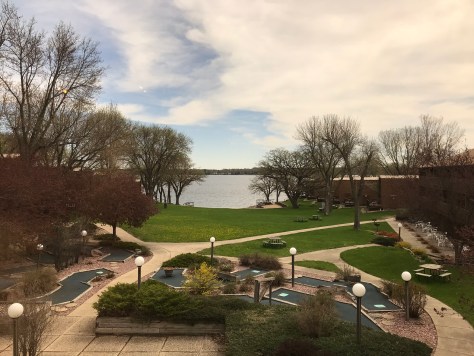
Day 9: Mitchell, SD to Spirit Lake, IA. Not a long drive, but the rain that has chased us all week comes and goes. We stop in Sioux Falls for fuel, our fifth fill-up since leaving home and our most expensive category so far. We decide to head south, taking Highway 18 this time: we’ve been across Iowa Highway 9 before. The rain catches us at when the route jogs north or south. We’ve traveled this area before, headed for the Starbucks kiosk in the Hy-Vee supermarket in Spencer, and restocking the groceries for our stay a short way north, on the west shore of Lake Okoboji, the gem of the Iowa Great Lakes.

I grew up just over the state line, in Minnesota. As a teenager, my buddy and I would drive down to Arnolds Park, an amusement park and namesake town on the south shore of Lake Okoboji, just to watch how people with money spent theirs. Of course, we did have to explain to our parents why we were two hours late coming home from Boy Scouts. I don’t think I spent a dime at Iowa’s playground then, and haven’t since we have passed through several times in this decade, including three years ago when we stopped by on a late Sunday afternoon with our 15-year-old grandson. He declared the wooden roller coaster a death trap. But, it’s been a popular tradition for generations of Iowans, since 1927.

Day 11: The rains came again, with a vengeance. Flooding is a big problem in the midwest. Although we think the bumps are hills, the region is relatively flat, the ground is saturated from the winter snowmelt, and the rains run off into the shallow river valleys, where the rivers spread out and up to make things miserable for residents and travelers.

Our resort only offers complimentary WiFi in the lobby, so we have made our daily pilgrimage to the main building to connect the computers to the Internet. We have our phones, but two weeks on the road have depleted our data plan for the month already. We have resigned ourselves to bumping up our plan, but still have three weeks before it rolls over, so prudence is still required.

Day 11: It is still cold in the Midwest, but the rain has subsided for now, so this is our big ride day. Two years ago, we camped in our van near the lake and rode our bicycle around, counter-clockwise on the Iowa Great Lakes Trail, missing a few kilometers due to a blown tire and a Good Samaritans’ lift to the bike shop in the town of Okoboji.  We set off around the lake, clockwise this time,  After it warmed up a bit, we headed north on the paved concrete bike trail, clockwise around the lake this time. The trail switches to the west side of IA-86, diving under through a tunnel which is, thankfully, dry. A few miles later, past farms and a golf course, it dives back under the highway to end in a residential area of RV parks and beach cottages. The route follows the roads around the north end of the lake, resuming as an off-road trail through the prairie and a nature preserve before crossing US 71 at a traffic light. So far, the trail has been rolling, but soon turns south onto a rail-trail that takes us into the town of Okoboji, swinging out to follow US 71 through town. The route signs take us through a beach condo parking lot and across the bridge between the east and west arms of the lake to the town of Arnolds Park. The trail turns left at the town cemetery to wind around Minnewashta Lake, crossing a bridge between Minnewashta and Lower Gar Lake. The trail soon dumps us back on a road, headed west. We climb a long hill, past—as we later discover—my cousin Jack’s house, cross US 71, and wind around the south end of Lake Okoboji through the West Okoboji beachfront, then out to follow Highway 86 north past where our 2017 ride ended in a tire blowout, then through the hills, prairie, farms, and fens on the west side of the lake.  No issues this time. We get in the full 33.4 km circumnavigation of the lake. It seemed a bit more hilly this early in the season, but we managed to make it up all the bumps on our wheels.

Day 12: Rain, lots of it, and door-hinge-busting wind. Our plan of the day takes us to Rabab’s for lunch, a  newly renamed (formerly Chick’s) bistro on US-71 on a spur of the bike trail just north of where we crossed yesterday. It’s a few weeks ahead of the tourist season in the Iowa Great Lakes, so many businesses aren’t open at all, and those that cater to the locals off-season are only open two or three days a week. The place is crowded, as the outside patio seating is rocking back and forth in the gusty deluge. Unlike the usual midwest fare that gives you a choice of one or all three main locally-grown food animals, liberally seasoned with bacon, the menu serves up big-city hipster dishes like avocado toast and “southwest” salads, topped with egg, of course. Someone has to eat all these farm products…

After lunch, we visit the nearby nature center, which we had ridden past the previous day. By some fortune, our visit is between hands-on sessions for toddlers and pre-schoolers, so we wade through the piles of confetti and wend our way around tiny tables covered with plates of prairie humus (aka plain old dirt) and wildflower seeds to look at the tanks of turtles, cases of small-animal skeletons, and lifelike examples of local fauna preserved with the taxidermist’s art. Hands-on children’s exhibits are fun for adults, too, as we stroke pelts of badger, fox, coyote, and other beasts we only see in fleeting moments on the bike trails.

Day 13: Another blustery day. Thanks to social media, we are informed that my cousin Jack Parkins—who I thought was in Arizona, having lost track of him 20 years ago—was living nearby, In fact, as noted, we had ridden past his Iowa house on Tuesday, where he and Sue spend summers, when not at their Arizona residence.  We meet them for lunch and a pleasant afternoon catching up on a lifetime. Jack, who is six years older, had taught at Mankato State College in Minnesota before becoming a snowbird and settling in a retirement home in the summer playground we all grew up in. As elderly folks do, we compared health and medications, finding—being close relatives—we have a lot in common. Reluctantly, we cut our visit all too short, as we had a dinner date across the border in Minnesota, with 98-year-old Aunt Jo, my mother’s sister-in-law, and cousin Cathy and her husband Bill. We hadn’t expected to see Bill this trip, but his planned activity of the day, relocating game bird stocks, was cancelled because of the bird-walking weather. Apparently, the wild game I remember as being so abundant in my youth now are reared in pens like fish and the fields stocked to satisfy the demands of 21st-century hunters and fishermen.

Pizza, BBQ, and “Coney” (hot dog slathered in BBQ) night at the veterans club, with the usual choice of Chicken, Pork, Beef, or all three, the quintessential Minnesota comfort food, presented its usual dilemma for the strict vegetarian, so dinner for me was a heavily salted soft pretzel dipped in chipotle seasoned liquid nacho cheese, which made a reasonable substitute for the yellow mustard I remember from my years in New Jersey, back in the 1970s. But, we had a good visit. It’s Aunt Jo’s weekly night out, and we had a good visit, holding our own against the boisterous crowd of younger folks (Jackson High School Class of ’65, still wild at 72) behind us, and the bar did have a few bottles of Guinness to satisfy us aged western hipsters who don’t drink “beer you can see through.”  But, it was great seeing everyone this trip.

Day  14 dawned cold, but clear.  After it warmed up a bit, we suited up and headed for a trailhead, Kiwanis Park in Spirit Lake, and headed north on the Iowa Great Lakes Trail, a rolling and sometimes winding trail that is partly on the road around the west side of Spirit Lake (the body of water).  Across from Minnewakan State Park at the north end of the lake, we cross into Minnesota on the Jackson County Trail, which follows the roads and then meanders along the creek between Loon Lake and Spirit Lake.  We stop at Loon Lake for a snack and to enjoy Loon and Pearl Lakes at Brown County Park.  When I was in Boy Scouts, 60-65 years ago, our troop spent at least a week each summer on the east shore of Loon Lake, where a farmer had graciously let use his lakefront.After our snack stop, Judy’s saddle fell off the bike, 16 km from the car.  Fortunately, all the parts were intact; one of the seat rail clamp screws had loosened and fell out while we were stopped on the paved trail.  Out came the tool kit and the repair was quick and successful.   The trip back was much more enjoyable than pushing a broken bike would have been. We chatted briefly with another grandfatherly cyclist we met at the top of the steepest hill while stopped for a scenery view.

Back at the condo, we started packing for the next stage of our road trip, destination Orillia, Ontario, beginning our third week on the road.

To be continued…

Road Trip 2018: Part 1 – Southwest

Hoping for some time to ride our bicycle this winter, we packed up our van “White Knight” for our annual circuit through the Southwest to visit relatives.  As usual, our schedule was full to the max: we left immediately after the Olympia Weavers Guild February meeting, arriving in Pendleton, Oregon well after dark.

Our rather unrealistic plan for this trip was to camp in parking lots and truck stops along the way to save a few dollars to offset the cost of gasoline for the truck.  However, we were somewhat disillusioned on arrival at the travel center outside Pendleton: it was cold and windy; the parking lot sloped a bit more than we would have liked, and the only seating area in the center was in the McDonalds restaurant.  Feeling a bit out of touch with the reality of 21st century truck stops and nostalgic for the 20th century when such places had full-service restaurants, we drove back into town and checked in at a renovated 60’s motel.  The building winter storm across the West changed our plans quickly to include nightly stops in a bit more comfort.  Fortunately, winter lodging prices promised to be less of a burden on our travel budget.

Snow

In the morning, we returned to the truck stop to refuel.  Oregon is one of two states (the other is New Jersey) which outlaws self-service fueling.  But, this year, the legislature exempted certain rural areas, which Pendleton is not, but the truck stop is on and operated by the Umatilla Nation, which has its own rules, so we finally got to pump fuel legally in Oregon.  A small satisfaction.

The climb over the Wallawa mountain range brought snow, lots of it, over Emigrant and Deadman passes, with occasional rain through the valley.  After lunch in Ontario and picking up a few groceries, we headed across Idaho.  The speed limit on I-84 is 130 km/hr, but we usually keep our speed under 105, to save wear and tear on the 22-year-old truck and get better fuel efficiency as well.  The trip settled into stopping every 600 km and taking on 90 liters of fuel.

Fortunately, fuel cost in the American West is kept reasonably low, averaging between $0.60US and $0.70US/liter in the Rocky Mountain region, varying between $0.55/liter (west Texas) and $0.88/liter (southern California).  Staying at older motels, and foraging in groceries keeps our out-of-pocket travel expenses under $125/day, despite the higher fuel consumption.  The only way to reduce this would be free camping in parking lots, which isn’t going to happen with the return of winter weather.  Using motel chain loyalty cards and making on-line reservations keeps our motel costs to sometimes less than camping in commercial RV parks, when you consider motels usually provide some sort of coffee-and-doughnut (or waffle) breakfast.

With the storm licking at our heels, we pressed on, crossing into Utah at sunset.  We had estimated we might reach Ogden this day, but the slow progress in snow and the prospect of driving late and tired in heavy traffic revised our estimate a bit.  Weary, we pulled off I-15 at Brigham City to Cheap Motel #2.  This one bore the name of a once-prestigious chain of motels and family restaurants that spread across America with the construction of the Interstate Highway system in the late 1950s and 1960s, along with many other lesser-known chains that also still exist.  Most of these are on near the center of cities, on the old highways that now serve as main streets of decaying cities.

Our room was small, with the usual sticky doors warped with age and abuse.  The standard motel air-conditioning system was defunct, so there was a small space heater supplied.  Like many of these refugees from the age of family car trips, the sheets were thin, the towels threadbare, but there were no funky odors or loud neighbors (the motel was nearly deserted, making one wonder what state the other rooms were in if ours had make-shift heating).  Breakfast was adequate–we ate alone in the tiny lobby: no pretense of a breakfast room here, and no TV blaring out CNN or the morning talk shows we only know of because we travel and they are on in hotel breakfast rooms.

After our usual stop at Starbucks for coffee (espresso is kinder to our constitutions than brewed coffee, so we almost never use the motel coffee service), we are on the road again.  Not so long ago, it was difficult to find a decent coffee shop between the Cascade Crest and the Mississippi River, or at all in the Beehive State, but Starbucks has rolled into Utah on the wave of all the other food chains and big-box outlets.  The most common place to find them is in supermarkets, and this was no exception.  But, we were surprised to find one in one of the largest purveyors of milk and honey in the heart of the Mormon empire, indeed within the shadow of the local Temple.

We got an early start to run ahead of the snowstorm forecast for later in the day. We turned off I-15 at Spanish Fork, headed up the canyon on Highway 6 toward a blue hole that promised better weather. We stopped for lunch at Moab, where the skies were clear, but the wind blowing stiffly. We ended the day at Cortez, Colorado, which we had bypassed before but not stopped.

The morning dawned cold and still windy, with snow forecast there, too. We stopped for fuel at the Ute Nation casino just north of the New Mexico border, turning east at Shiprock and southwest at Farmington, headed once again on a four-lane highway toward Albuquerque. The wind continued, pushing the morning’s rain squalls ahead of us. We caught up with the rain at Cuba, despite pulling off the road briefly for lunch from our on-board larder.

In Albuquerque, we bypassed the city on the Tramway loop, checking out the bike path that skirts the east side of the city, realizing that the path climbed more than 100 meters above where we would be staying. Our meeting with our granddaughter wasn’t for a couple of days, so we settled in to plan our stay. The next morning, there was a dusting of snow in the parking lot, so we explored Old Town, checked out the riverfront bike trail, had lunch back on the east side, visited a Nob Hill yarn shop.

The next morning, the weather looked a bit more promising, so we bicycled the north half of the Paseo del Bosque trail, meeting our granddaughter and her new daughter-in-law for lunch in nearby Old Town after, and visited the Aquarium and Biological Park next to the trail with our youngest great-grandson and his somewhat older new nephew. On the way back to our hotel, we had the oil changed in the truck, as it was due, and picked up some supplies for the continuation of our Southwest adventure.


The Parkins Report: Events of 2017

As we move into the beginning of our ninth year of “retirement,” we are finally learning to take life as it comes, with minimal rush.  This includes being involved in activities that satisfy us, rather than from some sense of obligation or need (although there is still plenty of that to go around).

Travels

This year was again a year of travel. In January, we headed south the day before Inauguration Day.  The drought had broken in California: we drove in slushy snow in the north and rain in the central and southern parts of the state. The first week, we took Judy’s brother-in-law Ben from Anaheim to San Diego to visit her cousin Margaret, then headed east to New Mexico and west Texas: Las Cruces, El Paso, and Albuquerque, to visit Larye’s children, grandchildren, great-grandchildren, and great-great grandchild.  Then, it was back to California, via Flagstaff and Bakersfield, then through rain again to San Francisco for a week exploring the city before driving home.

While at home, we worked on our van conversion project, building a folding sleeping platform with room beside it for the bicycle. In April, we made a test run to Idaho, camping overnight to and from McCall, where we spent a week with our friends Gary and Char at a timeshare, getting in a couple of short bike rides despite the snow and wet of central Idaho. We toured the Painted Hills of central Oregon on the way back. While training for the summer bicycling season, we had a frame failure on our Bike Friday, prompting a trip to the factory in Eugene to have it repaired. That trip showed us the old van was not ready for our ambitious touring schedule, so it was back to the shop for some major repairs on that, too.

While our bike was in the shop, we dusted off our 31-year-old Santana tandem for a scheduled charity ride and ended up taking it to Victoria, Canada when we attended the Association of Northwest Weavers Guilds conference over the Canada Day weekend. After the conference, we rode parts of the local trails we missed in the spring of 2010.

At the end of July, we set off on Road Trip 2017, starting with a detour to Eugene to pick up our Bike Friday, then off to northern Idaho for another week with Gary and Char at their vacation home. We soon discovered that our old van had no working air conditioning, so we spent the next six weeks of summer heat reliving the nostalgic days of yesteryear when turning on the “factory air” meant cranking the side windows down.

From Idaho, we headed east, spending a week in western Montana, visiting relatives, some also visiting from Florida and New York, visiting friends in the Bitterroot, and checking out the new Experimental Aircraft Assoc. chapter hangar at the Missoula airport. Heading southeast through Wyoming, we got in some trail riding in Nebraska and a weekend in Lincoln to be there for the total solar eclipse on Monday. After a brief stop in southern Minnesota to drop off a family heirloom with cousin Cathy, we worked our way through Iowa, riding around Lake Okoboji in the northwest, then the High Bridge Trail north of Des Moines. We drove down the Des Moines River, posing for Grant Woods’ American Gothic painting before turning north up the Mississippi River at Keokuk.

At the Quad Cities, we bicycled along the Great River Trail in Moline, Illinois and up Duck Creek in Bettendorf/Davenport, Iowa. We continued up the Iowa side of the Mississippi, then along the Wisconsin/Illinois border and up to Middleton, to visit son Matt and family over the Labor Day weekend, getting in one family bike ride in the process.

Crossing over the Mississippi back in to Minnesota, we stopped in Shakopee to visit a newly found cousin on Larye’s maternal grandfather’s side of the family. We bypassed the traffic around the west side of Minneapolis and checked into a campground on the south end of the Paul Bunyan Trail to ride up the trail to Baxter. The next day, we met with more of Larye’s cousins for a weekend reunion in Baxter and nearby Motley, near where the clan’s great grandparents had homesteaded.
Following the reunion, we rode some more of the Paul Bunyan Trail, starting north of Brainerd where we had turned around two years ago. The next morning, we headed to North Dakota to spend a couple of days with Judy’s cousin Fred and his wife, Ann. Smoke from the fires in Montana made visibility poor, so we pushed on west toward home, bypassing a return stop with the Montana folks to get home after a long trip, with the rain coming in and snow starting in the mountains.

The last weekend in October, we went to Astoria, Oregon to camp at and ride the trails at Fort Stevens State Park, in perfect weather. Our riding was cut short by the first flat on the front tire, which has lasted through two back tires, nearly 6000 km (3600 miles) in six years. The casing is a bit thin in the grooves, and a tiny puncture in the thickest tread: we “retired” it to secondary spare status.

By the end of November, our wanderlust struck again, and we retreated to Long Beach for a few days on the beach, on the edge of winter, one of our favorite times, since the crowds of summer are long gone.  In their place, however, is cold rain.  We also finally got talked into upgrading our vacation club membership, despite uncertain financial future of our status as elderly poor.

A return trip to Vancouver, BC in December capped the touring season, with Char joining us this time, Gary stayed home with a sick pet.

Travel Hosts

Between our own tours, we host international bicycle tourists through the Warm Showers network. We had 14 in April and May, then restricted visitors to “by invitation only” while we were preparing for our summer tours, picking up two more, a weaver from New Zealand we met on Facebook and a 69-year-old world traveler from Australia we met at the Olympic Bakery near Spencer Lake and invited to drop by on his way through Shelton.  On our return in the fall, we took in six more tourists before the rainy season and cold weather.

Transitions

As the rainy and cooler weather arrived in mid-October, Delia, our feline companion for the past 17 years, lost her struggle with kidney disease, just short of her 21st birthday. She had come to us in Missoula in the spring of 2000, a 3-1/2-year old “pound kitty,” wary of people in general. Over the years, especially after the demise of our other pound kitty, Nicolaus, in February 2005, she warmed to us and spent many hours of lap time in front of the fire. She also came to enjoy the attention of the many bicycle tourists who passed our way. She saw us through four houses and spent a lot of time “vacationing” at Pampered Pets in Darby, Montana and Just Cats Hotel in Olympia, where she was a favorite guest over the last eight years. She had been in poor health for about a year, but rebounded in the spring and summer, her favorite times of the year.

We welcomed a new great-great-granddaughter, Bea, in August, who we have not yet met. Bea joins her brother, Hyperion, in our growing and dispersing family. Visiting family takes longer now that grandchildren and great-grandchildren are becoming adults with their own households and schedules. Judy made a trip back to her hometown, Sunnyside, Washington this fall, for a family gathering of cousins, many of whom she had not met or had not seen for many years: Larye had a weaving class scheduled, so did not attend.

Lifestyle

For the first time in more than a dozen years, we have television, the result of upgrading our Internet service, which came bundled with a TV offer. The set is installed in Judy’s upstairs craft studio, which we furnished with a thrift shop small sofa. However, only a few available programs have piqued our interest so far, so the space has become just another reading room in the evenings. Public radio, both broadcast and satellite, remain our primary source of news and entertainment, along with selected video clips on the Internet.We continue to regularly practice yoga at the local senior center (when we are in residence), and attend the Ruby Street Art Quilters group in Tumwater. Judy completed a project for an exhibit at a brew pub in Olympia, and Larye finally finished a 2012 class project quilt as a baby quilt for Bea. We also joined the Friends of the Shelton Timberland Library this year and spend one afternoon a week sorting and pricing donated books and restocking the sale shelves, from which the proceeds support youth programs at the library.

We are still active in both the Olympia and Tacoma Weavers Guilds, and Larye manages the web sites for both. We both attended classes at the conference in Victoria this summer, and Larye attended a class in Olympia this fall, but not much progress on projects during this year. Between our travel schedules and taking care of our ailing cat, there simply hasn’t been a lot of time to actual work on the hobby projects for which we belong to the many organizations.

Find our videos on YouTube: Larye’s YouTube Channel, or view a summary of our bike touring season below:


and on Vimeo: Larye’s Vimeo Channel

Road Trip Summer 2017, interlude: Reflections on Journeys and Journals

U.S. Highway 10, central Minnesota. Highway 10 once stretched from Detroit to Seattle, now largely replaced by Interstate 94 and Interstate 90 from Fargo to Seattle.

As we prepared to leave the lands of our ancestors, we reflected on the journeys they and we have undertaken, and on the art of documenting, recording, and remembering those journeys. Just as our modern journeys take leaps and bounds by air or skim across the landscape at 125 km/hr in our automobiles, journals flow from our fingertips in a stream that can be cut up, deflected, and rearranged at will, making us much less cautious about collecting our thoughts before committing them to paper as with ink and pen.

My cousin Mary, a career journalist*, says I need an editor. It’s true. There is that fear of taking William Strunk’s dictum “Omit needless words” reductio ad absurdum, to just “Omit words:”  the needless words creep in and put down roots. The problem, then, is between recording moment-to-moment what we see and think, versus telling a story: giving focus to one thread of this experience that stands out and makes a statement about a key aspect of events, landscapes, or history that we witness.

Tl;dr, “Too long; didn’t read,” is the watchword of our modern society. When e-mail burst into the main stream 25 years ago, I noticed a trend: if you didn’t put the key point in the first sentence (and make the sentence shorter than two or three screen lines), the recipient didn’t read past that point, either getting a wrong impression of what you were trying to convey or missing the point entirely.

The “tl;dr” syndrome is a function of being bombarded with attention-getting distractions in a stream of letters scrolling up the screen of first, our desktop computers in office or den, then on laptops in the conference room, coffee shop, or airport waiting room, and now hand-held phones we carry everywhere. A poorly worded or rambling message can put us in physical danger, or cause us to miss a more-important and urgent message further down the stream, as the “You Have Mail” announcement becomes a stuttering, “YouYouYouYoYYYY”.

The old adage, “A Picture is Worth a Thousand Words” becomes even more true in this age of information overload. I’ve found that the best way to grab a moment’s attention is to post a photo with a message. In fact, the modern social media engines will dig down into a post and display any photos they find at the top of the post, becoming a de facto robot editor: newspapers have long put photos at the top of an article to grab attention. But, then, tl;dr  kicks in: the photo becomes the only part of the post the viewer sees. Even photo albums have given way to a photo montage: a half-dozen images tiled into one. Click. Next post, please.

A journey, by nature, consists of a stream of images and impressions, particularly if the journey is an exploration, traveling to somewhere new or to a familiar destination by a different route. Such was this journey. We visited places we hadn’t been, at least together, or places to which we hadn’t been in many decades. The input stream is a cacophony of places, people, and events. Sifting through the data to distill useful information from which to construct a kernel of knowledge is a foreboding task. For most of us, journaling consists of a phone full of snapshots, some shared on social media. “Here we are, having fun.” Our modern smart phone cameras record the city and date, and the social media records the specific place. We can see who we were with, and that’s enough for most of us. The old-fashioned written journal is becoming an artifact of the past, when travel was slow and journeys hard, with plenty of time to reflect on the day’s events, before putting pen to paper.

If we do journal today, we use a tablet or computer, words and thoughts flowing from our fingers in near-random fashion, knowing we can easily rearrange, delete, or insert material later to make a coherent and concise narrative. Which we seldom do, unless prodded by external forces, i.e., the Editor, who may have a different agenda, and whose purpose is to publish knowledge, rather than mere data and facts. Why are those people together? Why is this fun? Would they do it again? Why in this place? What is interesting about this, and how does it advance our cause (or make a profit for us and our advertisers)? The other point is: a journal is a personal reflection and memory. If we publish it, we intend a wider audience. Who is our audience, and what do they need to know? Whether we have an editor to decide this or we self-publish (as a blog or social media post), those questions need to be answered, and needless words omitted.

Part of my reason for blogging is to tell the story of growing old in the twenty-first century.  We don’t identify with the twentieth-century stereotype of befuddled oldsters out-of-touch with the pace of modern life and technology, or carefree well-to-do retirees off on guided tours or cruises, or the average elders spending their days playing cards or bingo at the senior citizens center.  We’re still active in creative arts, volunteer to keep work skills sharp, and seek out our own active adventures, with quilting, weaving, bicycling, and auto touring, as well as continuing to write computer code, primarily for web sites..

At some point, whether through conscious editing or delayed entries, the journal becomes a memoir, more of a statement of “how we got here,” rather than “here we are.” For us old folks–and we are, in our 70s–journaling keeps our own memories sharp. Our tales of adventure may also inspire others to venture forth in their “Golden Years.” As a message to our children and younger friends, it’s a reminder that fun and adventure is in our nature, and it doesn’t stop as long as you are able to pursue it. So, we keep on, recording our adventures in journals, photos, and videos, learning the crafts of writing, photography, and videography as we go, as well as keeping as physically and mentally fit as we can manage.

The journey continues…

*Read Mary’s excellent blog at ordinarylife-mk.blogspot.com