Category Archives: Bicycling

Practice, Practice, Practice: An Amateur Filmmaker’s Journey

The old saw, “How do you get to Carnegie Hall?”  Answer:  “Practice, practice, practice,” is so true.  All of us are impatient: we just want to “do artistic stuff” and have it turn out like the examples that inspired us in the first place.  However, no matter how refined our tastes, our talents take time to develop.  How long depends on how much help or critique we get along the way, plus a lot of hard work.  What follows is a narrative example of and informal tutorial on making videos on a budget, with inexpensive equipment and open source software.

I’ve always wanted to learn to make video presentations.  I imagined I might want to record test flights in the homebuilt airplane project that has languished, unfinished, in my cluttered and sometimes soggy workshop.  Another  project is documenting our bicycle travels.  One obstacle was gear: quality video equipment is expensive.  However, all modern digital cameras have a video mode.  I started practicing several years ago, strapping my Fuji pocket camera and small tripod to the handlebars of our tandem bicycle, to document rides on the bike trails.  It was pretty terrible, amplifying the bumps and roots on the trail and the clicking of the gear shift, as well as not being very well attached, with the camera flopping around from time to time.

The next year, I got a GoPro Hero 3 (Silver–the mid-range model) point-of-view sports camera, and a handlebar mount made for it, a modest investment.  The  GoPro web site has daily videos sent in by users, showing off amazing feats of surfing, bicycling, motorcycling, scuba diving, parachuting, wing suit plunges, and all manner of dangerous sport, seen from a camera strapped to the forehead, chest, or wrist of the participant.  Some were exciting, some just plain scary, but all very professional-looking.

motelDSCF0614
The Mean Green Machine on tour in Michigan’s Upper Peninsula, with the GoPro mounted above the handlebars (and the headlight) in its waterproof case. While at an ideal Point of View height, the mount tends to vibrate a lot. I have a helmet mount, but my riding style involves a lot of head movement, which is distracting as well.


At first, I strapped the new camera on the handle bars of our Bike Friday Tandem Traveler “Q,” turned it on, and set off on a 35-km ride.  The result was better than the first attempt with the Fuji, but still shaky, vibrating, and endless.  OK, a bit of editing to show some particularly interesting parts, or at least cut out the really boring and really shaky parts.  But, a lot of time sifting through gigabytes of footage.  I eventually pared the hour and a half of “film” (I only recorded one way of the out-and back ride) down to 11 minutes of not-very-exciting or informative view of lake and woods drifting by at 15km/hr bicycle speed, plus a few moments of 30km/hr downhill bouncing and shaking.  The sound track was a muffled one-side conversation between me and my stoker, Judy, on the tandem, plus a lot of road noise transmitted through the frame, and the frequent clicking of the shifters  and hissing of the brake shoes on muddy metal rims.  A really round-about way of saying “We went for a really satisfying bike ride up the south shore of the lake, and came to nice waterfalls about once an hour.  Wait for it.”  Fast forward two years of trial and error…

After watching a lot of other people’s videos, and the progression in skill over the years of some of my favorites, like Dutch cycle tourists and videographers Blanche and Douwe, I have possibly picked up some hints of what makes a good video presentation.  I mostly publish on Vimeo.com, which offers a set of short tutorials on making videos., but I also recently viewed some good tips by Derek Muller, a science educator who makes a living filming short YouTube videos on various topics in science (Veritasium.com), and Ira Glass, host of National Public Radio’s “This American Life,” who published a series of four short talks on storytelling on YouTube.  Both agree that getting good takes practice.  Lots of practice.  Probably not as much as Malcom Gladwell’s tale of 10,000 hours of solid practice (in “Outliers“).  but a lot nevertheless.

The main point of Derek and Ira’s stories is: video is storytelling.  As we found, it is not enough to simply record the world as it goes by on your adventure.  The result has to tell a story: why you did it, where you went, what it was like, and what you learned, in a concise way that holds the interest of the viewer.  I know that most of my efforts failed, because of my viewer numbers on Vimeo.  Sometimes both of my loyal viewers watch a particular video, sometimes neither of them do.  Obviously something needs work.  Submissions to video contests garner a couple hundred views (compared with thousands for the winning entries, and millions for the viral baby, cat, and stupid human tricks videos on YouTube and Facebook), with no idea how many viewers actually watched all the way through.  So, we evolved over time, failure after failure.

First, I got rid of the “native sound,” because what the camera mic picks up isn’t what I focus on or even consciously hear while riding.  Instead, I find a piece of music that I think reflects the sense of motion and emotion in the ride, or one that at least fits the length of the film, or that I can cut the film to fit without making the visual too short or too long.  A fast ride needs a beat reflective of the cadence; beautiful scenery or glorious weather deserves a stirring orchestration or piano number, a matter of taste.  The next step is to trim the video clips to match the phrasing of the music, if possible.

I realized that, though I find looking forward to what is around the next bend exciting while on the bike, watching endless scenery flow by on the small screen isn’t particularly engaging.  Most of other people’s videos I enjoy have clips (scenes) of 7-10 seconds each.  Mine ran generally 20 seconds to several minutes.  Boring.  Furthermore, long takes don’t necessarily advance the story line, just as important to film as to the page, unless there is some interesting progression unfolding in the clip, much as a detailed sex scene in a novel is only necessary to define a key point in the development of the relationship between the characters:  mostly, it is sufficient for the characters to retreat to the privacy of the bedroom behind a line of asterisks, as a transition between scenes.  A video fade on a long stretch of empty road to the next bend suffices just as well.  We’re not promoting “bike porn” here: no matter how much we personally enjoyed the ride.  I’m beginning to appreciate the need for story-telling that doesn’t fall into the “shaggy dog” genre, i.e., drawn-out and pointless–suspense to boredom without a satisfying punch line.

Picking music is another issue.  At first, I shuffled through my library of ripped CDs (no piracy here,  just a convenient way to carry your music library with you, on the hard drive of your computer instead of a case full of plastic in a hot car).  However, even if the audience is small (i.e., myself and others in the same room), such usage violates the copyright on commercial recordings, especially on a public post on the ‘Net.  I’ve recently started re-editing some of the early videos I made this way, substituting from my new library of royalty-free music published under a creative commons license, and downloadable from several sites on the Internet, notably www.freemusicarchive.org, where musicians leave selections of their work as a calling card or audio resume, hoping for commission work or performance gigs, or to sell physical CDs in uncompressed, high-fidelity audio instead of downloading the lower-quality MP3 lossy compression version.

This is the wave of the future in a world where digital copies are easy: whether you buy a copy or get one free, play it, listen to it, use it to enhance your art, just don’t resell it whole.  That’s the idea behind creative commons.  Unfortunately, much of music publishing is still in the “for personal use” only, and if the pressed recording gets scratchy, buy another one, no “backup” copies allowed, and no sharing with friends: if you want them to hear a song, invite them to your house or take your iPod over to theirs: you can’t stream it or email it or share a copy on the cloud.   ASCAP blanket licensing for broadcast or use in video is still on a corporate price scale, intended for production studios and well beyond the reach of a PC user who just wants to add her favorite pop tune to a video of her and her friends having fun.  So it is that Kirby Erickson’s ballad of driving up US93 through the Bitterroot as background to a bike ride up US93 through the Bitterroot is gone, so viewers who aren’t familiar with his work won’t be tempted to buy the album the song came from, because they won’t ever hear of it.   Restrictive licensing actually potentially reduces sales in the Internet age.  By now, you can’t even upload videos if they have copyrighted music audible in them–Facebook, for one, matches audio signatures from video against a sound library and blocks them.

Although I see some improvement in quality in my amateur videos, I still have a long way to go.  For one, the handlebar mount for the GoPro camera introduces too much vibration, so the picture is hard to watch, and doesn’t reflect the experience of riding.  Some damping is needed.  We did get some better results with the camera mounted on our trailer, but we only use that when touring.  Some sort of counterweight to produce a “steady-cam” effect might work here, as the “real thing” is expensive and a bit bulky.

The story is more interesting when it shows the participants, which, for us, means using the trailer mount or some sort of “selfie stick” to put the camera to the side or front, or, as I did in one clip, turn the camera around briefly.  During my convalescence from heart surgery last summer, we did a lot of hiking, where I devised a selfie-stick approach to give the impression of the viewer being with us instead of sharing our point of view.   I’m a bit happier with some of those, particularly the ones where the camera boom isn’t in the view.  More practice, and experimentation.  I’ve been more satisfied with ones where we’re in the shot only when necessary to tell the story (an essential point, when the story was that I was OK, and getting better), and the scenery out in front when it was the story.

Now, the issue is to trim the scenes to the essential elements (who, what, where, when, why, and how).  To that effect, part of the re-editing process to replace the audio tracks involves cutting the video to synchronize with the sound track phrasing, as well as reducing the length to the minimum necessary.  To paraphrase E.B. White’s dictum on writing, “Omit needless frames.”

fireflyDSCF0730
This still frame says it all: who is reflected in the window, how is the bicycle, where is “Firefly Coffeehouse” in Oregon, Wisconsin. what is “bike tour,” and why is, well, we’re having a good time.


One of the issues with being the director, cameraman, and actor all at once is to keep the bicycle safe while planning the shot and operating the camera, as well as keeping the mission (travel) moving along.  We miss some good shots that way, but it is inevitable.  One popular technique is to set up the camera along the route and show the bicycle or hikers approaching or receding across or into the frame, which involves stopping and staging the shoot.  This is less intrusive where there are two or more cyclists, so it is a matter of setting up the shot ahead of or behind the other rider(s), but that isn’t an option with the tandem, and we’ve used it in limited fashion by propping up the monopod/selfie-stick along the trail.  We do have several sizes of tripods, but they aren’t convenient to carry when the photography is incidental to the main purpose of travel.  I’ve long since taken to filming short takes “on the fly” rather than just leaving the camera on to pick up everything, which involves anticipating some scenery reveals or events, and, of course, missing some.  But,  editing “on the fly” to limit scenes does shorten the editing process and save battery life on the camera.  We work with what we have.

Recently, we entered a video contest for a short travel documentary on the Newberry National Volcanic Monument,  in central Oregon, which seemed to demand some dialogue in addition to the usual soundtrack and titles, so we experimented with voice-over to add a short narration where appropriate.  This also wasn’t the best, since our microphone is the headset-attached variety, suitable for making Skype phone calls and video chats, but little else.  Good quality condenser microphones for the computer and lapel microphones compatible with the GoPro are simply not in the budget, along with professional video cameras with microphone jacks or built-in directional microphones.  Drones are all the rage, now, but one suitable for carrying a GoPro as a payload is stretching the budget, also, and presents safety and control issues for use in our primary video subject, i.e., bicycle touring and trail riding.

Besides finding a story in a video clip sequence, getting the story to flow smoothly, and finding an appropriate sound track to evoke the mood of the piece, the skill set also involves learning to use video editing software.  Microsoft Windows comes with a decent simple video editor, but we don’t use Windows.   We do have iPads, which have apps for making videos, but haven’t spent a lot of time on those, which also limit one’s ability to import material from multiple sources (the apps work best with the on-board iPad camera).   There are a number of contenders in the Linux Open Source tool bag, some good, some complex.  We chose Open Shot, a fairly simple but feature-full non-linear video editor, which gives us the ability to load a bunch of clips, select the parts we want, and set up multiple tracks for fades and transitions and overlays of sound and titles.   We also found that the Audacity audio recording and mixing software can help clean up the sound from less-than-adequate equipment.  ImageMagick and the GIMP are still our go-to tools for preparing still photos to add to the video.  Open Shot uses Inkscape to edit titles and Blender for animated titles.

Video is memory and CPU-intensive, so it helps to have a fair amount of RAM and a fast multi-core CPU (or several).  Our main working machine, a Zareason custom Linux laptop, has 8GB of RAM, an Nvidia GeForce Graphics Processor Unit, and a quad-core dual-thread CPU, which looks like an 8-processor array to Linux.  This is barely adequate, and often slows down glacially unless I exit from a lot of other processes.  The more clips and the longer the clips, the more RAM the process uses; often the total exceeds the physical memory, so swap space comes into play.  I’m usually running the Google Chrome browser, too, with 40-50 tabs open, which tends to overload the machine all by itself.

This isn’t something you could do at all on a typical low-end Walmart Windows machine meant for browsing the ‘Net and watching cat videos on Facebook and YouTube, so investing in a professional-quality workstation is a must.  Since we travel a lot and I like to keep our activity reporting current, that means a powerful laptop machine, running Unix, OS/X, or Linux.  Fortunately, our laptop “strata” is in that class, though only in the mid-range, a concession to the budget as well as portability.  We purchased the machine when we were developing software to run on the National Institutes of Health high-performance computing clusters, and is roughly comparable to a single node in one of the handful of refrigerator-sized supercomputers in the laboratories that have several hundred CPU cores and several dedicated GPU chassis each.

In addition to Open Shot, we also sometimes use avidemux, a package that allows us to crop and resize video clips so we can shoot in HD 16:9 wide-screen format and publish in “standard” 4:3 screen format if necessary, or crop 4:3 stills and video automatically to 16:9 format to use with other HD footage.  In addition to the GoPro, we now have a new FujiXP pocket camera that can shoot stills and video in 16:9 HD, and a Raspberry Pi camera unit, that is programmable (in Python), that we use for low-res timelapse and security monitoring.  The programmable part means we write automated scripts that select the appropriate camera settings and frame timing and  assemble a series of still photos into a timelapse movie, using the Linux ffmpeg command-line utility.

So it goes–gradually, the videos we turn out get slimmer and more to the point, if not technically better quality, something we need to work on constantly with prose as well, as an intended 500-word blog post ended up a 3000-word tutorial instead.

The Parkins Report: Events of 2014

Note: this is an expanded version of the one-page PDF we circulate.

DSCF1134banner
“Entering Utah,” on Road Trip 2014, a January venture to visit relatives in New Mexico,Texas, and California.

This year was characterized by extreme medical adventures, interspersed with the usual auto tours and some slightly different activities. The year started fairly normally, with an auto tour to New Mexico and California, and a business trip to Montana, but then took a different tack.

The Southwest Loop tour began with the Bike Friday perched on top of the Jeep, with the intent of getting in some winter riding early, while visiting with kids, grandkids, and great-grandkids in Santa Fe, Las Cruces, and El Paso. In keeping with our advancing age and reluctance to let scenery pass by in the dark, we took several days enroute, stopping in eastern Oregon and Durango, Colorado, arriving in sunny Santa Fe to -11C temps, much too cold for riding.

Las Cruces was a bit more hospitable, weatherwise, and we did get in a few rides, one in the middle of a half-marathon, where we shared the trail with many runners for 2 km. The back and chest pain Larye had experienced on early-season rides for the past several years returned, but overall the ride was pleasant.

desert_shadowDSCF1220
Crossing the Sonoran Desert, headed from Las Cruces to Anaheim.

Moving west, we visited relatives in Anaheim and Thousand Oaks. After a few days, we headed north, overnighting in Carmel-by-the-Sea before settling in for a few days vacation and riding at Clear Lake. The weather was a bit cold and Larye’s discomfort was more pronounced, through we did manage a 30-km ride on a mild day. Despite the drought, we drove US 101 the rest of the way north to Oregon in sometimes heavy rain, taking time to tour the scenic drives through the redwoods. In Oregon, our way was blocked by a large tree blown down across US101, with high winds when we finally reached our evening’s destination. Our tour culminated with a stop at the chilly air museum in the blimp hanger at Tillamook, then directly home after encountering snow at the 45th parallel.

judy_cabin20140302_095613
A quick inspection of the exterior of our cabin: the snow was piled deep against the front door, so we didn’t go in.

In early March, we traveled to Montana, staying with nephew Rick rather than shoveling out our cabin, which was buried in several feet of snow. A business trip to Rocky Mountain Laboratory yielded a task to flesh out a web application Larye had written years before and package it for general distribution to other users of the instrumentation with which it was designed to work.

bdfacs_login
The login screen on Larye’s web app, a custom user interface to create plate definition files for the BD Biosciences FACS cell-counting instrument, originally designed for the Research Technology Section of the Research Technology Branch of the National Institute for Allergy and Infectious Disease, and soon to be released to Open Source as a Linux software package and virtual appliance, for all users of the instrument model.


old_mill20140414_154350
At Lake Chelan, as the fruit trees were starting to bloom.

We visited with friends Gary and Char at a resort near Mt. Hood in the spring, and they stayed with us in May at McCall, Idaho. It’s always fun to share vacations.  Gary was the first to note that Larye’s exercise-related pain might be something other than reflux, having been through similar symptoms himself the year before.

A few local bike rides were cut short because of Larye’s recurrent pain when starting out. We spent a week at Lake Chelan in late April, with some riding around Manson, with minor starting-out pains. Memorial Day weekend, we rode the 30km around Payette Lake, from McCall, Idaho, with frequent stops for pain to subside and pushing through the loose sand and gravel on about a quarter of the route.

readytorideDSCF1743
Ready to begin our circumnavigation of Payette Lake, at McCall, Idaho. The 30-km loop was fraught with frequent stops to let the angina pain subside. Judy grounds Larye for the duration of the week: three weeks later, he was in ICU recovering from cardiac bypass.

On returning home, Larye saw his physician and insisted on a cardiac stress test, “just to rule out any problems.” Well, the stress test lasted almost three minutes before blood pressure and pulse spiked over 200, and Larye was feeling pain down to his fingertips. This was on a Friday, and he was sent home with nitro pills and beta blockers, with a Monday cardiology appointment, which yielded an early Tuesday catheterization: the blockage was severe, and a full cardiac artery bypass graft was scheduled for the afternoon, as soon as the surgical team finished the morning surgery.

Waiting for lunch in the ICU, the morning after surgery.

So, suddenly, the summer plan turned from training for a bicycle tour in Wisconsin to slowly regaining strength by walking back and forth on the porch, gradually extending to downtown sidewalks, then city and county parks, then regional trails, and an excursion into the Olympics and salt marshes, hiking trails we hadn’t visited in 20 years or more. By the time the Portland Knit,Quilt, and Stitch came around in August, Larye was ambulatory enough to drive to the Lacey Amtrak station and we attended the conference via public transit, after getting a clean bill of health from his cardiac surgeon, and later, a release from the cardiologist: no rehab program needed, since we were hiking up to 6km on the trails by then.

mid_span20140811_102742
Rehab: a walk across the Tacoma Narrows Bridge, 6km round trip, before going in for 8-week checkup with the heart surgeon.

Labor Day weekend found us “on the road again,” with the weekend in Silverton, Oregon, touring the Oregon Gardens, with a brief tour of Silver Falls before heading east to the dry side for a week in the Bend area. The original plan had been for a bicycling holiday, but we continued to hike, visiting the Newberry Volcanic National Monument and hiking the trails around the resort, including an hour’s spin on a side-by-side one-speed tricycle just to prove we could still ride, albeit cautiously. Since then, Larye has set up his old Fuji touring bike on a wind trainer in the basement to get in some interval training without danger of crashing, something we don’t want to do: read on.

Workout from Larye Parkins on Vimeo.

Recovery was not without setbacks, however. A couple weeks after surgery, on July 4, Larye experienced a pulmonary embolism, which prompted another hospital stay, so he is on blood thinner for a year, which involved several weeks of daily painful injections into the stomach while building up the poison levels… Then, a few days before a planned long fall vacation trip to Montana, Idaho, eastern Washington, and British Columbia, the warfarin mistook Larye for a rat and he turned up with bleeding kidneys, for a few frightening days until the warfarin level was brought down and the flow stopped, plus some unpleasant tests to rule out bladder cancer: found a kidney stone, to be addressed later. We were able to join our vacation route “in progress,” with a trip to visit Judy’s brother and sister-in-law in eastern Washington before heading for Canada’s Okanagan Lake and a visit with Larye’s cousin, Becky.

kelowna20141025_124316
Kelowna, BC, Canada. Where we stayed was exactly 75km each direction from cousin Becky’s house, on the opposite side of the lake. The lake is 135km long, with Kelowna and its floating bridge about halfway.

We had one more trip planned this year, at least, to spend another week at Lake Chelan, finishing out this year’s timeshare obligations, sans bicycle, but with hiking shoes. It is quiet time at the resort, with only three of the 24 units in our section occupied, including ourselves.

This was the year that Larye became more or less retired for real, after electing not to renew his contract for support of the NIH, which expired in September. He has hinted to his remaining clients that nothing is forever, so they should have a Plan B.

Being an official “retired person,” Larye didn’t have any excuses to put off completing the inside storm window project this fall, spurred on by an early cold snap in mid-November.

Our fourth year as Warm Showers hosts saw an early influx of bicycle tourists, with a trio of hardy souls in January on a Seattle-to-Los Angeles trip, and a scattering of early season tourists in between our own travels in the spring. The medical issues forced us to close for the summer as well as cancel a few reservations, but we had a flurry of guests between our Bend and Kelowna trips, and a late-November tourist who needed rescued from storms and steep hills that left him cold and wet, far short of his goal by dark, 60km from us and far from other hosts. We had to turn down yet another potential guest in early December, due to our schedules.  The guest count is close to 100, plus a number of cancellations and just requests for advice or assistance.

lacey_art_20140606_180515
“Twilight in the Garden,” a quilted, discharged, appliqued, and bead-embellished piece from 2008, which now hangs in a classroom at the Lacey Senior Center

Judy continued as program director for the Olympia Weavers Guild, which is more or less a full-time job, if not a lifetime position, as few are willing to undertake the task. She also is now primarily a weaver, having sold her quilt fabric stash last year and, on the weekend before Larye’s surgery, her long-arm quilting machine. Fortunately, her health has been good this year.  Judy also sold an art piece this year, to the Lacey Senior Center, as a result of a call for entries for art to hang in the new center at Woodland Park.

Peace — Larye and Judy (and Delia)
For more photos and videos, find us on Facebook,Vimeo, or our personal blogs.  (Links to some of our videos below.)

IMG_0003_w
18-year-old Delia runs the house, insisting on a lap near the fire, and her favorite quilt.

Appendix: Travels with Judy and Larye, a video notebook

Las Cruces – NMSU from Larye Parkins on Vimeo

Once past the half-marathon (2000 runners) with whom we shared the bike path, we continued on to the New Mexico State University campus, then back to our B&B on the normally busy El Paseo commercial strip, where there was no bike lane.

LakePort from Larye Parkins on Vimeo.

A ride around the north end of Clear Lake to Lakeport and back saw much heavy traffic, despite being “off season.”

Wapato Lake from Larye Parkins on Vimeo

On our spring trip to Lake Chelan, we rode up into the hills and around the lakes and apple and wine country north of Manson.

Payette Lake from Larye Parkins on Vimeo.

The Payette Lake ride was the ultimate wakeup call that no amount of diet and training was going to fix what turned out to be advanced heart disease. The lack of film footage on this ride around the beautiful high mountain lake was telling–Larye was too busy dealing with getting back to town alive to operate the camera.

Capital Lake from Larye Parkins on Vimeo.

One of our first long walks.  We also walked around the north basin of Capital Lake later, and made a number of walks on the 3-km Huff ‘n Puff trail park in Shelton, as well as other city trails and county park trails.

Staircase remix from Larye Parkins on Vimeo

Staircase is the southwest gateway to the interior of the Olympic National Park.  We last hiked this in 1985 on a weekend backpacking trip with Matt, Mark, and Jason.

Theler Wetland Nature Preserve Trail from Larye Parkins on Vimeo.

Another nostalgic visit: we hiked this tidal marsh trail when it first opened in 1994.

Amtrak Cascades – Olympia to Portland from Larye Parkins on Vimeo.

A train trip to the Quilt, Knit, and Stitch expo in Portland.  We did a lot of walking around the Lloyd Center area, where our Montana friends
were staying, as well as downtown Portland, taking the light rail and buses around the city, along with more walking.

Newberry caldera from Larye Parkins on Vimeo.

A trip to Bend, Oregon, led us to a hike around the east shore of West Paulina Lake, in the crater of the Newberry volcano south of Bend, in search of the hot springs at the north side of the crater.

ClineFalls from Larye Parkins on Vimeo.

We had intended to cycle the paths around Eagle Crest Resort and the roads and trails near Bend, but ended up hiking the trails instead, one of which led us down into the Deschutes River trail upstream from Cline Falls.

Trike from Larye Parkins on Vimeo.

Our first pedal outing, on a rented side-by-side trike at Eagle Crest Resort, near Bend.

Warm Showers 2014, Part 2

In mid-September, after our return from Oregon and when I was finally healed enough from my thoracic surgery to safely open and close the garage door and lift moderately heavy objects, we once again hung out the welcome sign on the warmshowers.org website. Almost immediately, we started getting requests, as touring season on the Pacific Coast runs until late October, with tourists taking advantage of the cooler weather in southern California in November and winter months in Central America.

ronnie_linda_100_4549

Our first fall guests were Ronnie and Linda, seasoned tourists from the Netherlands, on the last stage of a two-year odyssey that took them through New Zealand and from the tip of South America to San Francisco, where they jumped north to Alaska to make their way back south to San Francisco.

normand_helene_100_4550

Next came tandemists Normand and Helene, who had ridden from their home in Quebec to Seattle, visiting the Black Hills, Yellowstone, and Glacier parks on the way. They were on an open-ended tour, and starting their way down the Pacific Coast to see where there travels led them. Unfortunately, a week or so later, they caught the front wheel in a groove in the asphalt on a particularly treacherous section of US101 just south of the Oregon Hwy 26 intersection and crashed, fortunately neither onto the roadway nor into the guard rail, but nevertheless onto the rough shoulder. Helene was badly injured, with multiple collarbone fractures, and both suffered heavy abrasions (“road rash”). With the help of a cyclist doctor who treated them and Warm Showers host Neil in Seaside, they were able to recuperate enough to head for home. In the spirit of the generosity and comradeship of the Warm Showers organization, they lent some of their gear to another tourist who had been victim of theft. Sadly, bicycle tourists are not immune to theft, and the density of bicyclists along the Oregon Coast makes it a prime target area for thieves. Leaving a loaded bike unattended for even a few minutes invites disaster. You can read more of their epic and tragic journey at http://www.crazyguyonabike.com/doc/?o=Sh&doc_id=12201&v=3PV (It’s in French, with some English translation)

We have great sympathy for Normand and Helene, having survived a low-speed tandem crash ourselves in the spring of 2013. Any bicycle crash can result in serious injury or death, but a tandem crash is particularly dangerous because of the increased weight and momentum. Plus, while the captain may sense the impending fall and brace for it, the stoker may not be aware of the accident until striking the ground with great force, adding disorientation to injury. While most of US 101 through Oregon has a wide shoulder, there are still places where repaving has left a rough or partial shoulder. Slides are very common also, opening cracks parallel to the road along the edge. No matter how fast tandems travel, they are still no match for cars and trucks, so it isn’t always possible to move into the traffic lane when confronted with damaged or substandard shoulder conditions.

We had a few other reservations that didn’t pan out, when the tourists stopped short of Shelton because of rain. Then we had some who were almost drop-ins, with a few hours notice, when mechanical issues or weather made Shelton the only practical destination for the day.

eric_100_4552

Eric called us from downtown Shelton, in early evening. On his first day of his tour from Seattle to San Francisco, less than 20km from the Bremerton ferry, his chain broke. He got a ride into Belfair and bought a chain at the hardware store, but it wasn’t the right size for a 9-speed cassette, so he called us and his rescuer ferried him on to Shelton in search of a non-existent bike shop, and then to our house. The next morning, Eric and I took a car trip to Olympia to our favorite bike shop, Falcone’s, to pick up a genuine Shimano Deore 9-speed chain, then back home to install it and send him on his way, with a caution to pull the power when shifting. The old chain was just at the 75% wear mark, where shifting becomes difficult and the chain does not drop smoothly into gear, and it sounded like a shift under load did it in. He now has a spare link, as most chains are a bit longer than needed. We also carry a spare link and chain tools when we tour.

gina_100_4555

Gina, like Normand and Helene, was starting the Pacific Coast leg of a cross-country tour, having left Seattle after a five-day layover. She had started from Madison, Wisconsin, picking a route that led her to homes of college friends along the way, and plans to reach San Francisco in the next few weeks. Amazingly, she had camped at the city park in Odessa, Washington, just a block away from Judy’s brother’s house, on her way to Moses Lake. Gina had planned to make it to Elma for the night, but fought blustery and cold headwinds from Bremerton, so called us from Belfair in midday, arriving just before dark. We helped her plan the next day’s route. She was an early riser, and headed off into the mist just as the city road crew arrived to start re-configuring the pavement in front of our house.

We also quickly packed up and left in the car, dropping the cat at Just Cats Hotel on the way to Odessa to resume our postponed fall road trip, “in progress,” skipping the Montana-Idaho legs of our plan. So, we managed to host a couple more tourists than we would have had we not been forced to postpone our planned trip due to medical reasons. But, by the time we return at the end of October, the season should be over, as rain and frost discourage all but the most dedicated of tourists. Already, the days are getting too short to make good progress, and hypothermia due to damp and cold conditions is an ever-present danger in case of mechanical breakdown or even just plain exhaustion from wind and hills. Many of the RV parks and campgrounds are closed for the season, and motels, though cheaper in the off-season, are still expensive when you can only travel 60-100km per day on short days in bad weather.

As for us, we are looking forward to a winter of indoor training and a spring of trail riding before adventuring out on the road next summer, should our health hold and my blood-thinner regimen end on schedule. We certainly don’t need to risk another crash or significant road rash. The incident that postponed our trip was a four-day bleeding episode that abated only when the dosage was reduced.

So, this year’s Warm Showers guest list included only 17 overnight guests and one lunch guest (a rider who stopped short the day before), in contrast to last year’s 44 overnight guests plus a dog and a repair assist. This year saw the earliest arrivals, in January, and two tandem teams. Of course, we were closed to guests for three months during peak touring season due to convalescence from my heart surgery, and unfortunately had to cancel several reservations because of that. Cyclists ages weren’t in as wide a range this year—most were late 20s to early 50s: most years range from infants to septuagenarians.

Shelton desperately needs either more in-town Warm Showers hosts or a decent bicycle campground. We feed our guests, so we spend a bit extra for groceries, and many of our guests restock supplies before arriving, so cycling is a non-insignificant part of the summer tourist economy. Many cyclists stay at local motels, either because of lack of alternatives or because that is their style of travel. Some find local lodging through the Couch Surfer web network, but that, in our experience, is a bit more bohemian than the cyclist-only Warm Showers network, and not as desirable for a lot of older tourists. Many more would stay at an in-town or nearby campground if one was available, rather than pushing on to Elma or Olympia or, as many Canadian and European tourists do, simply go off-road onto forest land and pitch a tent out of sight of the road, a practice we try to discourage in Mason County.

As for us, we may not be available for hosting much longer, as we plan to downsize, which will entail yet another move, and to travel more during prime season: the hosting versus guest ratio stands now about 17 to 1, so we could “collect” a few nights as guests over the next couple of years without guilt. We also plan to move fairly close to bike trails and public transit, and will most likely have a guest room yet. Next year depends on how soon we can unburden ourselves of way too many books and other possessions and when and for how much we can sell our properties in Shelton and Montana. Our ideal is to pare down to what will fit in the bike trailer, but that isn’t practical, so we will also need to find another place that fits our projected life style through our 70s.

Warm Showers 2014

The 2014 Warm Showers hosting season started early, with three brave riders in January, taking advantage of the mild but wet Pacific Northwest winter to head from Seattle to Los Angeles.

Peter, Eric, and Shaun prepare to head south toward drier and warmer climes.  January, 2014.
Peter, Eric, and Shaun prepare to head south toward drier and warmer climes. January, 2014.
James headed out in March for a "shakedown" tour around the Olympic Peninsula before heading east toward Nashville.
James headed out in March for a “shakedown” tour around the Olympic Peninsula before heading east toward Nashville, becoming the second visitor of the season to the Adventure Cycling Association headquarters in Missoula, missing first place by mere hours.
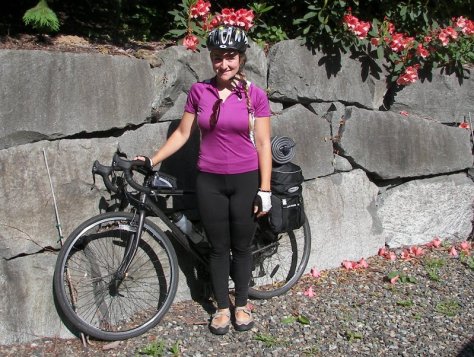
Liz and Morgan, traveling companions headed south in late April.
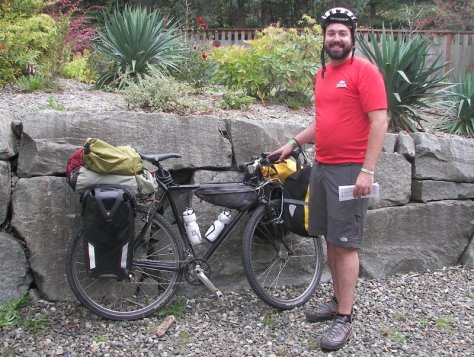
Bruce and Karen, a tandem team and B&B owners from Ohio, on spring tour in May before the tourist season back home.
George and Dennis, retirees from southern California, headed down the coast in mid-May.
Maryam, northbound for a summer job in the San Juan Islands at the end of May.
Jameson had made a reservation for the previous day, but his mileage estimates were off, so he just stopped by for coffee and a chat midday the next day in early June, and didn't stay.  He is a yoga instructor, so we had something in common besides a love of cycling.
Jameson had made a reservation for the previous day, but his mileage estimates were off, so he just stopped by for coffee and a chat midday the next day in early June, and didn’t stay. He is a yoga instructor, so we had something in common besides a love of cycling.

Unfortunately, the season was cut short: our own “training” rides and mini-tours, starting in New Mexico and California in late January and early February, continuing in April and May in Washington and Idaho, were  truncated because of increasing back and chest pain while riding.  We finished a successful 2013 riding and tour season (including a 700km self-supported tour to cap a 2500-km yearly total) after seeking treatment for GERD (gastro-esophageal reflux disease), but the symptoms progressed to a wider spreading chest pain as the 2014 season developed.  After returning from a really scary 30-km ride in Idaho at the end of May, and experiencing chest pains even while walking, I pressed for more comprehensive testing to get a better diagnosis: we were a mere six weeks out from a scheduled supported week-long tour and needed to train.

A treadmill test on Friday, June 13 (an auspicious date) made it absolutely clear that the problem was cardiac-related, and severe: the test was aborted after less than three minutes, with blood pressure and pulse over 200 and the EKG trace looking like a major earthquake.  After being sent home with nitro tablets and some powerful heart regulators and told to “do nothing” over the weekend,  a visit with the cardiologist on Monday got me scheduled for more testing on Tuesday, June 17, a cardiac catheter probe, which showed nearly total blockage of the main cardiac arteries, only days or hours (or one bike ride)  from what would have been a fatal heart attack.  I was wheeled from the recovery room at the test center directly to surgery, where I had a full six-hour open-heart procedure.

While still in the hospital, I took us off the Warm Showers schedule for the summer, and cancelled our late July tour: I went home at the end of the week a temporary invalid, confined to a (new) recliner in the living room for a few weeks while Judy, a retired nurse, slept on the sofa for a few nights and then in the downstairs guest room.  After a few weeks, I could, with help, get in and out of the guest room bed, as lying flat helped the healing some, but continued to spend part of the night in the recliner for the next two months.  After a month, I was strong enough to climb stairs to the master bedroom, and able to walk a kilometer or two, slowly.

Now, eight weeks after what can only be called emergency surgery, and six weeks after a repeat hospitalization for severe pulmonary emboli and subsequent warfarin regimen that will last for six months or more, recovery is in sight.  I am driving again, and able to walk at least 5 km on outings 4-5 days a week, but not yet cleared for heavier duties like opening the garage door and other pushing and pulling, so our guest room is still closed.  We’re off to Portland, Oregon by train and public transit next week for a conference, and on vacation in early September, one we had hoped would be filled with day rides, but we will need to be content with hikes and walks.  The bicycle needs to wait until the bones are completely healed and probably until the blood thinner treatments end.  We might open our doors to guests for a week or so between the Oregon trips, in late August, but only if I get medically cleared for more activity.

But, by mid-September, we should be on the Warm Showers active roster again for the  Fall Pacific Coast touring season, briefly, but at least for a couple of weeks before we head to Montana in early October to re-winterize the cabin we last saw–buried in snow–in March, and to build a ship’s ladder to replace the vertical ladder to the loft, now that I have joined the ranks of the old and feeble, to avoid undue strain on the divided and now “zippered” sternum, which I have been promised will soon be strong enough to withstand hours on the handlebars for many touring seasons yet to come.


Warm Showers (www.warmshowers.org) is an international organization of bicycle tourists who provide lodging—at a minimum, a place to camp and access to shower and toilet facilities—to other cyclists on tour. Many hosts also provide full guest services: bed, meals, laundry, transport to and from public transit facilities and bike shops, sag service, and storage (bike boxes, etc). The web site is run by volunteers and funded by donations, and guests are never charged for services offered. Warmshowers.org is also on Facebook, where members discuss travel and post photos.

Of CABGs and Kinks

“The time has come,” the Walrus said,
“To talk of many things:
Of shoes–and ships–and sealing-wax–
Of cabbages–and kings–
And why the sea is boiling hot–
And whether pigs have wings.”

–Lewis Carroll, “The Walrus and the Carpenter”

Cardiac Artery Bypass Graft (CABG, pronounced cabbage) is not a term one thinks about while riding one’s bicycle.  Indeed, the association is with elderly, out-of-shape American males who have been indiscriminate in diet and lax in activity.  However, all of those things are cumulative over time, leading eventually to atherosclerosis in the elderly of both sexes who haven’t succumbed to some other infirmity.  Somehow, though we don’t feel “elderly” at 70, we do fit the demographic age group, are overweight, and exercise in spurts.

So, after a decade of daily bicycle commuting, near the end of which a cardiac stress test was passed with flying colors, I found myself, in semi-retirement, having some pain on casual, but aggressive riding.  “Out of tune, out of shape” seemed a reasonable assumption, and, indeed, the pain vanished with longer rides and more regular riding.  This went on for the next nearly five years, with occasional attempts to find answers, and several thousand kilometers of training and touring.

However, the persistence of some pain, usually at the start of a ride, led to a medical consult before commencing on our 2013 self-supported bicycle tour.  GERD (Gastro-Esophageal-Reflux-Disease) seemed a resonable solution and, indeed, a round of the popular treatment Omeprazole seemed to alleviate the symptoms, and off we went on tour, with no adverse affects during the 700-Km tour, riding up to 70Km per day over several weeks, towing a heavy (45Kg) trailer full of gear.

After the tour, however, the symptoms resumed, and eventually could not be reconciled to either poor choice of food before or during the ride (though cold weather was once thought to be a factor).  A second round of Omeprazole was ineffective, though a switch to the more preventive treatment, Ranitidine, seemed to help some.  Rides became shorter, as pains returned soon after the start of a ride, and required a stop to subside.  And, multiple stops, on a 30-km ride around Payette Lake in Idaho.

Yet another medical consult, this time insisting on a cardiac stress test.  We had registered for a week-long inn-to-inn bicycle tour at the end of July and were woefully behind in training for it.  After waiting more than a week for a referral, we took matters into our own hands and contacted our HMO’s cardiac unit directly, the closest in-house cardiology department being in Tacoma, rather than Olympia, where we usually go for specialty care.  Yes, we could get in Friday afternoon.  Meanwhile, the referral through our primary physician came through, too, though we would not have been scheduled until at least the following week.

On Friday, the stress test started normally, though my pulse rate went up quickly and blood pressure had been abnormally high during the last few doctor visits (abnormal for me, but apparently not for the average 70-year-old in poor health).  As soon as the test went to the next level at three minutes, classic angina pain set in; every reading spiked as pulse and blood pressure headed for the 200 mark, and the EKG readout looked like the audio track from one of our grandson’s  heavy metal rock recordings.  The test was immediately terminated.  The cardiologists had gone home for the day, so I was  prescribed a cocktail of nitro and heart regulators and sent home for the weekend, cautioned to “do nothing.”  Of course, I did tidy up, package, and upload my latest code project to the NIH, so as to justify my time and possibly leave behind something useful…

Monday was a consult with the cardiologist, who, with one glance at the EKG result, announced “serious blockage,” and muttered “time bomb” while scheduling a cardiac catheterization for early the next morning to plan the next step.

Cardiac catheterization is a minimally-invasive look at the heart’s arteries with a scope inserted into a groin artery, through which also the blocked artery might be opened without surgery using a balloon and a mesh expander called a stent.  The procedure is performed at an ambulatory surgery center, in this case, at the Franciscan Cardiac Unit at St. Joseph’s Hospital in Tacoma, 80Km from home.

On awakening, I was shown the result: two of the three major arteries supplying blood to the left ventricle (the big one) were blocked over 90% and the third one compromised.  The blockage, at the junction of the arteries, was not fixable and would have to be bypassed.  I had been minutes from a fatal heart attack every time I had felt a twinge in my chest over the past at least 200Km of riding, or even while taking out the garbage.  In these cases, the patient is not released, but scheduled for open-heart surgery at the next available opportunity.

Fortunately, there was a procedure in progress and the team agreed to put on a second procedure (an open heart surgery for bypass or valve replacement takes four to six hours or more).  I was sedated once more and wheeled off to the surgery suite.

I have been told that the prep is quite involved.  First, they paint you orange from head to toe with an antiseptic solution, attach various plumbing to manage bodily fluids, stuff your nose with anti-MRSA goop, then chill you to preserve the meat for what comes next, which is both terrifying and a miracle.

To get at the heart or lungs, sometimes surgeons can work between the ribs, or cut through only a few on one side.  But, for most, it is necessary to open the thorax completely, which means cutting the sternum from top to bottom.   I will have a scar about 25 cm long from my collar down.

Next, the blood flow is diverted through a pump and diffuser to oxygenate the blood and keep it flowing through the brain for next hour or so.  And the heart stops, the old definition of The End.

Working quickly, the surgical team takes sections of veins harvested at some point in the process from the legs and chest and sews them into the main arteries and the blocked arteries to create a new pathway.  Fortunately, with bicycling, I had lots of nice leg veins from which to choose, leaving a rather large scar behind my left knee. and an area that will remain numb for at least several months.

With the two bypass channels secured in place, and the seams checked for leaks, the heart is restarted and the massive wounds reclosed, stitching bone back together with heavy-gauge wire, and super-gluing external tissues together.

Finally, at nearly midnight on a day that started before 8:00 with the first injections of sedatives, I become aware of what seems to be a vacuum cleaner hose stuffed down my throat, which is being pulled out with the most unpleasant sensations.  Amazingly, the tortured vocal cords still work, but it hurts.  I immediately begin coughing up a sticky clear fluid and foam that is trying to fill my lungs, a process that continues, nearly two weeks later.  Deep breathing exercises are supposed to help the expectorant process, but the ribs and chest hurt, and the lungs don’t seem to expand all the way, possibly due to two rubber tubes stuffed in the sac with them, that are draining fluid and blood away into a container under the bed.

First post-surgery meal, in the ICU

But, the important part is, I am still alive, and probably wouldn’t have been had I not sought treatment when I did or had persisted in “riding through the pain” the last couple of months when we aborted rides that were especially painful.

Before long, I get bundled out onto a high-rise walker with hooks and racks for oxygen and aero-bars for a cruise around the ICU station, two laps.  Before leaving the Intensive Care Unit, the various tubes get yanked out, and off I go down the hall to the Progressive Care Unit, where I have to get up to the bathroom. Often.  Meals are delivered, but the food is inedible, some beef-eaters idea of “vegetarian” cuisine as boiled-to-mush starch and green paste.  I manage a few pieces of melon and occasional bowl of cream of wheat or oatmeal, and beg a snack pudding from the floor nurses the last day.

After I spend two nights in the PCU, get my cardiac jumper cables snipped (they are supposed to pull out, but hang up somewhere) and demonstrate the ability to climb a long flight of stairs without aid, Judy arrives with my clothes (sans personal cell phone, which disappeared somewhere during the personal effects transfers) and I am out the door,  four days nearly to the minute that I was wheeled into the operating room for  prep, and climb a bit unsteadily into the car for the 80-Km trip home, via the pharmacy.  I am now officially labeled with Cardiac Artery Disease, and must take several medications daily for whatever time remains to me.

Cat Therapy
Cat Therapy

Adapting to the residual diuretics, laxatives, and pain killers is part of the post-op/post-hospital period., and brings its own set of horrors.  Judy has bought me a La-Z-Boy chair, electrified, in which I will spend the next few weeks until I can lever myself in and out of bed without putting weight on my shoulders/elbows, etc.  No pushing, pulling, or lifting more than 4Kg until the cloven sternum is fully knitted under its metal lacing.  The lung fluid continues to collect, now without a built-in vacuum, but I learn to spit into a cup without leaving slug trails everywhere, mostly.  Sleeping in the chair elevated to aid breathing and  coughing leaves me with a painful kink in my neck (hence the title).

Sleep has eluded me since waking festooned with tubes, with the constant need to clear my airway of slime.  I am expected to get 8 hours of sleep, but it comes in 10 and 15-minute snippets.  The food is better, as Judy learns to cook what I usually prepare.  Melon continues to be a favorite, but I am soon eating well, then sleeping longer and longer as the flow of slug slime from my lungs diminishes.  It is hard to remember to use the “Incentive Spirometer” gadget they send home to build up your lung capacity and help clear the fluid.  The indicator is set at 750ml: I started past 1500ml in the ICU and peak the device at 2500 by the time I am home, leaving me to nearly turn blue waiting for the device to reset itself.  I still need to remember to practice deep, cleansing yoga breathing several times a day.

Venturing outdoors.
Venturing outdoors.

Finally, I manage to get in at least four hours of sleep, in 30-minute chunks as the diuretics work to dump the  remaining 5 liters of fluid pumped into my system during the surgery by the heart-lung machine.  This works too well, and I am soon 5Kg below my check-in weight by the time the pills run out.   I also had dropped the narcotic pain killers, opting for plain acetaminophen instead, so I spend most of the next day fuzzy and depressed, nose dripping, like a street junkie down on his luck.

Six days after returning home, I am ready to venture out: first mission, replace my lost phone.  A trip to the mall 30 Km away in the rain is mostly pleasant–I am not allowed to drive for six weeks while the bones heal–but then, done with the diuretics, the accumulated laxatives win the battle for fluid.  Dizzy with low fluid levels, I stumble from one restroom to the next as we finish our shopping and head for home.  Still, I am alive, and moving under my own power.  Life is good.

At last, down to my normal lifetime medication list and the lung output continuing to drop, we can plan the rest of the recovery.  The glue lines start to itch, tapes begin to peel, walks around the yard become less tiring.  Back and forth up and down the sidewalk; breathe, fall into an even cadence, faster, further.  There are trails yet to ride.


Acknowledgements:

Dr. Roger Chamusco and P.A. Bjorn Larsen, Group Health Cooperative, who treated my symptoms as an emergency and acted promptly.

Dr. Susan Hecker and her staff, Franciscan Cardiothoracic Surgery, who stayed overtime after a long procedure to perform mine, tired, but steady.

The ICU and PCU staff at St. Josephs Hospital, who put up with me through my recovery and discharge.

And, of course, Judy, who put on her nurse’s hat once more to see me through transition to convalescence at home and was there for me throughout my ordeal, and who said “Stop!” when I pedaled to the edge.