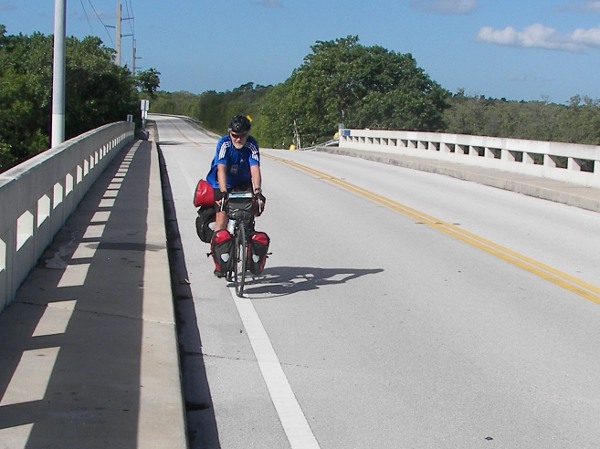
While the main tour group was, 15 miles away, getting up early for the relatively short but hot and sunny 35-mile ride to Key West, we drove into Marathon for breakfast before dawn and then started breaking down our camp, still at Knight’s Key. We did feel much better, but as soon as the sun rose and the temperature with it, we were dragging to get packed.


We were out of the campground by 10:00am and off across the 7-mile bridge, past Bahia Honda and into new territory, seen from the car instead of the bike. There were lots of bridges with reflective concrete barricades, and many short but wide keys in the Lower Keys that offered little commercial services along the highway. And, few bike lanes, leaving the rough-surfaced and often narrow shoulder. Near Key West, we started passing some of our tour group. A sign announced “bicycles on roadway,” and we thought “how thoughtful.” But, it turned out, the sign was there because the shoulder was closed for one portion of the highway, and our riders were forced onto the traffic lane. Most Floridians and probably most of the tourists on their way to Key West either never heard of or don’t believe in the “Share the Road” principal.

Some riders saw key deer on the way. We intend to stop at the visitor center on the way up the Keys to meet the group at Fort Myers tomorrow, along with a few other attractions we missed because of our riding schedule earlier. And, before the tour ends, we will get to reprise our role as grocery truck. By the time we had grabbed coffee and a quick lunch and fought traffic through downtown Key West, we were the last of our group to arrive at the hostel. As usual, we were all too early to check in. Most of us spent the time wandering a few blocks down the street to the “southernmost part of the conterminous United States” monument at the foot of South Street. Key West is “conterminous” only because of the dozens of bridges spanning the many keys, some of which have been replaced due hurricane damage, so the distinction has been intermittent.

We thoroughly enjoyed our late-afternoon walk around the city, to the waterfront to see the sunset, and dinner after at an excellent cafe (called The Cafe) that featured good vegetarian cuisine as well as seafood.
We aren’t happy that we aren’t riding, but we’re glad to be out of the sun and heat. We didn’t have any problems with maintaining a respectable speed on our trip, so our “failure to thrive” isn’t due to being abysmally out of shape or totally unprepared. We were, however, unprepared for the effects of hot sun and the extremely poor condition of the bike lanes in some areas and the even-rougher-than-Washington-state skid-proof surface on most of the roads in Florida. We bounced across tree roots and plowed through standing brackish water and were faced with abruptly ending bike lanes that forced us over thorn-infested grass. Traffic is awful when in a car. On a bike, “taking the lane” is suicide. We’ve walked almost every left turn, something we almost never do at home.
When we disassembled our bike, we noted that the trailer hitch had become dislodged and the bolts were holding on by a few threads, due to the severely rough roads. Most of the trailer parts have become corroded from riding through brackish water and exposure to the concrete-like dust generated from the fossil coral caprock. This is a harsh environment for bicycles, and even more so for old Washingtonians. But, we are grateful to have the opportunity to continue our tour in a casual support role. The group are great, though much faster than we: we are incompatible only in that respect. We’ve toured on our own without support before, so we are generally prepared to make common repairs and deal with the rigors of the road. But, we aren’t capable of keeping up with seasoned tourists on single bikes. Tandems are different. Some are fast, some are slow. We’re slow, though obviously fast enough to batter our machine to near-destruction on bad roads. Our goal is to live to ride another day, to learn something about the capabilities of ourselves and our machines, and have fun doing it. Some of this trip has been fun, some has been difficult, and some has been a challenge to our capabilities, as well as a test of our new machine, about which we are still learning.