Tour Diaries: Day 9 — LaBelle to South Bay 56 or 76 miles against the wind

The Riverside Retreat, a church camp along the Okeechobee waterway west of LaBelle, was a pleasant place to camp, but it got very cold during the night. The Unix Curmudgeon and the Nice Person were comfortable finally, but the folks more acclimated to the warm weather kept piling on more clothing during the night. Breakfast was nice in the rented pavilion, especially since everyone got up in the dark to prepare for the as-yet longest day of the tour. Two options were offered: the orginal ACA route through the Okaloacoochee Slough State Forest, for 76 miles, or straight across Highway 80 for 56 miles.

The Unix Curmudgeon, restless after several days off the bike and encouraged by the cooler weather, had spent much of the previous afternoon reassembling parts of the Mean Green Machine into the Lean Green Machine–the reason for Project “Q” in the first place: when the going gets tough, James Bond’s gadgets transform into something needed for the mission. While the Nice Person got left behind to break camp and stuff the soggy tent into it’s bag and load the group cooking gear and food into the car, the Curmudgeon took the road solo shortly after sunrise. His narrative:

The ACA route follows route 78A into LaBelle, but there is a cutoff route that saves several miles, along a scenic byway. The route was easily findable by following the “Dan Henry” markers for a local bike ride. In the Pacific Northwest, bike route markers are small white circles with flags bent left, right, or diagonal: here in Florida, they are huge, in florescent red, blue, and yellow, with straight flags angled the direction of the turn. I follow the red and yellow routes, for the most part, turning where the local bike folk were setting up a check station. Most of our group pressed on at this point, into LaBelle, following the ACA map.

The Lean Green Machine ("Q" in single configuration) at the Fort Denaud swing bridge

Past the swing bridge over the waterway, and taking a left proved scenic. The rural road was lined with spanish-moss-festooned trees and fields, where frightened cattle ran panicked from the hurtling green apparition.

Spanish moss along Fort Denaud Road, LaBelle, FL

Crossing route 80 onto route 80A to Route 29 saved some time, emerging on the ACA route at the Winn-Dixie. Cold water and an application of sunscreen, then south on route 29, with a slight tailwind. A few miles south, a large Circle K convenience store on the left proves to be the last services for 40 miles.

Turning east onto route 832 across the Okaloacoochee Slough brought the full force of today’s wind face-on. The wind increased to a steady 10-20 MPH blow that felt like a long uphill grind.

Okaloacoochee Slough State Forest. The slough a few miles further on is part of the "river of grass" that runs from Okeechobee through the Everglades

The State Forest road is, for the most part, just a rural road. A few spurs into the woods bordering the slough provide hiking and primitive camping.

Okaloacoochee State Forest access road to hiking trails and primitive camping

The Kerr Lookout Tower was disappointing, as it is a State Forest fire lookout and not open to the public. There were restrooms near the ranger station, though.  Pressing on, the road turned south and then north into the wind, leaving the State Forest into cattle country and a large Monsanto complex, then sugar cane fields. The wind continued unabated.
Turning north on route 833 offered relief from the wind before turning east again on the Hunt Club road, which was sparsely residential. North on Hacienda led to a park near a school that was not marked on the map. I had arranged to meet the support car for lunch near the intersection with route 80, so pressed on. The group following me on the long but scenic route stopped there for lunch.
After several twists and turns through a residential area, the route headed straight north on Flaghole Road, with a crosswind. The electric lines overhead buzzed and crackled in the wind. An unfenced dog gave chase, but I sprinted past the driveway before it reached the road. CJ and John, about 20 minutes behind, were not so lucky, and had to sprint hard with the dog on their heels.
The wooded residential area gave way to cane fields. The standing cane buffered the crosswind some, but the highway intersection ahead was in sight long before reaching it. Amazingly, I reached route 80 about the same time the main group, that had taken the shorter direct route on 80,arrived. They went on while I stopped for lunch.

Route 80 had a fairly wide shoulder, which was a minefield of shredded steel-belted tire debris. I dodged the larger pieces nimbly with the short version of the Bike Friday Q, but Roger’s BOB and Bill’s ‘bent weren’t so lucky. Flats were the order of the day on an already long ride.
Arriving in Clewiston, I searched in vain for the street marker for the detour around the busy commercial core. Finally, I called support for a GPS fix and found I had traveled two-thirds of the way to the point the ACA route rejoined the highway.
After the short bridge out of town, I saw a sign for lake trail access “left, .4 miles.” In .4 miles, there was no left and the shoulder ran out on the busy highway, so I reversed course back to the sign (at twice the speed I was making eastward against the wind!) and turned right, through a cemetery to a chain link fence reading “authorized vehicles only.” The driver of an official-looking vehicle coming out of the complex assured me that the trail was there. Apparently bicycles are “authorized,” though it didn’t make that clear.
Inside, I found some of our group on a rest break in a picnic shelter. Typical of Florida, there were no public restrooms. I knew from our car trip before the ride that there were restrooms eight miles ahead, so I cranked up onto the levee and into the wind once more.

Lake Okeechobee is the Great Lake of Florida, a horizon-spanning body of water surrounded by slough and an open channel created by dredging up the levee that controls water distribution for the south Florida irrigation system.

Lake Okeechobee. Open water in the distance stretches beyond the horizon. This was at the 68-mile mark, so I finally got in my "Birthday Miles" this trip.

At John Stretch Park, I met a couple who had camped next to us at Riverside Retreat the night before, who were amazed to see us this far. While talking with them, the rest of the main group caught up. The trail drops off the levee to detour around the dam and spillway through the park.
Back on the levee, I pushed on hard into the wind again for the last five miles, then down the boat ramp access road and into camp.

South Bay RV Campground, a county campground, very pleasant, surrounded by an alligator moat
Signs in the laundry at South Bay. Riders reported red eye reflections in the channel next to our tents. RV parks are meant for hard-shell camping, obviously.

The Nice Person, meanwhile, had reconned the surrounding area for restaurants and groceries, finding most food stores were closed on Sunday and slim pickings at that. We ended up sending the support car to Subway, two miles down the 4-lane highway, to pick up 15 foot-long Subway sandwiches, all custom order. As the increasingly impatient line formed behind us, we carefully did not mention what we were doing or where we were staying. Now well after dark, we commandeered the camp laundry as kitchen and dining hall.

South Bay

Day 8 — Fort Myers Beach to LaBelle: Into the Wind

Early morning, the tour group walked a half-mile to a great breakfast restaurant, then packed and headed out through the outskirts of Fort Myers to connect with the Florida Connector supplement to the ACA Atlantic Coast Trail, a 43-mile day.  Winds were forcast ENE at 10-20, which proved true.

Breakfast at Ft. Myers Beach

Having the burden of the car, we spent the morning exploring the Edison-Ford Winter Estates in Fort Myers.

Thomas Edison's winter estate, Fort Myers

Edison, famous for inventing the electric light bulb and the phonograph, also experimented with many plants. Most notably was a collaboration with his friend Henry Ford to find a domestic source of rubber. Ford had bought the house next door and both planted Mysore Fig, from which latex can be obtained.
Mysore Fig tree on the Edison estate.

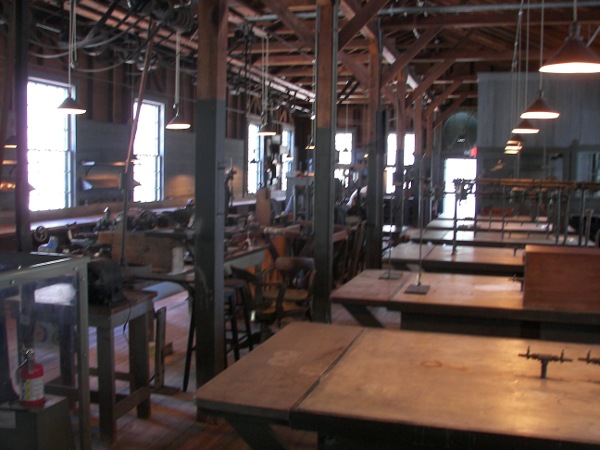
Edison also built a full-scale botany laboratory on his property to develop methods of rubber extraction from plants such as goldenrod.
Thomas Edison's botany laboratory, Fort Myers, FL

After touring the grounds and museum, we made our way east to the Riverside Retreat, the group’s destination for the night. We inventoried the groceries that the camp director had bought from Jack’s list, which included drinking water, as the camp water supply was “swampy” tasting. We determined we needed more of some things, so we drove to LaBelle and augmented the supplies, and collected ice at a large pavilion on the other side of the camp grounds. On return, we also decided to check into renting the small pavilion next to our tent area, as it had a full kitchen and large room with tables and chairs. It was very convenient to have an electric range to cook five pounds of spaghetti with sauce, and to have large cutting boards and multiple knives to cut up fruit and salad. The lighted, bug-free room was also very nice for evening socializing.
Raccoons were in abundance, so having secure food storage was also handy (besides our car, of course). One of the biggest problems with bicycle camping is keeping food away from animals. Earlier in the trip, our hardshell trailer helped, and now the car were alternatives.

Tour Diaries: Day 7 — Key West to Fort Myers Beach

Essentially a rest day for the cyclists, and a long driving day for us, started with breakfast at Pepe’s, a Key West institution since 1909, located on the waterfront on Carolina Street.

Pepe's, a must for breakfast in Key West
Breakfast on the Patio, Pepe's, Key West

After breakfast, the cyclists explored the city until time for the ferry to Fort Myers, which loaded at 4:30pm for a 6:00pm departure. We made a few last passes through the city, driving by Earnest Hemingway’s house. We planned to check out the Eco Discovery Center, but it was in the middle of the staging for this weekend’s Cigarette Boat racing event, so we headed up US1.


We stopped at Big Pine Key to check out the Key Deer population. We were told at the visitor center (hard to find–it is hidden in a shopping center) where to look, and were rewarded with several sitings. The key deer are an endangered species. Though protected, cars are their most successful predator.

Key deer are a miniature breed unique to Big Pine Key and No Name Key.
As a protected endangered species, the does are seemingly unafraid of people
The bucks, however, remain elusive, hiding in the mangroves

We also stopped at the Pigeon Key Visitor Center, next to the Knights Key Campground and bought a book on the building and demise of the overseas railway. We didn’t have time for three-hour tour of Pigeon Key, a small island just north of the seven-mile bridge and once home to the railway construction crews.

Moving north, we made a brief stop again at the Robert Is Here fruit stand in Florida City and headed across highway 41, which is the northern boundary of the Everglades National Park and the southern boundary of the Big Cypress National Preserve. We stopped at the Big Cypress Visitor Center, where we spotted a pair of big (2 meters long) ‘gators and a turtle in the Tsunami Canal in front of the building.

If the left one don't get you...
...the right one will.
This large turtle seemed unconcerned about his neighbors a few feet upstream...

At sunset, we stopped at Zorba’s in Bonita Springs for hummus and greek pizza, then on to Fort Myers Beach. The rest of the tour arrived at 10:00pm from the ferry dock across the channel.

Arriving from the ferry at 10:00pm
Checking in is a bit of an ordeal -- most of the rooms were on the 3rd floor, no elevators

Tour Diaries: Day 6 — Bahia Hondo to Key West

The Ultimate Breakdown: ready to pack the tandem

While the main tour group was, 15 miles away, getting up early for the relatively short but hot and sunny 35-mile ride to Key West, we drove into Marathon for breakfast before dawn and then started breaking down our camp, still at Knight’s Key. We did feel much better, but as soon as the sun rose and the temperature with it, we were dragging to get packed.

The Captain's half of the bike goes in here
And the stoker's half plus trailer parts go in here

We were out of the campground by 10:00am and off across the 7-mile bridge, past Bahia Honda and into new territory, seen from the car instead of the bike. There were lots of bridges with reflective concrete barricades, and many short but wide keys in the Lower Keys that offered little commercial services along the highway. And, few bike lanes, leaving the rough-surfaced and often narrow shoulder. Near Key West, we started passing some of our tour group. A sign announced “bicycles on roadway,” and we thought “how thoughtful.” But, it turned out, the sign was there because the shoulder was closed for one portion of the highway, and our riders were forced onto the traffic lane. Most Floridians and probably most of the tourists on their way to Key West either never heard of or don’t believe in the “Share the Road” principal.

The end of the road, Key West


Some riders saw key deer on the way. We intend to stop at the visitor center on the way up the Keys to meet the group at Fort Myers tomorrow, along with a few other attractions we missed because of our riding schedule earlier. And, before the tour ends, we will get to reprise our role as grocery truck. By the time we had grabbed coffee and a quick lunch and fought traffic through downtown Key West, we were the last of our group to arrive at the hostel. As usual, we were all too early to check in. Most of us spent the time wandering a few blocks down the street to the “southernmost part of the conterminous United States” monument at the foot of South Street. Key West is “conterminous” only because of the dozens of bridges spanning the many keys, some of which have been replaced due hurricane damage, so the distinction has been intermittent.

The "90 Miles To Cuba" monument at the end of South St., Key West

We thoroughly enjoyed our late-afternoon walk around the city, to the waterfront to see the sunset, and dinner after at an excellent cafe (called The Cafe) that featured good vegetarian cuisine as well as seafood.

We aren’t happy that we aren’t riding, but we’re glad to be out of the sun and heat. We didn’t have any problems with maintaining a respectable speed on our trip, so our “failure to thrive” isn’t due to being abysmally out of shape or totally unprepared. We were, however, unprepared for the effects of hot sun and the extremely poor condition of the bike lanes in some areas and the even-rougher-than-Washington-state skid-proof surface on most of the roads in Florida. We bounced across tree roots and plowed through standing brackish water and were faced with abruptly ending bike lanes that forced us over thorn-infested grass. Traffic is awful when in a car. On a bike, “taking the lane” is suicide. We’ve walked almost every left turn, something we almost never do at home.

When we disassembled our bike, we noted that the trailer hitch had become dislodged and the bolts were holding on by a few threads, due to the severely rough roads. Most of the trailer parts have become corroded from riding through brackish water and exposure to the concrete-like dust generated from the fossil coral caprock. This is a harsh environment for bicycles, and even more so for old Washingtonians. But, we are grateful to have the opportunity to continue our tour in a casual support role. The group are great, though much faster than we: we are incompatible only in that respect. We’ve toured on our own without support before, so we are generally prepared to make common repairs and deal with the rigors of the road. But, we aren’t capable of keeping up with seasoned tourists on single bikes. Tandems are different. Some are fast, some are slow. We’re slow, though obviously fast enough to batter our machine to near-destruction on bad roads. Our goal is to live to ride another day, to learn something about the capabilities of ourselves and our machines, and have fun doing it. Some of this trip has been fun, some has been difficult, and some has been a challenge to our capabilities, as well as a test of our new machine, about which we are still learning.

Sunset, Key West, November 10, 2011

Tour Diaries: Day 5 — Knights Key to Bahia Honda, or There and Back Again

Sunrise at Knight's Key

As another hot day dawned in Marathon, we decided we could not ride today: although it was only 15 miles to the next stop, it was remote, far from any services, across the 7-mile bridge and through a series of park-like keys with little or no permanent habitation. And we were still dehydrated and not feeling at all well. So, we signed the releases. However, our leader made us a proposition: if we had to rent a car to get back to our vehicle and then come collect our bike and gear, we could certainly continue to use the accommodations reserved for us. We also heartily agreed to provide vehicle support as needed. With no towns near the destination, riders would have to ride the 15 miles, drop their gear, then ride back for groceries, a total of 45 miles of riding for the kitchen crew.

Breakfast and map meeting: no surprises today -- cross bridge, turn at state park

Without the Internet, it would be difficult if not impossible to travel as we do. Calls to several car rental agencies either produced a “please try your call later” or “we’ll call you if we get any cars available.” We made an on-line reservation and took a taxi the five miles to the Marathon airport, where a car became available early. We stopped at the supermarket, filled the list, got more requests as we were shopping, as a pre-arranged plan for meals fell through. We loaded the trunk of the rental with coolers of meat, more tempeh, cheese, pies, and salad mixes. We loaded the back seat with bread, cereal, and other non-refrigerated staples, and headed across the bridges to the next campground.

After unloading the food, we headed back toward our own vehicle, reaching Miami near rush hour. Being unfamiliar with the turnpike system, we somehow ended up dumped onto US1 and creeping from traffic light to traffic light for several miles until we could get on I-95 at its southern terminus. Having a toll transponder in the rental, we zipped through the city and quickly arrived at the economy parking lot, where we retrieved our car at about 5:00pm. We then convoyed down the turnpike, tag-teaming the lane changes to get around slow traffic, until we got mired in the southbound merger of several tollways and crept along. A quick stop at Florida City, with which we were familiar from our Everglades layover day, for a quick snack and then onto US1 and the Overseas Highway to Marathon, where we refueled both vehicles, dropped off the rental car at the airport, and continued on to our tent and bicycle, arriving a bit after 8:30pm.

The rest of the tour, meanwhile, had all safely arrived at the Bahia Honda campground and apparently enjoyed a feast of grilled brats, grilled chicken, grilled corn on the cob, and potatoes, with tempeh and edamame for the vegetarians. Several riders stronger than we are had experienced difficulty in the hot sun crossing the long bridge, so we felt we had made the safe decision.